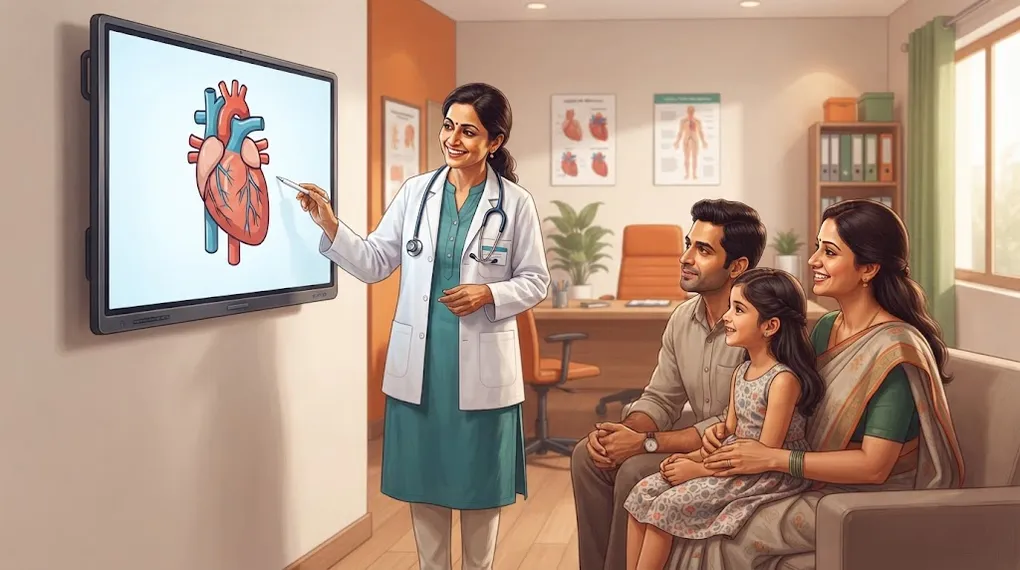
Patient Education Presentations
How doctors can create simple, safe patient education slide decks for OPD counselling, waiting rooms, webinars, and health camps.
Patient education presentations are not mini-CME lectures.
Patients need clarity, reassurance, and next steps. They do not need every mechanism, every exception, or a long list of medical terms.
AI tools can help you quickly create patient decks, but you must control the language and safety boundaries.
Good Topics for Patient Decks
Patient education decks work well for:
- Dengue warning signs
- Fever care in children
- Hypertension basics
- Diabetes lifestyle counselling
- Inhaler technique
- Antenatal visit preparation
- Vaccination reminders
- Ultrasound preparation
- Post-procedure care
- When to seek urgent care
Avoid using AI decks for highly individualized advice unless the deck is clearly reviewed and adapted by the doctor.
Patient Deck Structure
Use 8-12 slides.
- What this topic means
- Why it matters
- Common symptoms or concerns
- What patients should do
- What patients should avoid
- Warning signs
- When to contact the clinic
- What to bring or track
- Short recap
- Doctor disclaimer or clinic contact slide
For waiting-room decks, use fewer words and more visual cues.
For webinars, add speaker notes.
Language Rules
Use:
- Short sentences
- Familiar terms
- Examples from daily life
- Clear danger signs
- Calm tone
Avoid:
- “Always” and “never” unless medically appropriate
- Drug doses
- Treatment promises
- Complex anatomy
- Fear-based language
- Blame, shame, or moralizing
Prompt: Patient Education Deck
Create a 10-slide patient education presentation.

Topic: [TOPIC]
Audience: Indian clinic patients and families
Setting: [OPD waiting area / counselling session / webinar / health camp]
Reading level: Class 8
Tone: calm, respectful, practical

Use only these doctor-approved points:
[PASTE POINTS]

For each slide provide:
- Slide title
- Main text, maximum 25 words
- Suggested simple visual
- Speaker note for the doctor

Safety rules:
- Do not add drug doses
- Do not add treatment claims beyond the source
- Do not invent statistics
- Include warning signs clearly
- Add: "This is educational. Your doctor will guide your care."
Example: Fever in Children
Create a 10-slide parent education presentation.

Topic: Fever in children.
Audience: Parents in an Indian pediatric OPD.
Reading level: Class 8.
Tone: calm and practical.

Use only these doctor-approved points:
- Fever is a sign, not a disease by itself
- Most fevers are due to infections
- Monitor activity, feeding, urine, breathing, and alertness
- Give medicines only as prescribed
- Avoid self-medicating with antibiotics
- Seek urgent care for breathing difficulty, persistent vomiting, seizure, drowsiness, poor feeding, dehydration, or fever in a very young infant

For each slide:
- Keep main text under 25 words
- Add speaker notes
- Suggest one simple visual

Do not add drug doses.
Do not mention investigations unless listed above.
Review Checklist
Before showing patients:
- Language is simple enough
- No drug dose appears accidentally
- Warning signs are prominent
- The tone is not frightening
- No specific diagnosis is implied without evaluation
- No personal patient information is included
- Visuals are medically acceptable
- Translation has been checked if used
- Clinic contact details are correct
1-Minute Takeaway
Patient decks should make the next step clearer.
Use AI to simplify and structure. Do not let it add clinical advice, drug doses, or false reassurance.