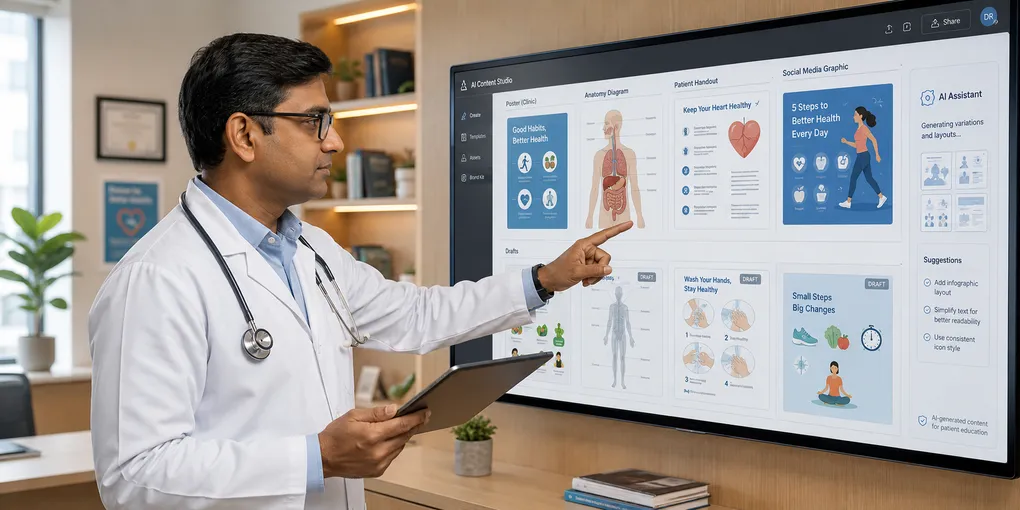
Image Generation for Doctors
How doctors can safely create patient education visuals, clinic posters, procedure explainers, and social media images with AI image tools.
AI image tools are now useful enough for everyday clinic work. Many AI chatbots and assistants can create patient education posters, simple anatomy explainers, waiting-room slides, social media graphics, and handout illustrations. They can also make convincing mistakes.
Use them for communication, not diagnosis.
The safest mindset is simple: AI-generated images are drafts for education and design. They are not patient evidence, clinical findings, or guaranteed treatment outcomes.
What Problem This Solves
Doctors often need visual material but do not have a designer available:
- A poster explaining fever danger signs
- A diet plate illustration for diabetes counselling
- A pre-procedure instruction card
- A child-friendly vaccination poster
- A social media image for a health awareness day
- A simple anatomy explainer for OPD counselling
Text-only handouts are easy to ignore. Good visuals improve recall, reduce repeated explanations, and make counselling feel more concrete. The risk is that image models may distort anatomy, miss safety details, produce unreadable text, or imply unrealistic outcomes.
This chapter gives you a practical prompt structure and a safety checklist.
How to Prompt for Medical Images
Use the V-SAFE formula:
1. Visual Goal
State the exact purpose.
Examples:
- “Create a waiting room poster about dengue warning signs”
- “Create a simple illustration for inhaler technique”
- “Create a social media square for World Diabetes Day”
2. Setting and Audience
Tell the model who will see it.
Examples:
- “For Indian parents in a pediatric clinic”
- “For elderly patients with low health literacy”
- “For Instagram, aimed at urban working adults”
3. Accurate Content
Give the clinical facts you want shown. Keep them short and reviewed.
Example:
- “Show fever, severe abdominal pain, persistent vomiting, bleeding, drowsiness, and breathing difficulty as danger signs.”
4. Format and Style
Specify size, layout, text amount, and visual style.
Examples:
- “Portrait poster, A4 ratio, large icons, high contrast”
- “Square 1:1 social media graphic”
- “Simple flat medical illustration, no gore, no scary imagery”
5. Exclusions and Final Checks
Tell it what to avoid.
Examples:
- “No diagnosis from images”
- “No before-after treatment claims”
- “No brand names”
- “No patient photos”
- “Leave space for clinic logo and emergency number”
Example Prompts
Example 1: Waiting Room Poster
Create an A4 portrait waiting-room poster for an Indian clinic.

Topic: Dengue warning signs.
Audience: Adults and parents, mixed literacy.
Visual style: Clean flat medical illustration, warm but serious, high contrast.

Content to show with icons:
- Severe abdominal pain
- Persistent vomiting
- Bleeding from nose/gums
- Drowsiness or confusion
- Breathlessness
- Reduced urine

Text rules:
- Use simple English
- Maximum 7 short lines
- Large readable text
- Add: "Seek urgent medical care if these occur"

Avoid:
- No blood-heavy or frightening visuals
- No treatment advice
- No medicine names
- No hospital logo; leave blank space at bottom for clinic details
Example 2: Patient Handout Illustration
Create a simple patient education illustration for metered-dose inhaler
use with spacer.

Audience: Elderly Indian asthma/COPD patients.
Format: 4-step horizontal visual sequence for a printed handout.
Style: Clear line-and-color medical illustration, no clutter.

Show these steps:
1. Shake inhaler
2. Attach inhaler to spacer
3. Breathe out gently
4. Seal lips around mouthpiece and breathe in slowly

Add small labels only. Keep text large and easy to read.
Do not show incorrect mouth position. Do not include medication dose.
Example 3: Social Media Health Awareness Post
Create a square 1:1 social media post for a cardiology clinic.

Topic: Do not ignore chest pain.
Audience: Indian adults aged 35-65.
Visual: Realistic but non-alarming illustration of a middle-aged person
pausing with chest discomfort while family notices.

Text on image:
"Chest pain + sweating + breathlessness?
Do not wait. Seek emergency care."

Style: Professional, high contrast, trustworthy, not sensational.
Avoid: No ECG diagnosis, no medicine names, no guaranteed claims,
no fear-based imagery.
Leave bottom strip for clinic name and emergency number.
Example 4: Procedure Preparation Visual
Create a patient-friendly pre-procedure instruction card for ultrasound abdomen.

Audience: Indian clinic patients.
Format: A5 portrait card, 3 icon sections.
Style: Simple flat illustration, clean clinic look.

Sections:
1. Come fasting if instructed
2. Bring previous reports
3. Arrive 15 minutes early

Text should be short, large, and easy to read.
Do not include clinical interpretation or diagnostic claims.
Leave space for clinic-specific instructions.
Example 5: Anatomy Explainer
Create a simple educational diagram of the knee joint for an orthopedic OPD.

Purpose: Explain osteoarthritis counselling to patients.
Style: Clean simplified medical illustration, not textbook-complex.
Show: femur, tibia, cartilage, joint space, mild cartilage wear.
Label only these parts: thigh bone, shin bone, cartilage, joint space.

Avoid:
- No surgical instruments
- No severe deformity
- No before-after result
- No claim that exercise or any procedure will cure it

Add a small note: "For explanation only. Your doctor will interpret your case."
Bad Prompt -> Improved Prompt
Bad Prompt
Make a poster showing how angioplasty fixes heart attack blockage.What is wrong:
- It may imply angioplasty is always appropriate
- It may show incorrect anatomy or device placement
- It lacks audience, format, and safety limits
- It could become promotional rather than educational
Improved Prompt
Create a patient education illustration explaining coronary artery narrowing
in simple terms.

Audience: Indian cardiology clinic patients and families.
Format: A4 portrait handout illustration with 3 panels.
Style: Simplified medical illustration, calm and non-scary.

Panels:
1. Normal artery with smooth blood flow
2. Narrowed artery with reduced blood flow
3. Doctor discussing treatment options with patient

Text rules:
- Use simple English
- Do not name a specific procedure as mandatory
- Do not show guaranteed outcomes
- Add: "Treatment depends on your doctor's evaluation"

Doctor must review anatomy and wording before use.
Safety Checklist
Before using any generated medical image, check:
- No patient identifiers were used in the prompt or reference images
- No real patient photo was uploaded without explicit written consent
- Anatomy is acceptable for patient education
- Device or procedure steps are not misleading
- Text is readable and correctly spelled
- Regional language text has been checked by a fluent speaker
- No diagnosis, drug dose, or emergency decision is implied
- No unrealistic before-after result is shown
- No brand, hospital, or doctor claim violates advertising ethics
- The final image has been reviewed by the responsible doctor
Copy-Paste Master Template
Create a medical education image for [CLINIC/SPECIALTY].

Purpose: [poster / handout / counselling visual / social post / slide]
Topic: [TOPIC]
Audience: [age group, literacy level, language, patient context]
Country/context: Indian clinic setting

Must show:
- [VISUAL ELEMENT 1]
- [VISUAL ELEMENT 2]
- [VISUAL ELEMENT 3]

Text on image:
"[SHORT APPROVED TEXT]"

Style:
- [flat illustration / realistic clinic photo style / infographic]
- [A4 portrait / square 1:1 / 16:9 slide / A5 card]
- High contrast, readable, clean medical design

Avoid:
- No patient identifiers
- No diagnosis from image
- No medicine doses
- No guaranteed outcomes
- No frightening or graphic imagery
- No brand names unless I provide them

Leave space for: [clinic logo / phone number / QR code].
1-Minute Takeaway
Use AI image generation for education, counselling, posters, and clinic communication across supported AI chatbots and image tools.
Do not use generated images as medical evidence, diagnostic output, or proof of expected outcomes. The best image prompts define the audience, exact educational message, visual format, style, and safety exclusions.
Every image needs doctor review before it reaches a patient.