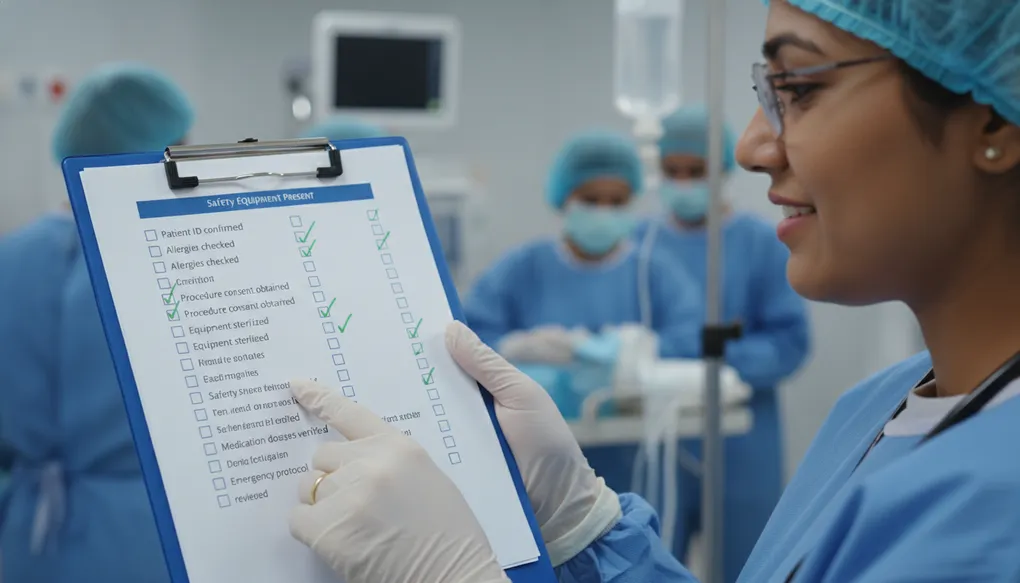
Checklists That Don't Miss Essentials
Generate comprehensive clinical checklists with AI—ensure nothing important is forgotten during procedures, consultations, or documentation.
It’s 11 PM. You’re discharging a patient after a minor procedure. You’ve covered wound care, medication timing, follow-up date. The patient leaves. At 2 AM, you remember: you forgot to mention dietary restrictions for the antibiotic you prescribed. Or worse—you forgot to confirm the patient understood the warning signs.
Every doctor has been there. Not because of incompetence, but because our brains aren’t designed for comprehensive recall under pressure.
Checklists fix this. AI helps you build better checklists, faster.
This article builds on the structured output techniques from E2 and the patient communication frameworks from I1, applying them specifically to creating clinical checklists that don’t miss essentials.
What Problem This Solves
Clinical work involves repetitive processes where forgetting one step can matter:
- Pre-procedure preparation: Did the patient stop blood thinners? Was consent documented? Is NPO status confirmed?
- Discharge: Did you cover all medications, warning signs, follow-up plans, and activity restrictions?
- New patient intake: Did you capture all relevant history—allergies, current medications, family history, social factors?
- Chronic disease reviews: Did you screen for complications? Check medication adherence? Update lifestyle counseling?
- Documentation: Did the note include all medico-legally required elements?
Why checklists fail in practice:
- Generic checklists don’t fit your specific workflow
- Too long = checklist fatigue (you stop reading after item 15)
- Too short = you miss things the checklist was supposed to catch
- Not updated = contains outdated items, missing new requirements
AI-generated checklists solve this by:
- Creating procedure-specific, context-aware checklists
- Balancing comprehensiveness with usability
- Allowing easy customization for your practice
- Enabling quick updates when protocols change
Remember: Checklists support your clinical judgment—they don’t replace it. A checklist ensures you consider everything; your expertise determines what applies to each patient.
How to Do It (Steps)
Step 1: Define the Checklist Purpose
Be specific about when and how the checklist will be used:
| Purpose | Format Needed | Key Consideration |
|---|---|---|
| Pre-procedure verification | Quick tick-boxes | Must complete before starting |
| Discharge counseling | Numbered steps with talking points | Patient-facing, needs explanation |
| Documentation completeness | Section-wise verification | Medico-legal requirements |
| New patient intake | Sequential flow | Comprehensive but time-efficient |
| Safety verification | Stop points | Critical items that halt if missed |
Step 2: Identify Must-Have vs Nice-to-Have Items
Every checklist has:
- Critical items: Forgetting these causes harm or legal risk
- Standard items: Should be done routinely but missing one isn’t catastrophic
- Situational items: Only relevant for certain patients
Ask AI to categorize items so you can prioritize appropriately.
Step 3: Specify Your Context
Generic checklists are useless. Specify:
- Your specialty and setting (private clinic, hospital, rural PHC)
- The procedure or situation
- Patient population (general adult, pediatric, geriatric, specific conditions)
- Your typical workflow and time constraints
- Any existing protocols you need to incorporate
Step 4: Request Actionable Format
Good checklist items are:
- Specific: “Confirm NPO status > 8 hours” not “Check preparation”
- Verifiable: You can definitively say yes/no
- Action-oriented: Written as tasks to complete
- Sequenced: In the order you’ll actually do them
Step 5: Test and Refine
Use the checklist for a few cases. Note what’s missing, what’s redundant, what’s in the wrong order. Then use AI to refine:
- “Add item X after item Y”
- “Remove this—we don’t do it in our setting”
- “Combine these three into one verification step”
Example Prompts (2-5)
Example 1: Pre-Procedure Checklist (Minor Surgery)
Prompt:
I'm a general surgeon in a private hospital in Pune. Create a
pre-procedure verification checklist for minor surgical procedures
(abscess drainage, lipoma excision, suturing under LA).

The checklist will be used by my OT nurse before I start the procedure.
It should take less than 2 minutes to complete.

Include:
- Patient identification and consent verification
- Relevant history confirmation (allergies, blood thinners, diabetes)
- Preparation verification (site marking, LA drawn up, sterile setup)
- Documentation readiness
- Safety check items

Format as tick-boxes with clear yes/no items.
Group into: "Before patient enters OT" and "Final check before starting"
Keep it to one page maximum.
Example 2: Discharge Checklist (Post-Cardiac Procedure)
Prompt:
I'm a cardiologist discharging patients after coronary angiography
(done via radial access). Create a comprehensive discharge checklist
that ensures I don't miss any counseling point.

Patient context: Middle-aged adults, often first-time procedure,
anxious about what comes next. Many are from smaller towns near
our hospital in Nagpur.

Include sections for:
1. Puncture site care and what's normal vs concerning
2. Medication changes and new prescriptions
3. Activity restrictions with specific timelines
4. Warning signs that need immediate attention
5. Follow-up appointments and tests
6. Lifestyle modifications to reinforce
7. Questions I should ask the patient to confirm understanding

Format as: Two columns—left column is item to cover, right column
is a notes space for patient-specific details.
Distinguish between "must cover every time" and "cover if applicable."
Example 3: New Patient Intake Checklist (Diabetes Clinic)
Prompt:
I run a diabetes clinic in Chennai. Create a new patient intake
checklist for my assistant to complete before I see the patient.

The checklist ensures we capture all relevant information for a
comprehensive diabetes evaluation.

Include:
- Demographic and contact details (with emergency contact)
- Diabetes history (type, duration, current treatment, monitoring)
- Complication screening questions (eyes, kidneys, feet, heart)
- Other medical conditions and medications
- Lifestyle factors (diet, exercise, smoking, alcohol)
- Psychosocial factors (work, family support, barriers to care)
- Previous records to collect (HbA1c, lipids, kidney function, eye exam)
- Patient's main concerns and questions for the doctor

Format as sections with tick-boxes and fill-in spaces.
Include a "Red flags for immediate doctor attention" box at the top.
Should take 10-15 minutes for assistant to complete with patient.
Example 4: Documentation Completeness Checklist (Medico-legal)
Prompt:
I'm a physician in a teaching hospital in Delhi. Create a documentation
completeness checklist for inpatient case records.

This checklist will be used during case record audits and before
patient discharge to ensure all medico-legally required elements
are documented.

Include verification of:
- Admission documentation (consent, history, examination, provisional diagnosis)
- Daily progress notes (SOAP format compliance, timely entries)
- Investigation documentation (ordering, results, interpretation)
- Treatment records (medication orders, procedures, consents)
- Informed consent forms (procedure-specific, blood transfusion if applicable)
- Discharge documentation (summary, instructions, follow-up)
- Special documentation if applicable (MLC, death summary, referral)

Format as section-wise checklist with reference to MCI/NMC documentation
guidelines. Include common deficiencies to watch for in each section.
Example 5: Chronic Disease Review Checklist (Hypertension)
Prompt:
I'm a family physician doing routine hypertension follow-ups.
Create a comprehensive review checklist that ensures I don't miss
any aspect of hypertension management over time.

Patients are typically seen every 2-3 months. Many have comorbidities
(diabetes, dyslipidemia). Setting is a busy urban clinic in Mumbai
with 10 minutes per follow-up.

Include:
- BP control assessment (current BP, home readings, any uncontrolled episodes)
- Medication review (compliance, side effects, need for adjustment)
- Target organ damage screening (when was last checked, any symptoms)
- Cardiovascular risk factor review
- Lifestyle modification progress
- Investigation schedule (what's due this visit vs annual)
- Patient education reinforcement points
- Red flags requiring action today

Format as a quick-reference card (pocket-sized).
Use symbols: ✓ (check every visit), * (check annually), ! (if present, act now)
Should be scannable in under 30 seconds.
Bad Prompt → Improved Prompt
Scenario: Creating a discharge checklist for post-operative patients
Bad Prompt:
“Give me a discharge checklist for surgery patients”
What’s wrong:
- No specific surgery type (appendectomy vs cardiac bypass?)
- No patient context
- No format specification
- No indication of how it will be used
- Will produce generic, useless output
Improved Prompt:
I'm a general surgeon discharging patients after laparoscopic
cholecystectomy (day-case). Most patients are middle-aged adults
going home with family support. Setting is a private hospital in
Hyderabad.

Create a discharge checklist with two parts:

Part 1: For me (the surgeon) - verification items before discharge
- Clinical stability confirmation
- Documentation completeness
- Prescription and instruction sheet given
- Follow-up scheduled

Part 2: For patient counseling - talking points to cover
- Wound care instructions
- Diet progression
- Pain management at home
- Activity restrictions with timeline
- Warning signs requiring immediate return
- When and how to contact us

Format Part 1 as quick tick-boxes (under 1 minute to complete).
Format Part 2 as numbered talking points with key phrases to use.

Include a "Patient understanding confirmed" signature line at the end.
Language should be suitable for explaining in English or Hindi.
Why it’s better:
- Specific procedure with typical patient profile
- Clear setting and context
- Two-part format serving different purposes
- Actionable format specified
- Practical considerations (language, timing) included
Common Mistakes
1. Making Checklists Too Long
A 50-item checklist won’t be used. People develop “checklist blindness.”
Fix: Ask AI to prioritize: “Give me the 10 most critical items that, if missed, cause the most problems. Put nice-to-haves in a separate optional section.”
2. Vague Checklist Items
“Check patient status” is useless. What specifically?
Fix: Request specific, verifiable items: “Each item should be something I can definitively answer yes or no to.”
3. Wrong Sequence
A checklist in random order wastes time as you jump around.
Fix: Specify: “Arrange in the order I would naturally encounter these during the procedure/consultation.”
4. Not Customizing for Your Setting
A checklist from a US hospital doesn’t fit an Indian clinic.
Fix: Always specify your setting, resources, and constraints. “In our setup, we don’t have X. Assume Y resource limitation.”
5. Set-and-Forget
Checklists become outdated as protocols change, new drugs become available, or you learn from near-misses.
Fix: Schedule periodic review. Use AI: “Review this checklist and suggest updates based on current guidelines for [condition/procedure].“
6. Ignoring Checklist Fatigue
If staff complete the same checklist 50 times daily, they start ticking without reading.
Fix:
- Keep critical items at the top
- Use visual hierarchy (bold, colors, separation)
- Include “stop points” that require active verification
- Rotate checklist audits to maintain attention
Clinic-Ready Templates
Template 1: Pre-Procedure Safety Checklist Generator
I'm a [SPECIALTY] doctor. Create a pre-procedure safety checklist
for [PROCEDURE NAME] performed in [SETTING: clinic/hospital/OT].

The checklist will be used by [WHO: nurse/assistant/self] and
should take [TIME] to complete.

Include these categories:
1. Patient identification and consent
2. Relevant history verification (allergies, medications, conditions)
3. Preparation confirmation (specific to this procedure)
4. Equipment and setup check
5. Final safety verification before starting

Critical requirements for this procedure: [ANY SPECIFIC MUST-HAVES]

Format: Tick-box style, grouped by when to check
(30 minutes before / just before starting).
Include a "STOP if any item unchecked" warning for critical items.
One page maximum.
Template 2: Discharge Counseling Checklist
Create a discharge checklist for [CONDITION/PROCEDURE] patients.

Patient profile: [AGE GROUP], [TYPICAL EDUCATION LEVEL],
[SUPPORT AT HOME], [SETTING/CITY]

Part 1 - Clinical verification (for doctor):
- Stability criteria for discharge
- Documentation complete
- Prescriptions and instructions ready

Part 2 - Patient counseling points (must cover):
- Medications (names, timing, duration, food interactions)
- Activity restrictions with specific timelines
- Diet modifications if applicable
- Wound/site care if applicable
- Warning signs (what's normal vs needs attention)
- Follow-up plan
- How to reach us for concerns

Part 3 - Understanding verification:
- Key points patient should repeat back
- Written instructions given and explained
- Contact information provided

Format: Checklist with talking point scripts for Part 2.
Include space for patient-specific notes.
Language guidance for explaining in [LANGUAGE].
Template 3: Chronic Disease Review Checklist
Create a comprehensive review checklist for [CONDITION] follow-up
visits in my [SPECIALTY] practice.

Typical visit duration: [TIME]
Visit frequency: [INTERVAL]
Common comorbidities in my patients: [LIST]
Setting: [CLINIC TYPE] in [CITY]

Include:
1. Disease control assessment
   - Current status indicators
   - Home monitoring review if applicable
   - Symptoms since last visit

2. Medication management
   - Compliance assessment
   - Side effects inquiry
   - Need for adjustment

3. Complication screening
   - What to check this visit
   - What's due annually
   - Warning symptoms to ask about

4. Lifestyle factors
   - Diet adherence
   - Exercise
   - Other relevant factors (smoking, alcohol, stress)

5. Investigations
   - Due this visit
   - Review pending results
   - Annual tests schedule

6. Patient education
   - Key reinforcement points
   - New information to share
   - Goal setting for next visit

Format as quick-reference pocket card.
Use symbols to distinguish: every visit / periodic / if indicated.
Include red flags that need immediate action.
Template 4: Documentation Audit Checklist
Create a documentation completeness checklist for [RECORD TYPE:
OPD notes / IPD case records / procedure notes / discharge summaries]
in my [SPECIALTY] practice.

This will be used for: [SELF-AUDIT / TEAM AUDIT / ACCREDITATION PREP]

Include verification of:
- Required elements per [MCI/NMC/NABH] standards
- Common documentation deficiencies to watch for
- Medico-legal essentials
- Specialty-specific requirements for [SPECIALTY]

For each section, indicate:
- What must be present
- Common mistakes to avoid
- Example of adequate vs inadequate documentation

Format as section-by-section checklist with examples.
Include a scoring guide if this will be used for audits.
Template 5: Emergency Readiness Checklist
Create an emergency readiness checklist for [EMERGENCY TYPE:
anaphylaxis / cardiac arrest / hypoglycemia / seizure / other]
in my [SETTING: clinic / hospital / camp].

This checklist will be:
- Reviewed [FREQUENCY] to ensure readiness
- Used during [TRAINING / ACTUAL EMERGENCY / BOTH]

Include:
1. Equipment check (what should be available and functional)
2. Medication check (what drugs, where stored, expiry dates)
3. Team readiness (who does what, contact numbers current)
4. Protocol accessibility (emergency protocols visible and current)
5. Post-emergency requirements (documentation, reporting, restocking)

Format:
- Monthly readiness verification section (preventive)
- Quick reference during emergency section (action steps)

Keep action steps to essential items only—cognitive overload
during emergencies is real. Maximum 10 steps for acute phase.
Safety Note
Checklists support clinical judgment—they are not a substitute for it.
Important principles:
-
A completed checklist does not guarantee safety. You can tick all boxes and still miss something that required clinical intuition. Checklists ensure you consider standard items; they don’t think for you.
-
Customize for your reality. Generic AI-generated checklists need adaptation for your setting, resources, and patient population. A checklist from a tertiary hospital may not fit a rural clinic.
-
Update when protocols change. A checklist based on 2020 guidelines may have outdated items. Periodically ask AI to review against current standards.
-
Critical items need redundancy. For truly critical verifications (patient identity, allergies, consent), don’t rely only on the checklist. Build in verbal confirmation, documentation checks, or team verification.
-
Watch for checklist fatigue. Staff who complete the same checklist hundreds of times may start auto-completing without engagement. Audit randomly, discuss near-misses, keep checklists focused.
-
AI-generated checklists need clinical review. Before implementing any AI-generated checklist in your practice, review it against:
- Current clinical guidelines
- Your institutional protocols
- Your specific patient population
- Your available resources
The goal: Checklists free your cognitive bandwidth for complex decisions by handling routine verification systematically.
Copy-Paste Prompts
Quick Pre-Procedure Checklist
Create a pre-procedure checklist for [PROCEDURE] with these sections:
1. Patient identification and consent confirmed
2. Relevant history verified (allergies, medications, conditions)
3. Preparation complete (fasting, site prep, labs if needed)
4. Equipment and setup ready
5. Safety verification before starting

Format: Tick-boxes, one page, under 2 minutes to complete.
Setting: [YOUR SETTING]. Include critical "stop if incomplete" items.
Quick Discharge Checklist
Create a discharge checklist for [CONDITION/PROCEDURE] including:
- Clinical stability verification
- Medications explained (with timing and food)
- Warning signs to watch for (what's normal vs urgent)
- Activity and diet restrictions
- Follow-up plan confirmed
- Patient understanding verified

Format: Two-column (item | notes space). Include patient signature line.
Patient context: [AGE, LITERACY LEVEL, SUPPORT AT HOME].
New Patient Intake Checklist
Create a new patient intake checklist for [SPECIALTY/CONDITION]:
- Demographics and contact (with emergency contact)
- Chief complaint and history of present illness
- Past medical/surgical history
- Current medications and allergies
- Family history relevant to [CONDITION]
- Lifestyle factors (diet, exercise, smoking, alcohol)
- Psychosocial factors affecting care
- Previous investigations to collect
- Patient's questions and concerns

Format: Sections with tick-boxes and fill-in spaces. [TIME] to complete.
Include red flag box at top for items needing immediate doctor attention.
Chronic Disease Review Card
Create a pocket review card for [CONDITION] follow-up visits:
- Disease control check (symptoms, monitoring data)
- Medication review (compliance, side effects, adjustments needed)
- Complication screening (what's due this visit vs annually)
- Lifestyle assessment (quick questions for diet, exercise)
- Investigation schedule (what to order, what to review)
- Education point for this visit

Format: Pocket-sized (half A4), scannable in 30 seconds.
Use symbols: ✓ every visit, * annual, ! act now if present.
Typical visit: [TIME AVAILABLE].
Checklist Customization Prompt
Modify this existing checklist for [PROCEDURE/SITUATION]:

[PASTE YOUR CURRENT CHECKLIST]

Changes needed:
- Add: [NEW ITEMS TO INCLUDE]
- Remove: [ITEMS NOT RELEVANT TO OUR SETTING]
- Reorder: [SEQUENCE CHANGES]
- Clarify: [VAGUE ITEMS THAT NEED SPECIFICITY]

Keep total items under [NUMBER].
Maintain grouping by [TIME/CATEGORY].
Format: [SAME FORMAT / NEW FORMAT].
Checklist Review and Update Prompt
Review this [PROCEDURE/CONDITION] checklist against current guidelines:

[PASTE YOUR CHECKLIST]

Check for:
1. Any outdated items (old drug names, discontinued practices)
2. Missing items based on current [GUIDELINE SOURCE] recommendations
3. Items that may need modification for [INDIAN CONTEXT]
4. Sequence improvements
5. Redundant items that can be combined

Provide: Updated checklist with tracked changes explanation.
Do’s and Don’ts
Do’s
- Do specify your exact clinical setting when generating checklists
- Do request items in the sequence you’ll actually use them
- Do ask for distinction between critical must-do items and optional nice-to-haves
- Do keep checklists focused—aim for 10-15 items maximum for daily-use checklists
- Do include verification steps (patient repeat-back, documentation confirmation)
- Do review AI-generated checklists against current guidelines before implementing
- Do update checklists when you encounter near-misses or learn of new requirements
- Do design checklists for the actual user (nurse-friendly vs doctor-focused)
Don’ts
- Don’t create checklists so long that staff develop checklist fatigue
- Don’t accept vague checklist items like “verify patient status”
- Don’t assume a generic checklist fits your specific context
- Don’t skip clinical review—AI may miss specialty-specific requirements
- Don’t let checklists become a substitute for clinical thinking
- Don’t forget to update checklists when protocols change
- Don’t use the same comprehensive checklist for routine and high-risk situations (have separate versions)
- Don’t ignore feedback from staff who use the checklist daily—they know what’s redundant or missing
1-Minute Takeaway
Checklists prevent the “I forgot to mention…” moment. AI helps you build them faster.
The checklist formula:
Create a [TYPE] checklist for [PROCEDURE/SITUATION].
Setting: [YOUR CONTEXT]. User: [WHO WILL USE IT].
Include: [SPECIFIC SECTIONS].
Format: [TICK-BOX/TALKING POINTS/POCKET CARD].
Time: Should take [X] minutes to complete.
Critical items: [MUST-NOT-MISS ELEMENTS].
Six checklist types every clinic needs:
- Pre-procedure (safety verification before you start)
- Discharge (patient counseling completeness)
- New patient intake (comprehensive history capture)
- Chronic disease review (nothing missed over time)
- Documentation audit (medico-legal compliance)
- Emergency readiness (periodic equipment/protocol check)
Checklist design principles:
- Specific and verifiable (yes/no answerable)
- Sequenced in natural workflow order
- Prioritized (critical items first and highlighted)
- Focused (15 items max for daily use)
- Actionable (tasks, not vague reminders)
Before implementing:
- Review against current guidelines
- Test with real cases
- Get feedback from users
- Schedule periodic updates
Remember: Checklists handle the routine so your brain can focus on the complex. They support your expertise—they don’t replace it.
This article builds on the structured output techniques from “Structured Outputs for Clinical Use” (E2) and the patient communication frameworks from “Clear Patient Communication” (I1). Apply these checklist principles to create your clinic’s essential verification tools.