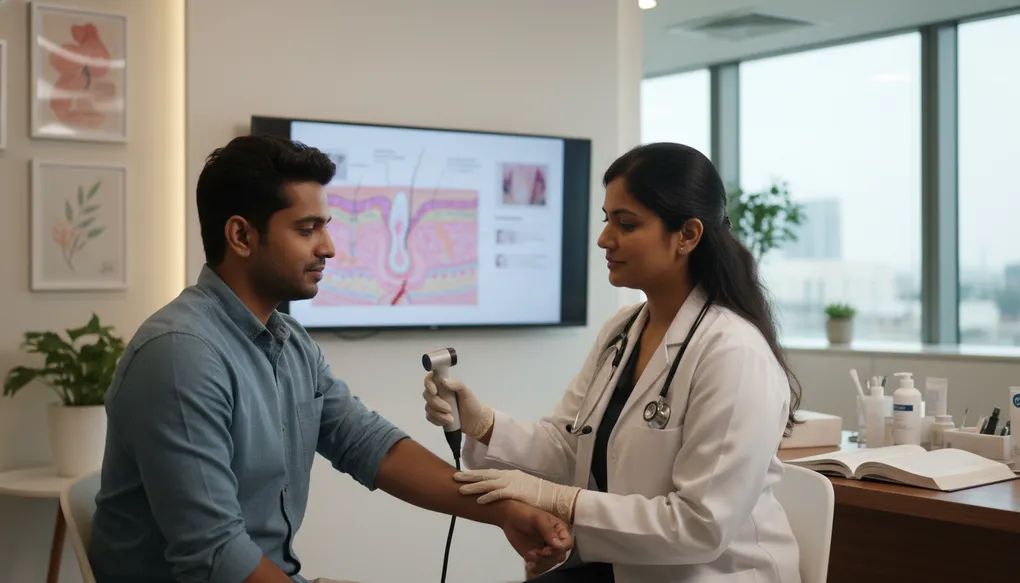
Dermatology Prompt Pack
Ready-to-use prompts for dermatologists—skin care instructions, treatment explanations, cosmetic procedure counselling, and condition-specific education.
Every dermatologist knows this scenario: you prescribe a topical retinoid, explain exactly how to use it, warn about the initial purging phase—and the patient calls three days later wanting to stop because “it’s making my skin worse.”
Or the patient with psoriasis who stopped their treatment because “someone said applying coconut oil with haldi is better.” Or the young woman who damaged her skin with DIY lemon-and-baking-soda “treatments” she found online.
The challenge in dermatology is not just diagnosis—it’s ensuring patients understand their treatment, have realistic expectations, and don’t sabotage their progress with misinformation.
This article builds on the patient instruction fundamentals from D2 and the specialty-specific approach, providing you with dermatology-specific prompts that address the unique challenges of skin practice in India—from topical medication compliance to cosmetic procedure counselling to combating fairness cream myths.
What Problem This Solves
Dermatology patient communication fails for specific reasons:
- Complex topical regimens: Patients confuse which cream goes where, in what order, and at what time
- Unrealistic expectations: “When will my pigmentation completely disappear?” (Answer: It may not, and that’s okay)
- Misinformation overload: YouTube, Instagram, and well-meaning relatives offering dangerous DIY remedies
- Indian skin-specific concerns: Hyperpigmentation risks, sensitivity to harsh treatments, climate-related issues
- Cosmetic vs. medical confusion: Patients expecting medical results from cosmetic procedures and vice versa
- Compliance problems: Patients stopping treatment during the “worse before better” phase
- Fairness cream culture: Deep-rooted beliefs about skin lightening that need sensitive handling
Well-crafted AI prompts can help you create patient education materials that address these challenges—setting realistic expectations, providing clear instructions, and countering misinformation with evidence-based facts.
How to Do It (Steps)
Step 1: Identify the Dermatology Communication Category
Different skin situations need different approaches:
| Category | Key Focus | Format |
|---|---|---|
| Topical medication instructions | Application sequence, quantity, timing | Step-by-step with diagrams described |
| Treatment timeline expectations | Phase-wise changes, realistic endpoints | Timeline infographic described |
| Pre/post procedure care | Preparation, recovery, restrictions | Day-by-day checklist |
| Chronic condition management | Flare prevention, maintenance, triggers | Long-term management plan |
| Cosmetic procedure counselling | Realistic outcomes, multiple session expectations | Before/after expectation setting |
| Myth-busting education | Evidence-based corrections | Fact vs. fiction format |
Step 2: Consider Indian Skin and Climate Factors
Always include in your prompts:
- Fitzpatrick skin type context: Most Indian patients are Type III-V, affecting treatment choices and pigmentation risks
- Climate considerations: Humid vs. dry regions, monsoon skin issues, summer sun exposure
- Cultural practices: Oil application habits, turmeric use, home remedy traditions
- Product availability: Indian pharmacy brands, price sensitivity, generic alternatives
Step 3: Address the Expectation Gap
Dermatology has a significant expectation gap. Include in your prompts:
- Realistic timelines (acne treatment takes 3-6 months, not 2 weeks)
- What “improvement” actually looks like (50% reduction may be an excellent outcome)
- The “worse before better” phenomenon for retinoids, chemical peels, etc.
- Maintenance requirements for chronic conditions
Step 4: Counter Misinformation Proactively
Indian patients are bombarded with skin advice. Your materials should:
- Directly address common myths they’ve likely heard
- Explain why certain home remedies are harmful
- Provide evidence-based alternatives to dangerous DIY treatments
- Acknowledge traditional practices respectfully while correcting harmful ones
Step 5: Separate Medical and Cosmetic Dermatology
Be clear about:
- What is a medical condition requiring treatment
- What is a cosmetic concern with optional procedures
- The difference in insurance coverage (where applicable)
- Realistic outcomes for cosmetic procedures
Example Prompts (2-5)
Example 1: Acne Treatment Regimen Instructions
Create acne treatment instructions for an 18-year-old female college
student in Mumbai with moderate inflammatory acne. She has Indian skin
(Fitzpatrick Type IV) and is prone to post-inflammatory hyperpigmentation.

Prescribed regimen:
- Morning: Gentle cleanser, Niacinamide 10% serum, Sunscreen SPF 50
- Night: Gentle cleanser, Adapalene 0.1% gel, Moisturiser

Include:
1. Step-by-step application instructions with pea-sized quantity guidance
2. The "purging phase" explanation—what to expect in weeks 1-6
3. Why sunscreen is non-negotiable (pigmentation risk for Indian skin)
4. Common mistakes to avoid (using too much, skipping moisturiser)
5. What NOT to do: no lemon, no toothpaste, no DIY scrubs
6. Timeline: when to expect improvement (realistic: 8-12 weeks)
7. Warning signs to contact clinic immediately

Format: Numbered steps with bold headings. Include a "Week-by-Week
Expectations" timeline.
Language: Simple English, friendly tone appropriate for young adult.
Add a "Myths vs. Facts" section addressing common acne misinformation.
Example 2: Pre-Chemical Peel Instructions
Create pre-chemical peel preparation instructions for a 35-year-old
woman getting a glycolic acid peel for melasma. She lives in Delhi
(high sun exposure, pollution) and has Fitzpatrick Type IV skin.

Include:
1. What to do 2 weeks before the peel (sun avoidance, retinoid pause)
2. What to do 1 week before (product restrictions)
3. Day-before checklist
4. Morning-of instructions
5. What to bring to the appointment
6. Setting expectations: this is session 1 of likely 4-6 sessions
7. Why melasma requires maintenance (it's not a one-time fix)

Address these common patient questions:
- "Will this remove my pigmentation completely?"
- "How many sessions will I need?"
- "Can I go to my cousin's wedding in 3 days?"

Format: Day-by-day countdown checklist.
Include a "Realistic Expectations" box for melasma outcomes.
Bilingual: English with Hindi terms for common products.
Example 3: Psoriasis Patient Education Sheet
Create an education sheet for a 42-year-old male bank employee newly
diagnosed with plaque psoriasis. He is worried about it being
contagious and has been avoiding social situations.

Include:
1. What psoriasis is (and is NOT—not contagious, not due to poor hygiene)
2. Why it happens (immune system explanation, genetic component)
3. Common triggers to identify and avoid (stress, infections, injuries)
4. How to apply topical steroids correctly (amount, duration, tapering)
5. Moisturisation importance (Indian climate-specific advice)
6. Lifestyle modifications (stress management, alcohol/smoking impact)
7. When to expect improvement with treatment
8. Why this is a long-term management condition, not a "cure"
9. Emotional support information—it's okay to feel frustrated

Format: Sections with clear headings. Include a "Trigger Diary"
template they can use.
Tone: Reassuring, non-judgemental, supportive.
Address the stigma directly—many patients feel embarrassed or isolated.
Include guidance for family members on how to be supportive.
Example 4: Post-Laser Hair Removal Instructions
Create post-laser hair removal care instructions for a patient who
just completed their first session of diode laser on underarms and
upper lip. Patient is a 28-year-old woman with Fitzpatrick Type IV skin.

Include:
1. Immediate care (first 24-48 hours): cooling, no heat, no deodorant
2. What's normal: redness, mild swelling, "pepper spots"
3. What to avoid: sun exposure, hot showers, tight clothing, perfumes
4. Skincare routine modifications for treated areas
5. Why sun protection is critical for Indian skin (PIH risk)
6. Timeline for hair shedding (10-14 days)
7. Realistic expectations: 6-8 sessions needed, 70-80% reduction typical
8. When to schedule next session (4-6 weeks)
9. Warning signs that need attention (blistering, burns, infections)

Address common patient expectations:
- "Why is hair still growing?" (explain hair growth cycles)
- "When will I see results?" (after session 3-4)
- "Is this permanent?" (significant reduction, not 100% permanent)

Format: Timeline-based care instructions with "Do's and Don'ts" boxes.
Include a section on what happens if they get sun exposure (why it
causes pigmentation in Indian skin types).
Example 5: Hair Loss Counselling Sheet (Female Pattern Hair Loss)
Create a patient education sheet for a 32-year-old woman diagnosed
with female pattern hair loss (androgenetic alopecia). She is
distressed and has been trying various oil treatments and Ayurvedic
remedies without improvement.

Include:
1. What female pattern hair loss is (genetic, hormonal, not due to
   oil deficiency)
2. Why it happens (sensitive hair follicles, not poor care)
3. What treatments actually work (minoxidil, PRP, nutrition)
4. Realistic timeline: improvement takes 4-6 months minimum
5. What won't work: most oils, most "hair growth" shampoos, biotin
   alone (if not deficient)
6. Proper expectations: stabilising loss and partial regrowth, not
   full restoration
7. How to use minoxidil correctly (application, drying time, patience)
8. Addressing the emotional impact—hair loss affects self-esteem

Sensitively address:
- "But my grandmother used coconut oil and had thick hair" (genetics vary)
- "Should I try [expensive Ayurvedic treatment]?" (lack of evidence)
- "Is this because I coloured my hair?" (no, different issue)

Tone: Empathetic, understanding of emotional distress, hopeful but honest.
Format: Q&A sections addressing common concerns.
Include a "What's Worth Your Money" vs "Skip These" section.
Bad Prompt -> Improved Prompt
Scenario: Instructions for a patient starting tretinoin for anti-ageing
Bad Prompt:
“Give me instructions for tretinoin use”
What’s wrong:
- No patient context (age, skin type, skin concerns)
- No mention of Indian skin considerations (hyperpigmentation risk)
- No format specified
- No mention of common mistakes or expectations
What you get: Generic instructions that don’t address the specific challenges of retinoid use in Indian patients.
Improved Prompt:
Create tretinoin usage instructions for a 38-year-old woman in
Hyderabad starting Tretinoin 0.025% cream for anti-ageing and mild
pigmentation. She has Fitzpatrick Type IV skin, combination skin type,
and has never used retinoids before.

Include:
1. How to start: "Skin training" schedule (2x/week → every other
   night → nightly over 4-6 weeks)
2. Pea-sized amount guidance with visual description
3. "Sandwich method" for sensitive skin (moisturiser → tretinoin →
   moisturiser)
4. The retinisation phase: peeling, redness, dryness is NORMAL for
   4-8 weeks
5. Why sunscreen is mandatory (non-negotiable, even indoors with windows)
6. Products to AVOID while using tretinoin (AHAs, BHAs, vitamin C
   initially, scrubs)
7. Products that help: gentle cleanser, ceramide moisturiser, SPF 50
8. When to see results: texture improvement 4-8 weeks, pigmentation
   improvement 3-6 months
9. Common mistakes: using too much, applying on wet skin, giving up
   too early
10. When to contact clinic: severe burning, blistering, persistent
    rash after 8 weeks

Address Indian skin specifically:
- Higher risk of post-inflammatory hyperpigmentation if irritated
- Need for extra sun protection in Indian climate
- Why "more is not better" with retinoids

Format: Numbered steps with "Week 1-2," "Week 3-4," "Week 5+"
progression. Include a "Troubleshooting" section for common problems.
Language: Clear English with friendly, encouraging tone.
Include a "Signs It's Working vs Signs of Overuse" comparison.
Why it’s better:
- Specific patient profile (age, location, skin type, skin concern, experience level)
- Indian skin considerations (hyperpigmentation risk, sun protection)
- Structured progression for retinoid introduction
- Realistic timeline for results
- Common mistakes addressed proactively
- Troubleshooting guidance included
Common Mistakes
1. Not Addressing the “Quick Fix” Expectation
Indian patients often expect dramatic results quickly, influenced by “before/after” marketing.
Fix: Always include realistic timelines. Add phrases like “Most patients see initial improvement by [X weeks] and best results by [Y months].“
2. Ignoring Pigmentation Risk for Indian Skin
Treatments that work fine for lighter skin types can cause hyperpigmentation in Fitzpatrick IV-VI skin.
Fix: Include in prompts: “Address hyperpigmentation risk for Indian skin type” and “Include sun protection emphasis.”
3. Dismissing Home Remedies Without Explanation
Simply saying “don’t use lemon on your face” without explaining why creates distrust.
Fix: Ask for “evidence-based explanation of why [specific remedy] is harmful” rather than just listing things to avoid.
4. Using Western Product Recommendations
Patients can’t easily find or afford many Western skincare brands in India.
Fix: Add “recommend products available in Indian pharmacies” or “include affordable alternatives available in India.”
5. Not Addressing the Fairness Cream Culture
Many patients have unrealistic expectations shaped by fairness cream marketing.
Fix: Include “address realistic skin tone expectations sensitively” in prompts for pigmentation-related conditions.
6. Forgetting Climate Variations
Mumbai humidity is different from Delhi pollution is different from Chennai heat.
Fix: Specify the patient’s city/region for climate-appropriate advice.
7. Missing the “Worse Before Better” Warning
Patients abandon effective treatments during the initial worsening phase.
Fix: Always include “purging/retinisation/initial flare explanation” in treatment initiation prompts.
Clinic-Ready Templates
Template 1: Topical Medication Application Instructions
Create topical medication application instructions for [PATIENT AGE/GENDER]
with [CONDITION] and [FITZPATRICK SKIN TYPE] skin.

Prescribed regimen:
Morning:
- [PRODUCT 1]
- [PRODUCT 2]
- [PRODUCT 3 - usually sunscreen]

Night:
- [PRODUCT 1]
- [PRODUCT 2]
- [PRODUCT 3]

Include:
1. Exact order of application with timing between products
2. Amount to use (pea-sized, fingertip unit, etc.)
3. How to apply (patting vs rubbing, areas to avoid)
4. What's normal during adjustment period
5. What indicates overuse or irritation
6. Products/activities to avoid while using these
7. When to expect visible improvement
8. Warning signs that need clinic visit

Format: Morning routine and Night routine as separate numbered lists.
Include a "Quantity Guide" visual description.
Add "Common Mistakes to Avoid" section.
Language: [ENGLISH/HINDI/BILINGUAL]
Template 2: Pre-Procedure Instructions (Laser/Peel/Cosmetic)
Create pre-[PROCEDURE NAME] preparation instructions for [PATIENT
DESCRIPTION] with [SKIN TYPE] scheduled [TIME UNTIL PROCEDURE].

Include:
1. Timeline: What to do [X weeks before], [X days before], day-of
2. Products to stop (actives, retinoids, etc.) and when to stop them
3. Sun exposure restrictions with explanation for Indian skin
4. Skin preparation requirements
5. What to eat/drink or avoid before procedure
6. What to wear to the appointment
7. What to bring (documents, previous photos if needed)
8. Setting realistic expectations for this specific procedure
9. Number of sessions typically needed
10. Recovery timeline preview

Address common patient questions:
- "Will this hurt?"
- "When can I return to normal activities?"
- "When will I see results?"
- "Is this a one-time treatment?"

Format: Day-by-day countdown checklist.
Include "Realistic Expectations" box.
Language: [PREFERENCE]
Template 3: Post-Procedure Care Instructions
Create post-[PROCEDURE NAME] care instructions for [PATIENT DESCRIPTION]
who just completed [SESSION NUMBER] of treatment.

Include:
1. Immediate care (first 24-48 hours): cooling, restrictions, products
2. Day 2-7 care: what to use, what to avoid
3. Week 2+ care: gradual return to normal routine
4. What's normal: [procedure-specific normal reactions]
5. What's concerning: when to call clinic immediately
6. Sun protection protocol (critical for Indian skin)
7. Makeup/skincare resumption timeline
8. Activity restrictions and duration
9. Next appointment scheduling
10. Expected timeline for results

Address procedure-specific concerns:
[ADD RELEVANT CONCERNS FOR THE SPECIFIC PROCEDURE]

Format: Timeline-based with "Do's and Don'ts" at each stage.
Include "When to Call Us" emergency guidance.
Add "What to Expect" photos description if relevant.
Language: [PREFERENCE]
Template 4: Chronic Skin Condition Management Plan
Create a management plan for [PATIENT DESCRIPTION] with [CHRONIC
CONDITION: eczema/psoriasis/rosacea/etc].

Include:
1. Understanding the condition: what it is, why it happens (non-technical)
2. It's NOT: contagious, caused by poor hygiene, their fault
3. Common triggers to track and avoid
4. Daily skincare maintenance routine
5. How to identify a flare starting
6. Step-up treatment during flares
7. When to use prescribed medications vs maintenance products
8. Lifestyle factors that help: diet, stress, sleep
9. Indian climate-specific advice for their region: [CITY/REGION]
10. Long-term outlook: management not cure, but good control possible
11. Emotional support: it's okay to feel frustrated

Include:
- Trigger diary template
- Flare action plan (traffic light system)
- Family guidance: how they can help
- Myth-busting section for this specific condition

Format: Sections with clear headings, actionable checklists.
Tone: Supportive, empowering, honest.
Language: [PREFERENCE]
Template 5: Cosmetic Procedure Counselling Sheet
Create a cosmetic procedure counselling sheet for [PROCEDURE:
Botox/fillers/PRP/laser toning/etc] for [PATIENT DESCRIPTION].

Include:
1. What this procedure does (and doesn't do)
2. Realistic outcomes: show improvement, not transformation
3. Who is a good candidate vs who should consider alternatives
4. What happens during the procedure
5. Downtime and recovery expectations
6. Number of sessions/how long results last
7. Cost expectations (initial and maintenance)
8. Potential side effects and risks for Indian skin
9. Why results vary between individuals
10. Before and after care requirements
11. Alternative options if this isn't right for them

Sensitively address:
- Social media vs reality expectations
- "I want to look like [celebrity]" responses
- Pressure from family/workplace on appearance
- When to say this procedure isn't suitable for this patient

Format: FAQ style with honest answers.
Include "Questions to Ask Before Proceeding" section.
Tone: Informative, honest, non-pushy.
Language: [PREFERENCE]
Safety Note
Critical reminders for dermatology AI-generated content:
Diagnosis is Doctor-Only Territory:
- NEVER use AI to diagnose skin conditions from descriptions
- Skin cancer, autoimmune conditions, and infections require clinical examination
- “What’s this rash?” questions MUST be answered with “please see a dermatologist”
Medication Safety:
- Verify all topical medication instructions against your prescription
- Check for contraindications (pregnancy, breastfeeding, drug interactions)
- Ensure dosage forms match (cream vs gel vs ointment makes a difference)
- Steroid potency and duration limits must be clinician-verified
Procedure Safety:
- AI cannot assess whether a patient is a good candidate for procedures
- Skin type assessment requires clinical examination
- Contraindications (active infections, pregnancy, medications) need human verification
- Post-procedure complications need clinical, not AI, assessment
Cosmetic Counselling Ethics:
- Avoid content that reinforces colorism or unrealistic beauty standards
- Address “fairness” requests with sensitivity and evidence
- Never promise specific outcomes for cosmetic procedures
- Acknowledge when procedures are not recommended
Indian Skin Specifics:
- Verify that advice accounts for hyperpigmentation risk
- Sun protection advice must match Indian climate
- Product recommendations must be India-available
- Cultural sensitivity around skin tone discussions
Before giving any AI-generated content to patients:
- Read every word yourself
- Verify product names and instructions
- Check that timelines are realistic
- Ensure cultural sensitivity
- Add your clinic contact information
Copy-Paste Prompts
For Acne Treatment Instructions
Create acne treatment instructions for [AGE]-year-old patient with
[MILD/MODERATE/SEVERE] acne and Fitzpatrick Type [III/IV/V] skin in
[CITY]. Prescribed: [LIST PRODUCTS]. Include: application order,
purging explanation, realistic timeline (3-6 months), sun protection
importance, what NOT to do (no DIY remedies). Format as morning/night
routine with "Week-by-Week Expectations." Add "Myths vs Facts" section.
For Pre-Procedure Preparation
Create pre-[PROCEDURE] instructions for [PATIENT] with [SKIN TYPE]
scheduled in [DAYS/WEEKS]. Include: product pause timeline, sun
restrictions, day-of checklist, realistic expectations for Indian
skin, number of sessions typically needed. Format as countdown
checklist. Address: "Will this give permanent results?"
For Topical Steroid Instructions
Create topical steroid usage instructions for [CONDITION] in
[PATIENT]. Prescribed: [STEROID NAME AND POTENCY]. Include: where to
apply (and where NOT to), how much (fingertip unit), how long to use
(max duration), tapering instructions, what happens if overused,
moisturiser importance. Format as numbered steps. Warn about: face
use, skin thinning, rebound.
For Hair Loss Counselling
Create hair loss education for [AGE]-year-old [MALE/FEMALE] diagnosed
with [TYPE: AGA/telogen effluvium/alopecia areata]. Include: why this
happens (not their fault, not poor care), what works (evidence-based),
what doesn't work (most oils/shampoos), realistic expectations (4-6
months for improvement), emotional support acknowledgment. Address
myths: oil massage, biotin, expensive "hair growth" products. Tone:
empathetic, honest, hopeful.
For Sun Protection Education
Create sun protection education for Indian patient (Fitzpatrick Type
[TYPE]) in [CITY] undergoing [TREATMENT/CONDITION REASON]. Include:
why Indian skin still needs sunscreen, SPF explained simply, how much
to apply (2 finger rule), reapplication guidance, sunscreen myths
(vitamin D, indoors), affordable Indian sunscreen options, additional
protection (hats, timing). Format: Numbered key points with "Common
Excuses Addressed" section.
For Skin Lightening Myth-Busting
Create a patient education sheet addressing skin lightening requests
sensitively. Patient is seeking treatment for [CONCERN: pigmentation/
dark spots/uneven tone]. Include: what can realistically be improved
(dark spots, uneven tone) vs what cannot (overall skin colour), why
"fairness creams" are harmful (mercury, steroids), evidence-based
pigmentation treatments, realistic timelines, sun protection importance,
self-acceptance messaging (without being preachy). Tone: Respectful,
evidence-based, supportive. Do not lecture about colorism but address
it sensitively.
Do’s and Don’ts
Do’s
- Do specify Fitzpatrick skin type—it significantly affects treatment safety and expectations
- Do include Indian climate context (humidity, pollution, sun exposure)
- Do address the “worse before better” phase for retinoids, peels, and acne treatment
- Do set realistic timelines—skin treatment takes months, not days
- Do include “What NOT to do” sections—patients get harmful advice everywhere
- Do acknowledge emotional impact—skin conditions affect self-esteem
- Do recommend products available in Indian pharmacies
- Do address maintenance requirements—most treatments aren’t “one and done”
- Do include sun protection for almost every dermatology instruction
- Do verify all product names and instructions before giving to patients
Don’ts
- Don’t promise specific outcomes—skin response varies between individuals
- Don’t ignore the fairness cream culture—address it sensitively
- Don’t recommend Western products unavailable in India
- Don’t dismiss Ayurvedic/home remedies rudely—explain why they don’t work instead
- Don’t use AI to diagnose skin conditions—ever
- Don’t forget to mention hyperpigmentation risk for Indian skin types
- Don’t create content reinforcing colorism or unrealistic beauty standards
- Don’t skip the “when to call clinic” section for procedure care
- Don’t assume all patients have same budget—include affordable options
- Don’t use medical jargon without simple explanations
1-Minute Takeaway
Great dermatology patient communication = Clear instructions + Realistic expectations + Myth-busting
Quick formula for dermatology prompts:
Create [INSTRUCTION TYPE] for [PATIENT: age, skin type, condition, city].
Include: Step-by-step application, realistic timeline, what's normal,
what to avoid (products AND DIY remedies), when to contact clinic.
Format: [NUMBERED STEPS/TIMELINE/FAQ].
Add: Myths vs Facts section for common misconceptions.
Five things every dermatology instruction needs:
- Step-by-step application/care instructions
- Realistic timeline for improvement (usually 2-6 months)
- “Worse before better” warning if applicable
- What NOT to do (DIY remedies, product interactions)
- Sun protection guidance for Indian skin
Indian skin considerations to include:
- Fitzpatrick Type III-V means higher pigmentation risk
- Sun protection is non-negotiable, even for darker skin
- Climate matters—Mumbai humidity vs Delhi dryness
- Product availability and affordability in India
- Cultural practices (oil application, turmeric) need sensitive handling
Before giving instructions:
- Verify product names match prescription
- Check timelines are realistic
- Ensure cultural sensitivity
- Add clinic contact information
- Read everything—AI makes mistakes
The goal: Patients who understand what to expect, know how to use their treatments correctly, won’t abandon effective treatment prematurely, and won’t sabotage their skin with harmful DIY remedies.
This article is part of the Specialty Prompt Packs series. For the foundational prompt formula, see B1: The 5-Part Prompt Formula. For general patient instruction principles, see D2: High-Quality Patient Instructions.