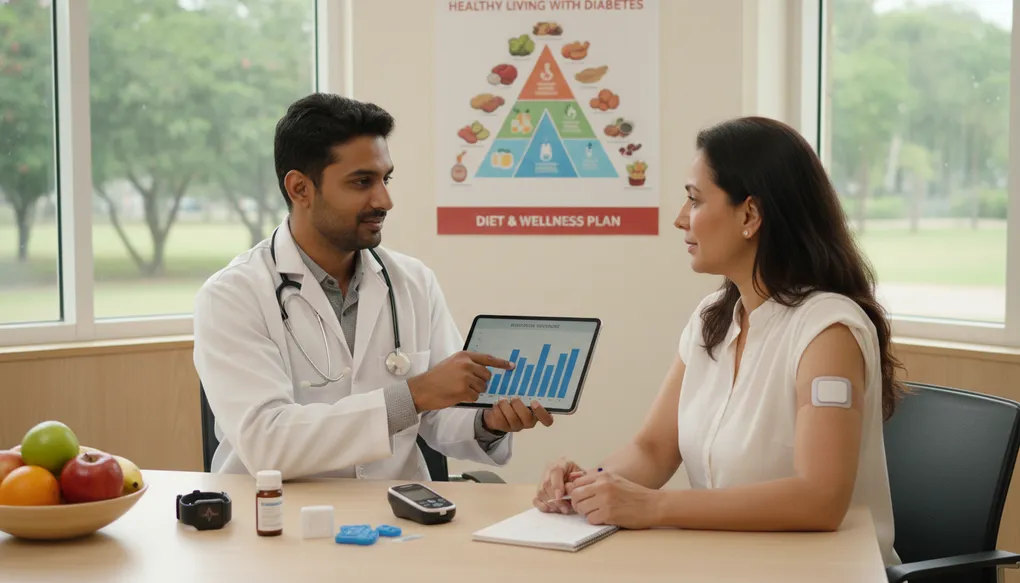
Diabetology and Obesity Clinic Prompt Pack
Ready-to-use prompts for diabetologists and obesity specialists—patient education, diet counselling, monitoring plans, and lifestyle modification scripts.
Diabetes and obesity are among the most common conditions managed in Indian clinics today. With over 100 million diabetics and rising obesity rates, these consultations are frequent, time-intensive, and heavily reliant on patient education.
The challenge? Each patient needs personalised counselling—newly diagnosed patients need different support than someone with uncontrolled sugars for years. A working professional needs different diet advice than a homemaker. Festival season eating guidance differs from everyday meal planning.
AI-assisted prompt engineering can help you create personalised, culturally appropriate patient education materials in minutes—materials that would otherwise take hours to customise.
This article builds on the prompt fundamentals from D4 (chronic disease management prompts) and F1 (specialty clinic workflows) to provide you with diabetes and obesity-specific prompts ready for immediate use.
What Problem This Solves
Diabetology and obesity clinics face unique communication challenges:
- Information overload: Patients receive too much information in one sitting—diet, exercise, medications, monitoring—and retain little
- One-size-fits-all materials: Generic diet charts that don’t account for Indian food habits, regional preferences, or budget constraints
- Myth management: Patients arrive with deep-rooted beliefs (“bitter gourd cures diabetes,” “insulin is addictive,” “once sugar is controlled, I can stop medicines”)
- Repeated explanations: Explaining HbA1c, hypoglycemia signs, or insulin technique dozens of times daily
- Festival and social eating: No guidance for navigating Diwali sweets, wedding season, or family pressure
- Different patient profiles: Newly diagnosed, uncontrolled, on OHA, on insulin, with complications—each needs different messaging
Well-crafted prompts can generate customised patient education materials that address these specific challenges—saving you time while improving patient understanding and compliance.
How to Do It (Steps)
Step 1: Identify Patient Profile
Before creating prompts, categorise your patient:
| Profile | Key Focus | Communication Style |
|---|---|---|
| Newly diagnosed | Education, acceptance, lifestyle basics | Reassuring, gradual |
| Uncontrolled (on OHA) | Compliance, intensification discussion | Firm but supportive |
| Starting insulin | Fear reduction, technique training | Patient, detailed |
| With complications | Monitoring, prevention of progression | Serious but hopeful |
| Obesity (without diabetes) | Lifestyle modification, sustainable changes | Motivating, realistic |
| Pre-diabetic | Prevention focus, reversibility message | Encouraging, action-oriented |
Step 2: Choose Education Topic
Common topics requiring patient materials:
- New diagnosis counselling
- HbA1c result explanation
- Diet planning (Indian-specific)
- Exercise prescription
- Hypoglycemia recognition and management
- Weight loss goal setting
- Medication adherence
- Insulin initiation and technique
- Foot care and complication screening
- Sick day management
Step 3: Consider Cultural Factors
For Indian patients, include:
- Regional food preferences (North/South/East/West)
- Vegetarian/non-vegetarian options
- Festival eating guidance
- Joint family dynamics (who cooks, who decides meals)
- Common myths to address
- Economic considerations (budget-friendly options)
Step 4: Specify Output Language
- English only (educated urban patients)
- Hindi only (Hindi-speaking patients with limited English)
- Bilingual (English + Hindi)—most versatile
- Regional language mention (for translation reference)
Step 5: Review and Personalise
Always review AI-generated content for:
- Medical accuracy
- Cultural appropriateness
- Patient-specific modifications needed
- Your clinic’s specific protocols
Example Prompts (2-5)
Example 1: New Diabetes Diagnosis Counselling Script
Role: Act as an experienced diabetologist who is excellent at explaining
conditions to worried patients in simple terms.

Context: A 48-year-old vegetarian businessman from Delhi has just been
diagnosed with Type 2 diabetes. His fasting sugar is 186 mg/dL and HbA1c
is 8.2%. He is anxious because his father had diabetes-related kidney
problems. He is educated but has no medical background. His wife
accompanies him and will be involved in meal planning.

Task: Create a first-consultation counselling script I can use or adapt.
Cover: what diabetes is (simple explanation), why he got it, that it can
be controlled, what happens if controlled vs uncontrolled, and immediate
next steps. Also address his fear about kidney problems.

Format:
- Opening reassurance (2-3 lines)
- Simple explanation section with analogies
- "Good news" section about control
- Father's history concern addressed
- Immediate action items (numbered)
- Closing with hope

Constraints:
- Conversational tone, as if speaking to him
- Under 400 words
- Include one relatable Indian analogy
- Address his wife too (she's the meal planner)
- End with "what we'll do together over the next 3 months"
- Do not mention specific medications (I'll add those)
Example 2: HbA1c Result Explanation (Hindi-English Bilingual)
Role: You are a diabetes educator who explains test results simply and
motivates patients to improve.

Context: Patient is a 55-year-old homemaker from Lucknow. Previous HbA1c
was 9.4%, current HbA1c is 8.1%. She is happy about improvement but I
want her to understand the target is still 7% and below. She reads Hindi
better than English. Her daughter helps her with health matters.

Task: Create a one-page explanation of her HbA1c result that:
1. Celebrates her improvement (1.3% drop is significant)
2. Explains what HbA1c measures (3-month sugar average analogy)
3. Shows the target and where she stands
4. Motivates her for the next 3 months
5. Gives her 3 specific things to focus on

Format: Bilingual—Hindi as primary language, English medical terms in
brackets. Use a simple visual scale showing her progress (text-based).

Constraints:
- Warm, encouraging tone
- Under 250 words
- Include "आपने अच्छा किया" (you did well) acknowledgment
- Explain HbA1c with a relatable analogy (like exam average)
- Make daughter feel included (she's the support person)
- End with achievable 3-month goal
Example 3: Indian Diet Plan for Diabetes (Vegetarian, North Indian)
Role: Act as a diabetes nutrition counsellor familiar with North Indian
vegetarian cooking.

Context: Patient is a 52-year-old vegetarian man from Jaipur, recently
diagnosed with Type 2 diabetes (HbA1c 7.8%). He is a government employee,
eats home-cooked food, and his wife cooks for the joint family of 6.
Budget is moderate. He loves dal-chawal and has 2 rotis with sabzi for
most meals. He has tea with biscuits twice daily. Main challenge: he
can't eat different food from the family.

Task: Create a practical one-week diet plan that:
- Uses common North Indian foods
- Doesn't require separate cooking
- Shows portion control (using everyday measures like katori, roti)
- Addresses his tea-biscuit habit with alternatives
- Includes breakfast, lunch, evening snack, and dinner

Format:
- Daily schedule table (7 days)
- Portion size guide using Indian measures
- "Smart swaps" section (instead of X, have Y)
- Festival eating tips (for upcoming wedding season)
- Tea and snack alternatives that won't feel like deprivation

Constraints:
- All foods commonly available in Jaipur
- Cost-effective (no expensive superfoods)
- Family-friendly (wife can serve same food to others with minor adjustments)
- Include dal, roti, sabzi, chawal in appropriate portions
- Show how to handle rice (don't ban it, teach portion control)
- Under 500 words for the main plan, can have additional tips
Example 4: Hypoglycemia Education Card (For Insulin Patients)
Role: Act as a diabetes specialist creating emergency education materials.

Context: Creating a wallet-sized card for patients on insulin. The card
will be given to all patients starting insulin and to family members.
Patients are typically 45-70 years old, varying literacy levels, mostly
Hindi-speaking with basic English. Card needs to be clear enough that
a family member can help during an emergency.

Task: Create content for a hypoglycemia (low sugar) emergency card with:
1. What is low sugar and why it happens
2. Warning symptoms to recognize (list of 6-8 signs)
3. Immediate action steps (Rule of 15)
4. What family members should do if patient is confused/unconscious
5. When to go to hospital immediately
6. Prevention tips (brief)

Format:
- Front of card: Warning signs + Immediate action
- Back of card: Family instructions + Prevention + Emergency number space
- Use icons/symbols where possible (describe them for printing)
- Bilingual Hindi-English

Constraints:
- Must fit wallet-card size (information very concise)
- Use large text guidance (for elderly patients)
- Numbers and timings very clear
- Include space for patient's name and doctor's emergency number
- "15-15 rule" explained simply
- Glucose tablets/sugar amount in simple measures (चम्मच not grams)
Example 5: Weight Loss Goal Setting Consultation Script (Obesity)
Role: You are an obesity specialist who practices motivational interviewing
and helps patients set realistic, sustainable goals.

Context: Patient is a 38-year-old IT professional from Bangalore. BMI is
34 (weight 98 kg, height 170 cm). He has tried multiple diets—keto,
intermittent fasting, GM diet—lost weight each time but regained more.
He is frustrated and skeptical. He has a sedentary job, works from home,
orders food often, and has pre-diabetes (HbA1c 6.2%). His wife is also
overweight and cooks occasionally.

Task: Create a goal-setting consultation script that:
1. Acknowledges his frustration and validates past efforts
2. Explains why crash diets fail (set-point, sustainability)
3. Introduces "1% body weight per week" realistic goal
4. Helps him identify ONE habit to change first
5. Sets 3-month milestone (not final goal weight)
6. Addresses the pre-diabetes urgency without fear-mongering

Format:
- Conversational, motivational interviewing style
- Include questions to ask him (not just talking at him)
- "Let's figure this out together" collaborative tone
- End with written 4-week mini-plan he takes home

Constraints:
- Under 500 words for the script
- Do not promise specific weight loss numbers
- Focus on behaviour change, not diet rules
- Include his wife as accountability partner option
- Address food ordering habit specifically
- Mention that pre-diabetes can be reversed (hope message)
- Avoid words like "obese" when speaking to patient—use "weight" instead
Bad Prompt → Improved Prompt
Scenario: Diet advice for a diabetic patient
Bad Prompt:
“Give me diet advice for diabetic patient”
What’s wrong:
- No patient details (age, type of diabetes, current diet)
- No cultural context (Indian foods? Regional preferences?)
- No format specified
- No literacy level mentioned
- No portion guidance requested
- Generic advice that won’t be followed
What you get: A generic list like “avoid sugar, eat vegetables, whole grains”—useless for practical implementation.
Improved Prompt:
Role: Act as a diabetes nutrition counsellor familiar with South Indian
vegetarian cooking.

Context: Patient is a 50-year-old vegetarian woman from Chennai with
Type 2 diabetes (HbA1c 8.5%). She eats traditional South Indian food—
idli/dosa for breakfast, rice with sambar and rasam for lunch, and
tiffin (upma/pongal) for dinner. She is pre-hypertensive too. She cooks
for her husband and two college-going children. Education: graduate.
Concern: She thinks she needs to stop eating rice completely.

Task: Create a practical diet guide that:
1. Addresses the "rice fear" with facts
2. Shows her how to modify her existing meals (not replace them)
3. Provides portion guidance using South Indian measures (tumbler, katori)
4. Includes breakfast, lunch, snack, dinner options she recognizes
5. Gives tips for reducing salt (for BP) without sacrificing taste
6. Offers quick options for busy days

Format:
- Main meals table (what to have, what portion, what to reduce)
- "Rice reality" section (truth about rice and diabetes)
- Cooking tips section (small changes, big impact)
- "When others eat" section (managing family meals)
- One-week sample menu

Constraints:
- All foods typical South Indian household ingredients
- Must include rice (teach portion control, not elimination)
- Salt reduction tips without making food bland
- Include millets as alternative, not replacement
- Cost-effective suggestions
- Under 600 words total
Why it’s better:
- Specific patient profile with regional food context
- Addresses her specific concern (rice fear)
- Family context included (cooking for others)
- Multiple health goals (diabetes + BP)
- Practical format with portion guidance
- Culturally appropriate South Indian foods
Common Mistakes
1. Banning Foods Instead of Teaching Portions
“Avoid rice completely” doesn’t work for Indian patients. Rice is staple food for millions.
Fix: Ask for “portion control guidance using cultural measures like katori, include rice in appropriate amounts.”
2. Ignoring Festival and Social Contexts
Diwali, weddings, family functions—patients need practical guidance for these situations, not just “avoid sweets.”
Fix: Include “festival eating tips” and “social situation management” in your prompts.
3. One-Size-Fits-All Diet Charts
A Chennai patient and a Punjab patient cannot follow the same diet chart.
Fix: Specify region: “North Indian vegetarian” or “Kerala non-vegetarian” or “Gujarati” food preferences.
4. Fear-Based Messaging for New Patients
Scaring newly diagnosed patients with complication lists creates anxiety and denial, not compliance.
Fix: Request “reassuring tone with hope message” and “what happens when controlled, not just uncontrolled.”
5. Ignoring the Family Dynamic
In India, the patient often doesn’t cook. The spouse, daughter-in-law, or parent does.
Fix: Include “address family meal planner” and “guidance for cooking same food for family with modifications.”
6. Complex Medical Jargon for HbA1c/Metrics
“Glycated hemoglobin represents average glycemic control” means nothing to most patients.
Fix: Ask for “simple analogies” like “HbA1c is like your sugar exam result for the last 3 months.”
7. Skipping the Myths Section
Indian patients carry significant myths: karela juice cures diabetes, metformin damages kidneys, insulin is last resort.
Fix: Add “address common myths” specific to the topic: “myths about insulin,” “myths about fruit and diabetes.”
8. No Actionable Next Steps
Education without action items doesn’t change behaviour.
Fix: Always ask for “3 specific things to do this week” or “one change to start with.”
Clinic-Ready Templates
Template 1: New Diagnosis Counselling Material
Role: Act as an experienced diabetologist counselling a newly diagnosed
patient.

Context:
- Patient: [AGE]-year-old [GENDER], [OCCUPATION] from [CITY]
- New diagnosis: Type 2 diabetes
- Current values: Fasting [VALUE], PP [VALUE], HbA1c [VALUE]
- Diet: [VEG/NON-VEG], [REGIONAL FOOD PATTERN]
- Family history: [DIABETES IN FAMILY? COMPLICATIONS?]
- Patient's main concern: [WHAT ARE THEY WORRIED ABOUT?]
- Support person: [WHO CAME WITH THEM? WHO MANAGES FOOD AT HOME?]

Task: Create a first-visit counselling document that covers:
1. What is diabetes (simple explanation with analogy)
2. Why they got it (genetics + lifestyle, not their fault alone)
3. Good news: it can be controlled
4. What happens when controlled vs uncontrolled
5. Immediate lifestyle steps (3 things to start this week)
6. Address their specific concern
7. What happens next (follow-up plan)

Format:
- Conversational sections they can read at home
- One visual (text-based): "Controlled vs Uncontrolled" comparison
- "Your First Week" action checklist
- "Questions to Ask Next Time" section

Constraints:
- [LANGUAGE PREFERENCE: English/Hindi/Bilingual]
- Reassuring, not scary tone
- Under [WORD LIMIT] words
- Include family member in instructions
- Address one common myth relevant to them
- No specific medication details (I'll add)
Template 2: HbA1c Result Explanation Sheet
Role: You are a diabetes educator explaining test results simply.

Context:
- Patient: [AGE]-year-old, [EDUCATION LEVEL] literacy
- Previous HbA1c: [VALUE] (or "first test")
- Current HbA1c: [VALUE]
- Trend: [IMPROVED/WORSENED/SAME]
- Current treatment: [OHA/INSULIN/LIFESTYLE ONLY]
- Key behaviour to reinforce/change: [WHAT DO THEY NEED TO DO?]

Task: Create a one-page HbA1c result explanation that:
1. Explains what HbA1c measures (with analogy)
2. Shows where they stand (with visual scale)
3. [If improved: celebrates progress and encourages more]
4. [If worsened: explains without blaming, identifies causes]
5. Sets specific 3-month target
6. Lists 3 actionable steps for next 3 months

Format:
- Simple language with HbA1c scale visual (text-based)
- "What your number means" section
- "Your 3-month goal" highlighted
- "3 things to focus on" checklist

Constraints:
- [LANGUAGE: English/Hindi/Bilingual]
- [TONE: Encouraging for improvement / Supportive-firm for worsening]
- Explain in terms of "sugar average" not technical terms
- Under 200 words
- Make it something they can show family
Template 3: Personalised Diet Plan Generator
Role: Act as a diabetes nutrition counsellor familiar with [REGION]
[VEG/NON-VEG] cooking.

Context:
- Patient: [AGE], [GENDER], [OCCUPATION]
- Condition: [TYPE 2 DIABETES/PRE-DIABETES/OBESITY]
- Current HbA1c/weight: [VALUE]
- Regional food: [SPECIFIC REGIONAL CUISINE]
- Typical current meals:
  - Breakfast: [WHAT THEY EAT]
  - Lunch: [WHAT THEY EAT]
  - Dinner: [WHAT THEY EAT]
  - Snacks: [WHAT THEY EAT]
- Food prepared by: [SELF/SPOUSE/PARENT/COOK]
- Family situation: [JOINT FAMILY? EATS SAME FOOD AS OTHERS?]
- Specific challenges: [EATING OUT/OFFICE LUNCH/SWEET TOOTH/etc.]
- Budget: [MODERATE/TIGHT/COMFORTABLE]

Task: Create a practical diet plan that:
1. Modifies their existing meals (not complete overhaul)
2. Provides clear portion guidance using Indian measures
3. Shows "instead of X, have Y" swaps
4. Includes all meals: breakfast, lunch, snack, dinner
5. Addresses their specific challenge
6. Provides tips for eating with family

Format:
- Daily meal table (one week or sample days)
- Portion guide with visual measures (katori, roti, cup)
- "Smart Swaps" section
- Festival/celebration eating tips
- "Quick meal" options for busy days

Constraints:
- All locally available, affordable foods
- Include their staple foods in appropriate portions
- Family-friendly (no separate cooking needed)
- Under 500 words for plan, can add tips separately
- [LANGUAGE PREFERENCE]
- Must address [SPECIFIC FOOD they asked about—rice/roti/fruit/etc.]
Template 4: Insulin Initiation Counselling
Role: Act as a diabetes specialist who helps patients overcome insulin
fears with patience and facts.

Context:
- Patient: [AGE]-year-old with Type 2 diabetes
- Current situation: [UNCONTROLLED ON MAX OHA/COMPLICATIONS/etc.]
- HbA1c: [VALUE]
- Patient's concerns about insulin: [SPECIFIC FEARS—addiction/kidney damage/
  last resort/injections painful/social stigma/etc.]
- Education level: [BASIC/MODERATE/HIGH]
- Support at home: [WHO CAN HELP WITH INJECTIONS IF NEEDED]

Task: Create insulin initiation counselling material that:
1. Addresses their specific fear with facts
2. Explains why insulin is needed now (body's own insulin insufficient)
3. Debunks common insulin myths (list and counter)
4. Explains that insulin is a tool, not failure
5. Describes what to expect (injection process, not painful)
6. Covers basic technique (to be demonstrated in person)
7. Discusses hypoglycemia awareness

Format:
- "Your Questions Answered" Q&A format
- Myths vs Facts table
- "What to Expect in Your First Week" section
- Simple injection technique steps (for reference)
- When to call doctor (warning signs)

Constraints:
- [LANGUAGE: Hindi/English/Bilingual]
- Reassuring, not defensive tone
- Under 400 words
- Include success stories framing (many patients on insulin live full lives)
- Address family's concerns too (they often reinforce myths)
- Space for injection schedule I'll fill in
Template 5: Weight Loss Program Overview (Obesity Clinic)
Role: You are an obesity medicine specialist who believes in sustainable,
non-judgmental weight management.

Context:
- Patient: [AGE]-year-old [GENDER], [OCCUPATION]
- Current weight: [KG], Height: [CM], BMI: [VALUE]
- Weight history: [PREVIOUS ATTEMPTS, YO-YO PATTERN?]
- Comorbidities: [PRE-DIABETES/DIABETES/HYPERTENSION/PCOS/etc.]
- Lifestyle: [SEDENTARY/MODERATELY ACTIVE], [EATING PATTERNS]
- Motivation level: [HIGH/MODERATE/SKEPTICAL]
- Main barriers: [TIME/FAMILY/STRESS EATING/MEDICAL/etc.]

Task: Create a weight management program overview document that:
1. Explains healthy weight loss rate (0.5-1 kg/week)
2. Sets realistic 3-month goal (not ideal weight)
3. Outlines the approach (lifestyle, not crash diet)
4. Addresses why previous diets failed (sustainability issue)
5. Introduces small, sustainable changes
6. Explains monitoring plan (weight, measurements, habits)
7. Discusses when medication might help

Format:
- "Your Personalised Plan Overview" title
- Realistic goal setting section
- "4 Pillars" approach: Food, Activity, Sleep, Stress
- Month-by-month milestone expectations
- "What Makes This Different" from crash diets
- Follow-up schedule

Constraints:
- Never use "obese" when addressing patient—use "weight"
- Focus on health gains, not just numbers
- Include non-scale victories (energy, sleep, mobility)
- Under 400 words
- Hopeful but realistic tone
- Mention that setbacks are normal
- [LANGUAGE PREFERENCE]
Safety Note
Critical safety reminders for diabetes and obesity AI-assisted materials:
Medical Accuracy Verification
- Always verify medication names, dosages, and timing—AI may hallucinate drug names or incorrect doses
- Check dietary advice against patient’s other conditions (e.g., CKD patients need different protein advice)
- Review exercise recommendations for patients with complications (retinopathy, neuropathy, cardiac issues)
- Hypoglycemia management information must be accurate—wrong advice can be dangerous
What AI Cannot Replace
- Clinical judgment: AI cannot decide if a patient needs insulin, medication changes, or hospitalisation
- Physical examination: Foot exams, injection site checks, complication screening need in-person assessment
- Individualised dosing: AI should never suggest specific medication doses—always leave placeholders
- Emergency decisions: Hypoglycemia, DKA, HHS symptoms need immediate medical evaluation, not AI guidance
Privacy Considerations
- Never include patient name, date of birth, address, or phone number in prompts
- Remove identifying details before using AI—use “48-year-old man from Delhi” not “Mr. Sharma”
- De-identify specific details that could identify the patient
Patient Communication
- AI-generated materials are education aids, not prescriptions
- Always tell patients that written materials supplement, not replace, doctor’s verbal advice
- Review every output before giving to patient—you are responsible for what you provide
- Adjust AI outputs based on individual patient circumstances
When NOT to Rely on AI
- Severe hypoglycemia management (patient-specific protocols needed)
- Insulin dose adjustments (requires clinical assessment)
- Complication management (retinopathy, nephropathy, neuropathy)
- Pregnancy and diabetes (high-risk, specialist protocols)
- Paediatric diabetes (different entirely from adult management)
- Emergency situations (DKA, HHS, severe hypo)
Remember: AI assists with communication and education. Clinical decisions remain yours.
Copy-Paste Prompts
Quick Prompt: New Diagnosis Reassurance Message
Create a reassuring message for a [AGE]-year-old newly diagnosed with
Type 2 diabetes (HbA1c [VALUE]). They are worried about [SPECIFIC FEAR].
Include: simple explanation of diabetes, that it's controllable, 3 things
they can start this week, and when they'll see you next. Tone: hopeful,
calm. Under 200 words. Language: [ENGLISH/HINDI/BILINGUAL].
Quick Prompt: HbA1c Explanation (Improved)
Create a simple explanation for a patient whose HbA1c improved from
[PREVIOUS] to [CURRENT]. Celebrate the progress, explain what HbA1c
means using a "3-month average" analogy, show target is [TARGET], and
give 3 specific things to continue doing. Under 150 words. Bilingual
Hindi-English. Encouraging tone.
Quick Prompt: HbA1c Explanation (Worsened)
Create a supportive message for a patient whose HbA1c worsened from
[PREVIOUS] to [CURRENT]. Don't blame—identify possible reasons to
discuss. Emphasize this can be improved. Set 3-month goal of [TARGET].
Give 2 specific actionable steps. Under 150 words. [LANGUAGE].
Supportive but honest tone.
Quick Prompt: Indian Vegetarian Diet Summary
Create a one-page diet summary for [REGION] vegetarian diabetic patient.
Include: what to eat freely, what to eat in portions (with katori/roti
measures), what to limit, smart swaps for common foods, and festival
eating tips. Format as bullet lists under each category. Under 300 words.
[LANGUAGE].
Quick Prompt: Hypoglycemia Card
Create wallet-card content for insulin patient on hypoglycemia. Front:
symptoms (6 items), immediate action (15-15 rule with Indian measures
like चम्मच). Back: family instructions if patient unconscious, when to
go to hospital, prevention tips (4 points). Bilingual Hindi-English.
Keep very brief—must fit small card. Include space for emergency number.
Quick Prompt: Exercise Prescription
Create exercise guidance for [AGE]-year-old diabetic patient with
[LIMITATIONS if any]. They are [SEDENTARY/MODERATELY ACTIVE] currently.
Include: type of exercise (walking-based, no gym), duration and frequency,
best timing (relation to meals), precautions for [INSULIN/OHA] patients,
and progression over 4 weeks. Practical for Indian urban setting. Under
200 words. [LANGUAGE].
Quick Prompt: Medication Adherence Counselling
Create medication adherence counselling points for diabetic patient who
[SPECIFIC ISSUE: misses doses/stops when feeling better/scared of side
effects]. Address their specific concern with facts. Explain why
continuous medication matters. Give 3 practical tips to remember doses.
Mention what to do if dose is missed. Under 200 words. [LANGUAGE].
Supportive, not lecturing tone.
Quick Prompt: Myth Buster Sheet
Create a "Diabetes Myths vs Facts" sheet addressing these common Indian
myths: [LIST MYTHS TO ADDRESS—e.g., bitter gourd cures diabetes, insulin
is addictive, diabetes means no sweets ever, thin people can't get
diabetes]. Format: Myth on left, Fact on right, brief explanation.
Bilingual Hindi-English. Under 300 words. Respectful tone—don't mock
beliefs, correct them gently.
Quick Prompt: Foot Care Instructions
Create foot care instructions for diabetic patient at risk for foot
complications. Include: daily inspection routine (what to look for),
washing and drying technique, nail care, footwear guidance (Indian
context—chappals vs closed shoes), warning signs needing immediate
attention, and what to avoid. Format as numbered daily checklist +
warning signs box. Under 250 words. [LANGUAGE].
Quick Prompt: Sick Day Management
Create sick day management guide for diabetic patient on [OHA/INSULIN].
Cover: when to check sugar more frequently, medicine adjustments (general
guidance—I'll specify), hydration needs, what to eat when appetite is
low, warning signs to go to hospital (sugar very high/very low, vomiting,
not keeping water down). Format as checklist. Under 200 words.
Bilingual Hindi-English.
Quick Prompt: Weight Loss Week 1 Plan
Create a Week 1 plan for [AGE]-year-old starting weight management
program. Current weight [KG], target to lose 0.5 kg first week. Focus
on ONE food change and ONE activity change only. Include: specific daily
food modification (practical), 10-minute walk plan, water intake goal,
and daily tracking checklist. Encouraging tone—small wins focus.
Under 200 words. [LANGUAGE].
Do’s and Don’ts
Do’s
- Do personalise diet advice to regional food habits—a Tamil patient and a Punjabi patient eat differently
- Do include portion guidance in Indian measures (katori, roti, cup, chamach)—not grams
- Do address the family meal planner—often not the patient themselves
- Do include festival and social eating guidance—Diwali, weddings, office parties are real challenges
- Do use the “modify, don’t eliminate” approach—teaching portion control for rice beats banning it
- Do address myths proactively—patients come with strong beliefs about diabetes
- Do make HbA1c understandable—use the “3-month exam average” analogy
- Do include hope messaging for new diagnoses—fear leads to denial, not compliance
- Do differentiate advice by patient profile—newly diagnosed vs. uncontrolled need different tones
- Do create bilingual materials—family members may have different language comfort
- Do include “what’s normal” reassurance—patients worry about medication side effects unnecessarily
- Do verify all AI-generated content against clinical knowledge before giving to patients
Don’ts
- Don’t give one-size-fits-all diet charts—regional, economic, family contexts matter
- Don’t use fear-based messaging for new patients—it backfires
- Don’t let AI suggest specific medication doses—always leave as placeholders
- Don’t promise specific weight loss numbers—bodies vary, and promises lead to disappointment
- Don’t ban foods completely—“never eat rice” advice won’t be followed
- Don’t ignore the insulin fear—most patients have heard myths about insulin
- Don’t skip the hypoglycemia education for insulin patients—this is safety-critical
- Don’t use medical jargon without explanation—“glycemic control” means nothing to patients
- Don’t forget to include emergency contact guidance—when to call, when to go to hospital
- Don’t include patient identifying information in prompts—privacy matters
- Don’t give AI outputs without reviewing—you are accountable for what patients receive
- Don’t use AI for emergency management decisions—DKA, severe hypoglycemia need clinical judgment
1-Minute Takeaway
Diabetes and obesity counselling is 80% communication, 20% prescription.
Quick Profile Assessment:
| Profile | Focus | Tone |
|---|---|---|
| Newly diagnosed | Education + hope | Reassuring |
| Uncontrolled | Compliance + barriers | Supportive-firm |
| Starting insulin | Fear reduction | Patient |
| Obesity | Sustainability + small wins | Motivating |
The Indian Context Checklist:
- Regional food preferences included?
- Portion sizes in katori/roti/cup?
- Family meal planner addressed?
- Festival/social eating covered?
- Common myths addressed?
- Language appropriate for patient?
Essential Components for Every Diabetes Education Material:
- Simple explanation (with analogy)
- Hope message (it can be controlled)
- Practical portion guidance (not grams—Indian measures)
- Family involvement (they control the kitchen)
- What to do this week (specific, small, achievable)
For HbA1c Discussions:
- Improved: Celebrate, encourage more, set next target
- Worsened: Don’t blame, identify barriers, reset plan
- Always use analogy: “Your sugar’s exam result for 3 months”
The Insulin Conversation Must Address:
- It’s not failure—it’s the right tool at the right time
- Not addictive—body needs what it can’t make enough of
- Not last resort—many start early and do well
- Injections are nearly painless with modern needles
Remember:
- AI creates drafts—you verify and personalise
- Never let AI decide doses or clinical management
- Regional food context matters enormously in India
- Fear creates denial—hope creates compliance
Your prompt formula for diabetology:
[Patient profile] + [Regional food context] + [Specific concern] +
[Family dynamic] + [Language preference] + [Format needed]
Get these elements right, and you’ll have personalised, practical patient materials in minutes—materials that would take hours to create from scratch.
Next up: Article H2—Cardiology Clinic Prompt Pack for creating patient education on heart health, post-MI care, and medication counselling.