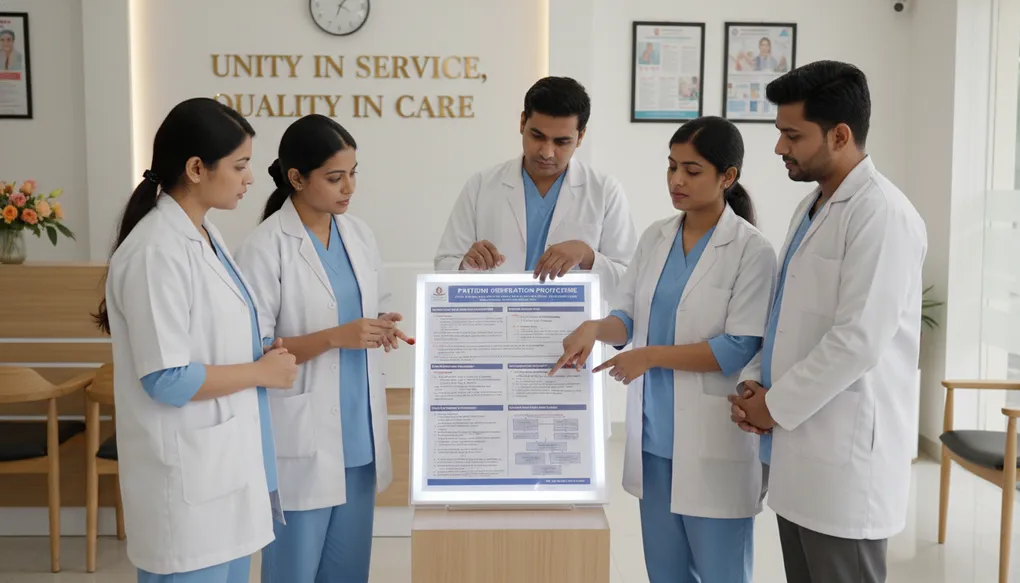
SOPs for Clinic Staff
Create clear standard operating procedures for your clinic staff—ensure consistency, reduce errors, and train new employees efficiently.
Every clinic owner knows this frustration: you explain a process to your receptionist, she does it perfectly for a week, then a new patient complains because she “forgot” one step. Or worse—your best staff member leaves, and suddenly nobody knows how to handle insurance pre-authorisations.
The solution is not more training sessions. The solution is Standard Operating Procedures (SOPs)—written, step-by-step guides that anyone can follow, every single time.
This article shows you how to use AI to create professional, clear SOPs for your clinic staff in minutes instead of hours. We will cover everything from patient registration to emergency protocols, with Hindi-friendly versions your staff can actually use.
What Problem This Solves
Without SOPs, your clinic faces these problems:
- Inconsistent patient experience: One receptionist asks for ID proof, another forgets. One handles complaints politely, another argues.
- Training nightmares: Every new hire requires hours of your time. When you are busy, they learn “on the job”—which means they learn bad habits.
- Staff dependency: Key processes live in one person’s head. When they take leave or quit, chaos follows.
- Errors and complaints: “But nobody told me to do that!” becomes a common excuse.
- No accountability: Without written standards, you cannot fairly evaluate performance.
What good SOPs give you:
- Consistency: Every patient gets the same professional experience
- Fast training: New staff can read, practice, and start working within days
- Accountability: Clear expectations mean fair performance reviews
- Reduced errors: Checklists catch what memory misses
- Scalability: Open a second location? Your SOPs travel with you
The AI advantage: Creating SOPs used to take hours of writing and formatting. With the right prompts, you can generate professional, clinic-ready SOPs in 10-15 minutes—then customise them for your specific workflow.
How to Do It (Steps)
Step 1: Identify Your Core Processes
Before writing any SOP, list the processes that need documentation. For most Indian clinics, these are the essentials:
| Category | Key Processes |
|---|---|
| Patient Flow | Registration, appointment booking, check-in, queue management |
| Communication | Phone handling, WhatsApp enquiries, appointment reminders |
| Clinical Support | Preparing consultation rooms, handling samples, filing reports |
| Financial | Billing, payment collection, receipt generation, insurance claims |
| Records | Filing, retrieval, confidentiality, record requests |
| Safety | Emergency protocols, fire safety, infection control |
| Operations | Opening procedures, closing procedures, inventory checks |
Step 2: Use the 5-Part Prompt Formula (From B1)
Remember the R-C-T-F-C formula? Apply it to SOP creation:
- Role: “Act as a clinic operations consultant…”
- Context: Your clinic type, staff education level, patient volume
- Task: The specific SOP you need
- Format: Step-by-step with clear numbering and sections
- Constraints: Language level, length, specific inclusions
Step 3: Include These Elements in Every SOP
A good SOP answers six questions:
| Question | SOP Element |
|---|---|
| What? | Process name and purpose |
| Who? | Staff role responsible |
| When? | Trigger or timing |
| How? | Step-by-step instructions |
| What if? | Common exceptions and how to handle them |
| Escalate to? | When and whom to involve |
Step 4: Create Bilingual Versions for Staff
Many clinic staff are more comfortable reading Hindi or regional languages. AI can help you create versions that use:
- Simple Hindi-English mix (Hinglish)
- Key terms in both languages
- Visual cues and numbering that transcend language
Step 5: Align SOPs with Your Clinic AI Policy
If your clinic uses AI tools (as covered in C4), your SOPs should reflect this:
- Which tasks can staff use AI for?
- What data can never be entered into AI tools?
- Who reviews AI-generated outputs?
Step 6: Establish a Review Schedule
SOPs are not “write once and forget.” Set a review calendar:
| SOP Type | Review Frequency |
|---|---|
| Clinical processes | Every 6 months |
| Administrative processes | Every 12 months |
| Emergency protocols | Every 6 months |
| Compliance-related | When regulations change |
| New processes | 1 month after implementation, then regular schedule |
Example Prompts
Prompt 1: Patient Registration SOP
Role: Act as a clinic operations consultant who has helped 50+ Indian clinics standardise their workflows.

Context: I run a multi-specialty clinic in an urban area. We see 60-80 patients daily. Staff education level is 12th pass to graduate. We use a computer-based registration system. Patients include elderly who need extra assistance.

Task: Create a Standard Operating Procedure for patient registration—covering new patients and returning patients.

Format:
- Start with SOP header (title, version, effective date placeholder, responsible role)
- Purpose section (2-3 lines)
- Scope section (who this applies to)
- Step-by-step procedure with clear numbering (1, 1.1, 1.2 format)
- "What to do if" section for common exceptions
- Escalation guide
- End with revision history table

Constraints:
- Use simple English that 12th-standard staff can understand
- Include specific details: what to collect, what to enter, what to give patient
- Add time benchmarks (e.g., "registration should take 3-5 minutes")
- Include data privacy reminders
- Total length: 600-800 words
Prompt 2: Phone Call Handling SOP (Bilingual)
Role: You are a healthcare operations trainer who creates training materials in Hindi-English mix for clinic staff.

Context: Our clinic reception handles 40-50 phone calls daily. Most callers want: appointment booking, doctor availability, directions, or to speak with doctor. Staff need clear scripts to sound professional and consistent.

Task: Create a Phone Call Handling SOP with actual scripts staff can use. Include Hindi-English (Hinglish) versions of key phrases.

Format:
- SOP header with title, version, date placeholder
- Purpose (why phone handling matters)
- Step-by-step call flow
- Scripts for: greeting, taking messages, appointment booking, handling complaints, ending calls
- Each script in both English and Hinglish
- "Never say this / Say this instead" table
- Escalation triggers

Constraints:
- Professional but warm tone
- Scripts should be 1-2 sentences each (easy to memorise)
- Include what information to collect for each call type
- Add "red flag" calls that need immediate escalation (emergencies, complaints about doctor)
- Under 700 words total
Prompt 3: Emergency Protocol SOP
Role: Act as a clinic safety officer familiar with Indian healthcare facility requirements.

Context: We are a ground-floor clinic (no lift issues). We have basic emergency equipment: first aid kit, oxygen cylinder, emergency medicines. Nearest hospital is 10 minutes away. We need clear protocols for: medical emergencies during OPD, fire, and natural disasters.

Task: Create an Emergency Response SOP that any staff member can follow during a crisis.

Format:
- SOP header
- Emergency contact list template
- Separate sections for: Medical Emergency, Fire Emergency, Natural Disaster
- Each section: immediate actions (first 60 seconds), next steps, roles
- Use numbered steps and bold key actions
- Include "DO NOT" warnings
- Post-emergency documentation checklist

Constraints:
- Actions must be specific and sequential (not vague)
- Include exact phrases for calling emergency services
- Staff should be able to follow without prior training
- Include how to handle patient relatives during emergencies
- Keep each emergency type to one page when printed
Prompt 4: Billing and Payment Collection SOP
Role: Act as a clinic finance manager who has created billing SOPs for healthcare settings in India.

Context: Our clinic handles: cash payments, UPI/card payments, and insurance (cashless and reimbursement). Common issues: patients disputing charges, partial payments, insurance claim rejections. We need clear processes and scripts.

Task: Create a Billing and Payment Collection SOP covering the complete payment cycle.

Format:
- SOP header
- Payment types section (cash, digital, insurance)
- Step-by-step for each payment type
- Standard scripts for: explaining charges, handling disputes, requesting pending payments
- Receipt and documentation requirements
- End-of-day reconciliation checklist
- Exception handling (short payment, bounced cheques, insurance issues)

Constraints:
- Include GST/receipt requirements
- Add scripts that are polite but firm
- Cover what to do when patient cannot pay full amount
- Include data entry and filing requirements
- Specify who authorises discounts or payment plans
Prompt 5: Opening and Closing Procedures SOP
Role: Act as a clinic operations manager who has standardised clinic workflows across multiple locations.

Context: Our clinic operates 9 AM to 8 PM. First staff arrives at 8:30 AM. Last patient typically leaves by 7:30 PM. We have: reception area, 2 consultation rooms, 1 procedure room, pharmacy counter, and small lab.

Task: Create Opening and Closing Procedures SOPs with detailed checklists.

Format:
- Two separate SOPs: Opening Procedures and Closing Procedures
- Each with: SOP header, purpose, responsible staff, time expectations
- Checklist format with tick boxes
- Organised by area (reception, consultation rooms, pharmacy, etc.)
- "Handover notes" template for issues discovered
- Security and safety final checks

Constraints:
- Opening checklist should take 20-30 minutes
- Closing checklist should take 15-20 minutes
- Include equipment checks (computer, printer, AC, medical equipment)
- Include inventory checks for critical supplies
- Specify what to do if something is wrong (whom to call, what to document)
Bad Prompt → Improved Prompt
Bad Prompt:
Write an SOP for my clinic receptionist.What is wrong:
- No context about clinic type or size
- Does not specify which process
- No format guidance
- No language or complexity preferences
- No specific elements requested
Improved Prompt:
Role: Act as a clinic operations consultant specialising in Indian healthcare settings.

Context:
- Clinic type: Single-doctor GP clinic in semi-urban area
- Staff: One receptionist (12th pass, 2 years experience)
- Daily patients: 30-40
- Current issues: Patients complain about long waits, confusion about when doctor is available

Task: Create an SOP for "Appointment Scheduling and Queue Management" that helps the receptionist manage patient flow efficiently.

Format:
- SOP header (title, version, effective date, owner)
- Purpose statement
- Scope (this SOP applies to...)
- Definitions (if any terms need clarification)
- Step-by-step procedure with sub-steps
- Time estimates for each major step
- Scripts for common patient conversations
- Exception handling (walk-ins, emergencies, VIPs)
- Performance metrics (how to measure if SOP is followed)

Constraints:
- Language: Simple English with Hindi translations for patient-facing scripts
- Include specific time slots and booking rules
- Address: overbooking prevention, buffer time, emergency slots
- Cover both phone bookings and walk-in management
- Total length: 500-700 words
- Must align with our policy that AI tools are not used for patient data
Common Mistakes
| Mistake | Why It Fails | How to Fix |
|---|---|---|
| Writing SOPs that are too long | Staff will not read them | Keep each SOP to 1-2 pages; use checklists |
| Using complicated language | Staff cannot understand or follow | Write for 10th-standard reading level; test with actual staff |
| Missing the “what if” section | Real situations have exceptions | Always include 3-5 common exceptions and how to handle them |
| No escalation guidance | Staff freeze when unsure | Specify exactly when and whom to contact |
| Creating SOPs without staff input | Procedures may not match reality | Involve staff in review; they know the edge cases |
| Writing once and forgetting | SOPs become outdated | Set review dates; update when processes change |
| No version control | Confusion about which SOP is current | Always include version number and effective date |
| Generic templates without customisation | Does not fit your clinic’s actual workflow | Start with AI-generated draft, then customise heavily |
Clinic-Ready Templates
Template 1: Universal SOP Header
=====================================================
STANDARD OPERATING PROCEDURE

Title: [PROCESS NAME]
SOP Number: [DEPT]-[NUMBER] (e.g., REC-001)
Version: [X.X]
Effective Date: [DD/MM/YYYY]
Review Date: [DD/MM/YYYY]
Owner: [ROLE/NAME]
Approved By: [CLINIC HEAD NAME]

Purpose:
[2-3 sentences explaining why this SOP exists and what it achieves]

Scope:
This SOP applies to: [LIST STAFF ROLES]
This SOP covers: [WHAT IS INCLUDED]
This SOP does not cover: [WHAT IS EXCLUDED]
=====================================================
Template 2: SOP Review and Update Log
=====================================================
SOP REVISION HISTORY

| Version | Date | Changes Made | Changed By | Approved By |
|---------|------|--------------|------------|-------------|
| 1.0 | [DATE] | Initial version | [NAME] | [NAME] |
| 1.1 | [DATE] | [BRIEF DESCRIPTION] | [NAME] | [NAME] |
| | | | | |

NEXT SCHEDULED REVIEW: [DATE]

REVIEW TRIGGERS (update SOP immediately if):
- Regulatory requirements change
- New equipment or software introduced
- Staff feedback indicates confusion
- Error or complaint related to this process
- Clinic policy changes
=====================================================
Template 3: Staff SOP Training Record
=====================================================
SOP TRAINING ACKNOWLEDGMENT

Staff Name: _______________________
Role: _______________________
Date of Joining: _______________________

I confirm that I have:
[ ] Read and understood the following SOPs:
    [ ] [SOP NAME 1]
    [ ] [SOP NAME 2]
    [ ] [SOP NAME 3]
    [ ] [SOP NAME 4]
    [ ] [SOP NAME 5]

[ ] Completed practical demonstration with supervisor
[ ] Asked questions and received clarification
[ ] Received my copy of relevant SOPs

I understand that:
- I must follow these SOPs in my daily work
- I should report any difficulties or suggestions to my supervisor
- SOPs may be updated, and I will be informed of changes
- I can ask for help whenever I am unsure

Staff Signature: _____________ Date: _____________
Supervisor Signature: _____________ Date: _____________
=====================================================
Template 4: Quick Reference Card Format
=====================================================
QUICK REFERENCE: [PROCESS NAME]
(Keep at workstation)

STEPS:
1. [ACTION] → [KEY DETAIL]
2. [ACTION] → [KEY DETAIL]
3. [ACTION] → [KEY DETAIL]
4. [ACTION] → [KEY DETAIL]
5. [ACTION] → [KEY DETAIL]

IF PATIENT ASKS: "[COMMON QUESTION]"
SAY: "[STANDARD RESPONSE]"

IF PROBLEM: [COMMON ISSUE]
DO: [QUICK SOLUTION]

ESCALATE TO [NAME/ROLE] IF:
- [TRIGGER 1]
- [TRIGGER 2]
- [TRIGGER 3]

NEVER:
- [PROHIBITED ACTION 1]
- [PROHIBITED ACTION 2]
=====================================================
Safety Note
Important considerations when creating and implementing SOPs:
-
SOPs must align with your clinic AI policy. If you have established rules about AI use (as covered in article C4), your SOPs should reinforce these. Staff should know which tasks allow AI assistance and which do not.
-
Patient data handling SOPs are especially critical. Any SOP involving patient information must include privacy reminders. Staff should never enter identifiable patient data into AI tools or unauthorised systems.
-
Emergency SOPs need regular drills. Writing an emergency SOP is not enough—staff must practice it. Schedule quarterly drills for medical emergencies and annual drills for fire safety.
-
SOPs do not replace training. Use SOPs as training tools, but ensure staff understand the “why” behind each step. A checklist followed without understanding is fragile.
-
Legal and compliance requirements change. SOPs related to medical records, consent, billing, and insurance must be updated when regulations change. Assign someone to track relevant updates.
-
Staff feedback is essential. The people doing the work often know what the SOP missed. Create a simple way for staff to suggest SOP improvements.
Copy-Paste Prompts
Prompt A: Complete SOP Generator
Role: Act as a clinic operations consultant who creates professional SOPs for Indian healthcare settings.

Context:
- Clinic type: [SINGLE DOCTOR / MULTI-SPECIALTY / HOSPITAL OPD]
- Location: [URBAN / SEMI-URBAN / RURAL]
- Staff education level: [10TH PASS / 12TH PASS / GRADUATE]
- Daily patient volume: [NUMBER]
- Current challenges: [SPECIFIC ISSUES YOU FACE]

Task: Create a complete Standard Operating Procedure for [PROCESS NAME].

Format:
- SOP header (title, number, version, dates, owner, approval)
- Purpose (why this SOP matters)
- Scope (who and what it covers)
- Definitions (if needed)
- Procedure (numbered steps with sub-steps)
- Time estimates for key steps
- Scripts for patient/caller interactions (if applicable)
- Exception handling (at least 3 common scenarios)
- Escalation guide (when and whom)
- Performance metrics
- Revision history table

Constraints:
- Language: [ENGLISH / ENGLISH WITH HINDI PHRASES / BILINGUAL]
- Reading level: [10TH STANDARD / 12TH STANDARD]
- Length: [500-700 / 700-900 / 900-1200] words
- Must include data privacy reminders where relevant
- Must align with clinic policy that [STATE YOUR AI POLICY]
- Include "Never do" warnings for critical errors
Prompt B: SOP for New Process
Role: Act as a healthcare operations expert who helps clinics document new workflows.

Context: We are implementing a new process in our clinic: [DESCRIBE THE NEW PROCESS]. Currently, there is no documentation, and staff are confused about the correct steps.

Task: Create an SOP for this new process that we can start using immediately.

Format:
- SOP header with all standard fields
- Background section (why we are implementing this)
- Prerequisites (what must be in place before starting)
- Step-by-step procedure
- Roles and responsibilities matrix
- Common questions staff might have (FAQ section)
- Pilot period guidelines (first 2 weeks)
- Feedback collection process

Constraints:
- Assume staff have never done this before
- Include extra detail for the first month
- Add "checkpoint" steps where supervisor should verify
- Keep language simple and actionable
- Include how to report problems during pilot phase
Prompt C: SOP Translation to Hinglish
Role: You are a bilingual trainer who creates staff training materials in Hindi-English mix for Indian clinics.

Context: I have an existing SOP in English. My staff are more comfortable with Hindi. I need a Hinglish version they can easily follow.

Task: Convert this SOP to a Hindi-English (Hinglish) version while keeping all the essential steps and information.

Original SOP:
[PASTE YOUR ENGLISH SOP HERE]

Format:
- Keep the same structure and numbering
- Use Hindi for common action words and patient interactions
- Keep technical terms and role names in English
- Include both versions for key scripts
- Add pronunciation guides for English terms if needed

Constraints:
- Do not change the meaning or steps
- Use simple Hindi (not heavily Sanskritised)
- Staff should be able to read this without English fluency
- Keep critical safety warnings in both languages
Prompt D: SOP Audit Checklist Generator
Role: Act as a quality assurance manager for healthcare facilities.

Context: I have multiple SOPs in my clinic and need to audit whether staff are actually following them.

SOPs to audit:
1. [SOP NAME 1]
2. [SOP NAME 2]
3. [SOP NAME 3]

Task: Create an audit checklist I can use to verify SOP compliance during random checks.

Format:
- Audit header (date, auditor, area, staff observed)
- Checklist items for each SOP (Yes/No/NA format)
- Space for observations
- Scoring system (compliance percentage)
- Action required section
- Staff signature (acknowledging feedback)
- Follow-up date

Constraints:
- Keep audit quick (10-15 minutes per SOP)
- Focus on critical steps, not every minor detail
- Include both process compliance and documentation compliance
- Add "instant fail" items for safety-critical steps
- Make it printable on one page per SOP
Prompt E: Staff Training Plan from SOPs
Role: Act as a clinic training coordinator who onboards new staff efficiently.

Context: A new [ROLE: RECEPTIONIST / NURSE / BILLING STAFF] is joining our clinic. They need to learn our SOPs quickly but thoroughly.

SOPs they must learn:
1. [SOP NAME 1]
2. [SOP NAME 2]
3. [SOP NAME 3]
4. [SOP NAME 4]

Task: Create a 5-day training plan that takes them from reading SOPs to confident independent work.

Format:
- Day-by-day schedule
- For each day: learning objectives, activities, practice tasks
- Mix of: reading, observation, supervised practice, independent practice
- Daily check-in questions (to verify understanding)
- End-of-week assessment checklist
- "Ready for independent work" sign-off form

Constraints:
- Assume trainee has no prior clinic experience
- Include time for questions and clarification
- Balance learning with actual work contribution
- Add contingency for slow learners (what to extend)
- Include who supervises each training activity
Do’s and Don’ts
Do’s
- Do involve staff in SOP creation—they know the real workflow
- Do use simple language appropriate for your staff’s education level
- Do include scripts for patient interactions (not just process steps)
- Do create quick reference cards for frequently used SOPs
- Do set specific review dates and actually review SOPs
- Do train new staff using SOPs from day one
- Do include escalation paths for every SOP
- Do version control all documents (never edit without updating version)
- Do align SOPs with your clinic AI policy
- Do test SOPs by having staff follow them exactly—find the gaps
- Do keep SOPs accessible (printed at workstations, digital copies)
- Do praise staff who follow SOPs and catch errors
Don’ts
- Don’t write SOPs in isolation—observe actual workflow first
- Don’t make SOPs so long that nobody reads them
- Don’t use jargon or complicated language
- Don’t forget the “what if” exceptions—they happen daily
- Don’t create SOPs without specifying who is responsible
- Don’t assume staff will read and remember—train and verify
- Don’t ignore staff suggestions for SOP improvements
- Don’t punish staff for SOP gaps that are actually poor documentation
- Don’t let SOPs become outdated—review on schedule
- Don’t skip the escalation section—staff need to know when to ask for help
- Don’t forget data privacy requirements in any patient-related SOP
- Don’t create SOPs for AI-assisted tasks without specifying AI use rules
1-Minute Takeaway
SOPs are your clinic’s memory. They ensure every patient gets consistent service, every new hire trains quickly, and every process runs smoothly—even when your best staff member is on leave.
The AI shortcut: Use prompts to generate professional SOP drafts in minutes. Apply the 5-Part Formula: Role (operations consultant), Context (your clinic specifics), Task (the SOP you need), Format (structured with headers, steps, exceptions), Constraints (language level, length, specific inclusions).
Every SOP needs six elements:
- What — Process name and purpose
- Who — Responsible staff role
- When — Trigger or timing
- How — Step-by-step instructions
- What if — Exception handling
- Escalate to — When and whom to involve
Make SOPs usable:
- Write for your staff’s actual reading level
- Create Hindi/Hinglish versions for patient-facing scripts
- Make quick reference cards for daily use
- Train staff using SOPs from day one
Keep SOPs alive:
- Review every 6-12 months
- Update immediately when processes change
- Collect staff feedback continuously
- Version control every document
Remember: An SOP that sits in a folder is useless. An SOP that staff actually use transforms your clinic from chaotic to professional. Start with your biggest pain point—the process that causes the most errors or complaints—and build from there.
Next article: Learn how to manage appointments and reduce waiting chaos with our guide to Appointment and Queue Workflow Prompts (G2).