Prescriptions to Patient Instructions
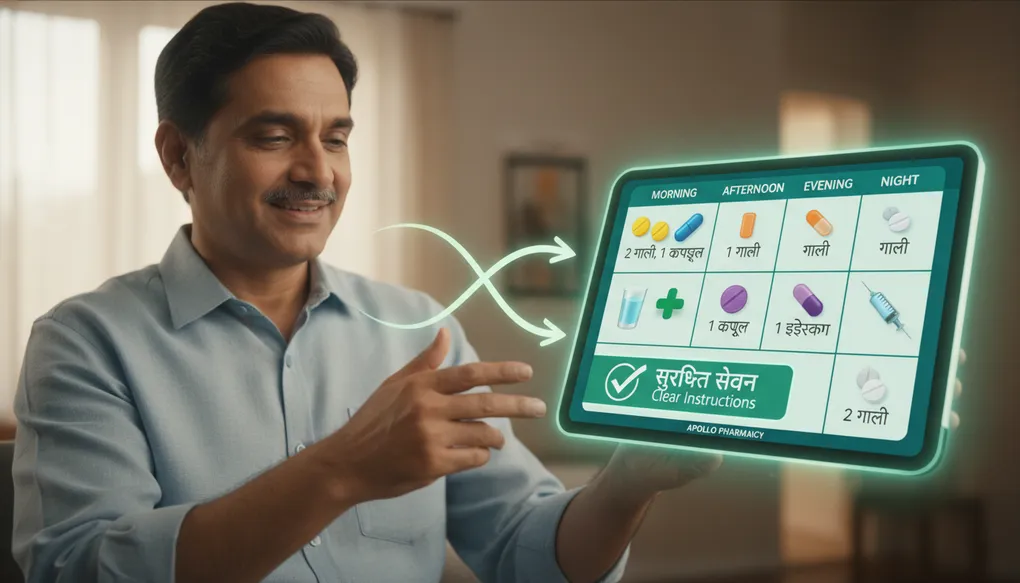
Transform complex prescriptions into simple, actionable instructions patients can follow—reduce medication errors and improve compliance.
Every doctor has seen it happen. You write a careful prescription, explain everything clearly, and three days later the patient returns—they took the morning medicine at night, the once-daily tablet thrice, and skipped the one that should never be missed.
The prescription was medically correct. But it was not understandable.
This article shows you how to use AI to convert your prescriptions into crystal-clear instructions that patients actually follow. Building on the prompt formula (F1) and format control techniques (D2), you will learn to create medication schedules, simple warnings, and practical guidance—all while keeping patient safety at the centre.
What Problem This Solves
Prescriptions are written in medical shorthand. “Tab Metformin 500mg BD with meals” makes perfect sense to healthcare professionals. But to a 60-year-old shopkeeper with diabetes, it might as well be a foreign language.
The consequences are serious:
- Patients take medicines at wrong times (reducing effectiveness)
- Patients skip doses they do not understand
- Patients stop medicines early because they feel better
- Drug interactions go unnoticed when patients do not understand warnings
- Elderly patients and caregivers struggle to manage multiple medications
What AI can do:
- Convert medical abbreviations to plain language
- Create visual medication timetables
- Translate drug interactions into simple “do not take with” warnings
- Convert side effects to “what to watch for” guidance
- Turn food/timing instructions into practical, meal-based schedules
What AI cannot do:
- Verify that the prescription is correct
- Catch prescribing errors
- Replace your clinical judgment
You prescribe. AI helps explain. You verify the explanation.
How to Do It (Steps)
Step 1: Gather the Prescription Details
Before prompting AI, have these ready:
- Medicine names with dosages
- Frequency (OD, BD, TDS, etc.)
- Duration of treatment
- Special instructions (before food, after food, at bedtime)
- Any known interactions or warnings
Step 2: Identify Your Patient’s Needs
Consider:
- Age: Elderly patients need larger text, simpler language
- Literacy level: Match language to patient’s education
- Caregiver involvement: Will someone else manage the medicines?
- Language preference: Hindi, English, regional language, or mixed?
- Number of medicines: More medicines = need for clearer organisation
Step 3: Choose Your Output Format
Pick the format that works best:
- Medication timetable: For patients on 3+ medicines
- Simple list: For 1-2 medicines with clear timing
- Medicine box labels: For elderly or low-literacy patients
- Caregiver instruction sheet: When family manages medicines
Step 4: Write Your Prompt
Use the 5-part formula:
- Role: Patient education assistant or medication counsellor
- Context: Patient details, prescription, special needs
- Task: Convert prescription to understandable instructions
- Format: Table, bullet points, labels, etc.
- Constraints: Language level, length, safety reminders
Step 5: Review and Verify
Critical step: Check every AI-generated instruction against your original prescription. Verify:
- Medicine names are spelled correctly
- Dosages match exactly
- Timing instructions are accurate
- No medicines are missing
- No incorrect information was added
Example Prompts
Example 1: Basic Prescription to Timetable
Role: You are a patient medication counsellor at an Indian clinic.

Context: Patient is a 58-year-old man with Type 2 diabetes and hypertension. He has completed 10th standard and reads Hindi better than English. He takes his meals at:
- Breakfast: 8 AM
- Lunch: 1 PM
- Dinner: 8 PM
- Bedtime: 10 PM

His prescription:
- Tab Metformin 500mg BD with meals
- Tab Glimepiride 1mg OD before breakfast
- Tab Telmisartan 40mg OD morning
- Tab Atorvastatin 10mg OD at bedtime

Task: Convert this prescription into a simple medication timetable he can follow.

Format: Table with columns for Time, Medicine Name (simple), Dose, and How to Take.

Constraints:
- Use simple English mixed with common Hindi terms
- Use meal times (breakfast, lunch, dinner) not clock times
- Add one simple line about what each medicine is for
- Include a "Do not forget" reminder at the bottom
- Keep medicine names simple (write "sugar medicine" alongside Metformin)
Example 2: Elderly Patient with Caregiver
Role: You are a patient education assistant helping create instructions for elderly patients.

Context: Patient is a 75-year-old grandmother. Her daughter-in-law manages her medicines. Patient has poor eyesight and memory issues. She cannot read English.

Prescription:
- Tab Amlodipine 5mg OD morning
- Tab Ecosprin 75mg OD after lunch
- Cap Omeprazole 20mg OD before breakfast
- Tab Calcium + Vitamin D3 OD after dinner

Task: Create a caregiver instruction sheet with clear medicine identification and timing.

Format:
- Table with large, clear entries
- Include physical description of each tablet/capsule (colour, shape, size)
- Use pictures/symbols where possible (sun for morning, moon for night)

Constraints:
- Assume caregiver has basic English reading ability
- Include physical tablet descriptions so caregiver can identify each medicine
- Add a section on "What to do if a dose is missed"
- Include emergency contact reminder
- Keep language extremely simple
Example 3: Post-Hospital Discharge Medicines
Role: You are a discharge medication counsellor at an Indian hospital.

Context: Patient is being discharged after a heart attack. He is on 6 new medicines he has never taken before. He is anxious and his wife is equally worried. Both are educated (graduate level).

Prescription:
- Tab Aspirin 75mg OD after food
- Tab Clopidogrel 75mg OD after food
- Tab Atorvastatin 40mg OD at night
- Tab Metoprolol 25mg BD
- Tab Ramipril 2.5mg OD morning
- Tab Pantoprazole 40mg OD before breakfast

Task: Create comprehensive medication instructions that address their anxiety and ensure they understand each medicine's importance.

Format:
- Medication timetable (table format)
- Brief explanation of why each medicine matters (1 line each)
- Clear "Warning Signs" section
- "Questions to ask at follow-up" section

Constraints:
- Reassuring but serious tone—these medicines are life-saving
- Explain why some medicines should never be stopped suddenly
- Include what to do if they miss a dose
- Under 1 page total
- Professional English, no jargon
Example 4: Antibiotic Course Instructions
Role: You are a patient instruction writer for an Indian OPD.

Context: Patient has a urinary tract infection. She is a 35-year-old working woman. She often forgets medicines when busy at work.

Prescription:
- Tab Nitrofurantoin 100mg BD with food x 5 days
- Tab Paracetamol 500mg TDS if fever

Task: Create simple instructions emphasising the importance of completing the antibiotic course.

Format: Bullet points with clear timing tied to her routine (breakfast before work, dinner at home).

Constraints:
- Emphasise: "Complete all 5 days even if you feel better"
- Include what happens if antibiotics stopped early
- Add practical tip for remembering doses at work
- Simple English, under 150 words
- Include a checkoff tracker for each dose
Example 5: Child’s Medication for Parents
Role: You are a pediatric medication counsellor.

Context: 4-year-old child with viral fever and throat infection. Mother is anxious. Father will also help give medicines.

Prescription:
- Syrup Paracetamol 5ml (160mg/5ml) TDS if fever >100°F
- Syrup Amoxicillin 5ml (250mg/5ml) TDS x 5 days
- Syrup Cetirizine 2.5ml OD at bedtime

Task: Create parent-friendly medication instructions.

Format:
- Simple timetable with child-friendly timing (morning, afternoon, after school/evening, bedtime)
- Include measurement guidance (using the measuring cup)
- Clear fever management instructions

Constraints:
- Reassuring tone—parents are worried
- Include when to give Paracetamol (only if fever, not routinely)
- Explain how to measure liquid medicine correctly
- Add section: "Call doctor immediately if..."
- Simple English
Bad Prompt → Improved Prompt
Bad Prompt
Convert this prescription to patient instructions:
Metformin 500mg BD
Glimepiride 1mg OD
Atorvastatin 10mg HS
What is wrong:
- No patient context (age, literacy, language)
- No meal timing information
- No format specified
- No safety constraints
- Abbreviations not explained for AI
- No verification reminder
What you get: Generic instructions that may not match your patient’s routine, possibly with errors you might miss.
Improved Prompt
Role: You are a patient medication counsellor at an Indian diabetic clinic.

Context:
- Patient: 52-year-old woman, homemaker, reads Hindi, basic English
- Condition: Type 2 diabetes, newly diagnosed with high cholesterol
- Meal times: Breakfast 7:30 AM, Lunch 12:30 PM, Dinner 8 PM, Bedtime 10 PM
- Special: She fasts on Tuesdays (no food until evening)

Prescription to convert:
- Metformin 500mg twice daily with meals (morning and night)
- Glimepiride 1mg once daily before breakfast
- Atorvastatin 10mg once daily at bedtime

Task: Convert this prescription into a clear medication schedule she can follow daily, including guidance for her fasting days.

Format:
- Table with Time, Medicine, Dose, With Food/Empty Stomach
- Add simple Hindi medicine nicknames in brackets
- Include a "Tuesday Fasting Day" modified schedule

Constraints:
- Simple English with Hindi terms where helpful
- Explain why timing matters for each medicine
- Include warning: "Do not skip Glimepiride on fasting days—ask doctor for guidance"
- Add reminder to keep medicines away from kitchen heat
- Total under 200 words excluding table
What you get: A customised, practical schedule that accounts for the patient’s actual life—including her fasting practice.
Common Mistakes
| Mistake | Why It Causes Problems | How to Fix |
|---|---|---|
| Not specifying meal times | AI assumes generic times that do not match patient’s routine | Always include actual breakfast/lunch/dinner times |
| Using medical abbreviations in output | Patient does not understand “BD” or “TDS” | Ask for “morning and evening” or “three times a day” |
| Forgetting literacy level | Instructions too complex for patient | Specify education level or “simple language” |
| No physical tablet description | Patient cannot identify which tablet is which | Include colour, shape, size for each medicine |
| Missing “what if I forget” instructions | Patient panics or double-doses when they miss | Always include missed dose guidance |
| No food/timing context | ”Take with food” unclear when patient eats irregularly | Tie instructions to specific meals |
| Skipping verification | AI errors go unnoticed | Always check output against original prescription |
| Ignoring fasting/cultural practices | Instructions fail on religious fasting days | Ask about and include modified schedules |
Clinic-Ready Templates
Template 1: Standard Medication Timetable
Role: You are a patient medication counsellor at an Indian clinic.

Context:
- Patient: [AGE]-year-old [GENDER], [OCCUPATION/BACKGROUND]
- Education: [LEVEL - basic/moderate/graduate]
- Language: [ENGLISH/HINDI/BILINGUAL/OTHER]
- Meal times: Breakfast [TIME], Lunch [TIME], Dinner [TIME], Bedtime [TIME]
- Special considerations: [FASTING DAYS/WORK SCHEDULE/OTHER]

Prescription to convert:
[LIST EACH MEDICINE WITH DOSE AND FREQUENCY]

Task: Convert this prescription into a clear medication timetable the patient can follow.

Format: Table with columns:
| Time | Medicine | Dose | Before/After Food | What It Does |

Constraints:
- Use patient's actual meal times, not clock times
- Simple language matching patient's education
- Include one-line purpose for each medicine
- Add "If you miss a dose" guidance at bottom
- Include "Keep medicines" storage reminder
- Total length: fit on one A4 page
Template 2: Medicine Box Labels
Role: You are creating medicine box labels for a patient with limited literacy.

Context:
- Patient: [AGE]-year-old, [LITERACY LEVEL]
- Caregiver: [YES/NO, if yes who]
- Number of medicines: [COUNT]

Medicines:
[LIST EACH MEDICINE]

Task: Create simple labels that can be stuck on each medicine box/bottle.

Format: For each medicine, provide:
- Large simple name (e.g., "SUGAR MEDICINE - MORNING")
- When to take (symbol: sun/moon + meal)
- How many (number with tablet/capsule drawing description)
- With food: YES/NO

Constraints:
- Maximum 10 words per label
- Use symbols: sun (morning), plate (with food), moon (night)
- Include colour/shape of tablet for identification
- Large text suitable for elderly eyes
- One label per medicine
Template 3: Caregiver Instruction Sheet
Role: You are creating a medicine management guide for a family caregiver.

Context:
- Patient: [AGE]-year-old with [CONDITIONS]
- Caregiver: [RELATIONSHIP], [EDUCATION LEVEL]
- Patient's limitations: [MEMORY/VISION/MOBILITY ISSUES]
- Number of medicines: [COUNT]

Complete prescription:
[LIST ALL MEDICINES WITH FULL DETAILS]

Task: Create a comprehensive caregiver instruction sheet for managing this patient's medicines.

Format:
1. Daily medicine schedule (table)
2. Medicine identification guide (colour, shape, size of each)
3. Special instructions for each medicine
4. What to watch for (side effects in simple terms)
5. Emergency checklist
6. Monthly medicine refill tracker

Constraints:
- Clear enough for caregiver to follow without medical background
- Include medicine identification by appearance
- Add section for "Questions to ask doctor"
- Include emergency numbers section
- Printable on 2 A4 pages maximum
Template 4: Antibiotic Course Tracker
Role: You are a patient compliance assistant.

Context:
- Patient: [AGE]-year-old with [INFECTION TYPE]
- Antibiotic prescribed: [NAME, DOSE, FREQUENCY, DURATION]
- Patient's routine: [WORK/HOME SCHEDULE]

Task: Create an antibiotic course instruction sheet with a dose tracker.

Format:
- Why completing the course matters (3 bullet points)
- Daily dose schedule tied to patient's routine
- Checkoff tracker grid (Day 1-[X], Morning/Afternoon/Evening)
- What to do if you miss a dose
- When to call the doctor

Constraints:
- Emphasise importance of completing full course
- Include what happens if stopped early (antibiotic resistance, simple explanation)
- Make tracker easy to tick off
- Include reminder to take at same times daily
- Simple language, under 200 words plus tracker
Safety Note
This is critically important. Please read carefully.
AI helps you convert format. AI does not verify medical accuracy.
When you use AI to convert prescriptions to patient instructions:
-
AI can make errors. It might:
- Misspell medicine names
- Confuse similar-sounding drugs
- Get dosages wrong
- Mix up timing instructions
- Add information that was not in your prescription
-
You must verify every output. Before giving any AI-generated instruction to a patient:
- Check each medicine name matches your prescription exactly
- Verify all dosages are correct
- Confirm timing instructions are accurate
- Ensure no medicines are missing
- Remove any incorrect additions
-
The prescription is yours, the explanation is yours. Even though AI helped create the patient instructions, you are responsible for their accuracy.
-
Never let AI add medicines or change doses. If AI suggests something different from your prescription, that is an error. Delete it.
-
Special caution with look-alike/sound-alike drugs:
- Losartan vs Lisinopril
- Metformin vs Metoprolol
- Prednisolone vs Prednisone
- Always double-check these
-
High-risk medicines need extra verification:
- Insulin dosing
- Blood thinners (Warfarin, newer anticoagulants)
- Heart medicines
- Seizure medicines
- Chemotherapy drugs
The 30-second safety check: Before handing any AI-generated instruction to a patient, take 30 seconds to read through it completely. Does every medicine, dose, and timing match your prescription? If yes, proceed. If anything seems off, fix it first.
Copy-Paste Prompts
Prompt 1: Quick Prescription Conversion
Role: You are a patient medication counsellor at an Indian clinic.

Context:
- Patient: [AGE]-year-old, [EDUCATION LEVEL - basic/moderate/good]
- Language preference: [HINDI/ENGLISH/MIXED]
- Meal times: Breakfast [TIME], Lunch [TIME], Dinner [TIME]

Prescription:
[PASTE YOUR PRESCRIPTION HERE]

Task: Convert this into a simple medication schedule the patient can follow.

Format: Table with columns - Time (using meal names), Medicine, Dose, Special Instructions

Constraints:
- Simple language matching patient's education
- Include what each medicine is for (one line)
- Add "If you miss a dose" note
- Keep under 1 page
Prompt 2: Elderly Patient Labels
Role: You are creating simple medicine labels for an elderly patient.

Context:
- Patient: [AGE]-year-old, poor eyesight, [CAREGIVER HELPS: YES/NO]
- Number of medicines: [COUNT]

Medicines to label:
[LIST MEDICINES WITH DOSES AND TIMING]

Task: Create one label for each medicine that can be stuck on the box.

Format per label:
- Simple name in LARGE TEXT
- When: Morning/Afternoon/Evening/Night (with sun/moon symbol description)
- How many: [NUMBER] tablet(s)
- With food: YES / NO
- Tablet looks like: [colour, shape]

Constraints:
- Maximum 15 words per label
- Large text descriptions (as if for printing in big font)
- Include tablet physical description
- Use meal times not clock times
Prompt 3: Diabetes Medicine Schedule
Role: You are a diabetes educator at an Indian clinic.

Context:
- Patient: [AGE]-year-old with Type 2 diabetes
- Other conditions: [LIST IF ANY]
- Fasting days: [IF ANY - e.g., "Tuesdays" or "Ekadashi"]
- Meal pattern: Breakfast [TIME], Lunch [TIME], Dinner [TIME]

Diabetes medicines:
[LIST ALL DIABETES MEDICINES WITH DOSES]

Other medicines:
[LIST NON-DIABETES MEDICINES]

Task: Create a comprehensive medicine schedule with special guidance for fasting days.

Format:
- Regular day schedule (table)
- Fasting day modifications (if applicable)
- Hypoglycemia warning signs and what to do
- Foods to avoid with these medicines

Constraints:
- Explain why timing matters for diabetes medicines
- Include warning signs of low blood sugar
- Address fasting day concerns specifically
- Simple Hindi-English mix appropriate for patient
- Add reminder about regular blood sugar monitoring
Prompt 4: Post-Surgery Medicine Instructions
Role: You are a post-operative care counsellor.

Context:
- Patient: [AGE]-year-old, had [SURGERY TYPE]
- Discharge date: [DATE]
- Caregiver at home: [YES/NO, RELATIONSHIP]
- Pain level expected: [MILD/MODERATE]

Discharge medicines:
[LIST ALL MEDICINES]

Task: Create clear post-surgery medication instructions for home care.

Format:
- Medicine timetable for first week
- Pain medicine guidance (when to take, maximum per day)
- Warning signs requiring immediate attention
- Wound care reminders (if applicable)
- Follow-up appointment reminder

Constraints:
- Reassuring but clear about warning signs
- Specify maximum doses for pain medicines
- Include "Do not take with" warnings
- Add section on gradually reducing pain medicines
- Emergency contact reminder
- Under 1 page
Prompt 5: Multiple Medicine Organiser
Role: You are helping organise medicines for a patient on multiple medications.

Context:
- Patient: [AGE]-year-old with [CONDITIONS]
- Total medicines: [NUMBER] different medicines
- Uses pill organiser: [YES/NO]
- Family member helps: [YES/NO]

Complete medicine list:
[LIST ALL MEDICINES WITH DOSES, FREQUENCY, AND PURPOSE]

Task: Create a comprehensive weekly medicine organisation guide.

Format:
- Daily breakdown by time slot (Morning, Noon, Evening, Bedtime)
- Pill organiser filling guide (what goes in each compartment)
- Medicine identification chart (what each tablet looks like)
- Interaction warnings (which medicines not to take together)
- Refill tracker (when to reorder each medicine)

Constraints:
- Clear enough for family member to fill pill organiser
- Include tablet descriptions for identification
- Flag any medicines that need refrigeration
- Note medicines that should not be crushed
- Printable format for refrigerator/wall
Do’s and Don’ts
Do’s
- Do include patient’s actual meal times in every prompt
- Do specify literacy level and language preference
- Do ask for physical tablet descriptions (colour, shape, size)
- Do include “what if I miss a dose” in every output
- Do verify every medicine name, dose, and timing before sharing
- Do consider fasting days and cultural practices
- Do create separate schedules for special days (fasting, travel)
- Do use simple terms alongside medicine names (“BP medicine” with Amlodipine)
- Do include storage instructions (away from heat/moisture)
- Do add emergency contact information on instruction sheets
Don’ts
- Don’t share AI-generated instructions without verifying against prescription
- Don’t let AI add medicines or suggest dose changes
- Don’t use medical abbreviations (BD, TDS, OD) in patient instructions
- Don’t assume patient understands “with food” without specifying which meal
- Don’t forget to include what each medicine is for (increases compliance)
- Don’t create instructions in English for patients who read Hindi better
- Don’t skip the missed dose guidance—patients will miss doses
- Don’t ignore the caregiver when patient cannot manage medicines alone
- Don’t use AI for controlled substances or high-risk medicine instructions without extra scrutiny
- Don’t rely on AI for drug interaction warnings—verify with reliable drug databases
1-Minute Takeaway
Converting prescriptions to patient instructions is about translation, not just transcription.
Your prescription is medically accurate but written in medical language. Your patient needs the same information in their language—tied to their routine, their meals, their life.
The Quick Formula:
- Patient context first: Age, literacy, language, meal times, fasting days
- Format for their needs: Tables for multiple medicines, simple lists for few, labels for elderly
- Always include: What each medicine does, when to take it (meal-based), what if missed
- Verify everything: 30 seconds checking saves hours of fixing medication errors
Remember this rule:
AI converts the format. You verify the accuracy. The prescription remains yours.
Three things every patient instruction needs:
- When to take each medicine (tied to meals, not clock times)
- Why they are taking it (one line per medicine)
- What to do if they miss a dose
Start simple: Take your most common prescription pattern. Create one good prompt. Save it. Refine it. Use it daily.
Good patient instructions take 2 minutes to create with AI. They save hours of phone calls about “which tablet when” and prevent dangerous medication errors.
Your prescription is only as good as your patient’s ability to follow it.
Next article: Learn to create visual diet charts and meal plans that patients actually follow.