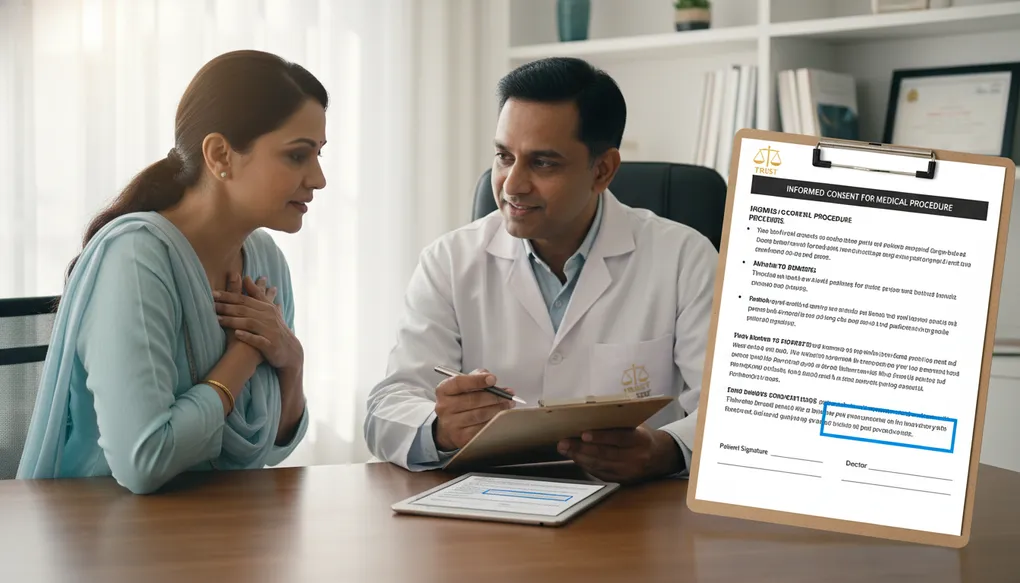
Consent and Procedure Notes
Generate comprehensive consent forms and procedure notes that protect both patients and practitioners—legally sound and patient-friendly.
“Doctor, main sign kar deta hoon, aap bolo kahan?”
How often do you hear this? The patient is ready to sign before you have even explained what the procedure involves. They trust you—and that trust is precious. But in 2026, informed consent is not just about trust. It is about legal protection, ethical practice, and genuine patient partnership.
The Consumer Protection Act 2019 treats medical services as consumer services. The MCI (now NMC) guidelines mandate documented informed consent. And every court case about medical negligence inevitably asks: “Was proper consent taken?”
Good consent documentation protects your patient AND you. Let us learn how to create it efficiently without spending 30 minutes per form.
What Problem This Solves
The Consent Crisis in Indian Clinics:
- Consent forms are often generic photocopies that say “I agree to everything”
- Patients sign without understanding what they are signing
- When complications occur, documentation gaps become legal nightmares
- Procedure notes are rushed, incomplete, or written days later
- Language barriers mean patients cannot truly give “informed” consent
The Documentation Burden:
- Writing comprehensive consent forms takes 20-30 minutes per procedure
- Each procedure has different risks to document
- Translating medical risks into patient-friendly language is time-consuming
- Procedure notes require specific details that are easy to forget
What AI-Assisted Drafting Solves:
- Creates consistent, comprehensive consent frameworks in minutes
- Ensures all essential elements are included (risks, benefits, alternatives, right to refuse)
- Generates patient-friendly explanations alongside technical documentation
- Produces procedure note templates that capture critical details
- Helps with multilingual versions for diverse patient populations
Important: AI generates the framework. You customize it for each specific patient and procedure, then verify every detail.
How to Do It (Steps)
Step 1: Understand What Makes Consent “Informed”
Before using AI, know what legally valid informed consent requires:
- Disclosure: All material risks, benefits, and alternatives explained
- Comprehension: Patient actually understands (not just heard)
- Voluntariness: No coercion, patient can refuse
- Competence: Patient is mentally capable of consenting
- Documentation: Written record with signatures and witness
Step 2: Use the RCTFC Formula (from Article B1)
Structure your consent prompts with:
- Role: Medical documentation assistant familiar with Indian medico-legal requirements
- Context: Procedure type, patient profile, setting
- Task: What specific document you need
- Format: Checklist, narrative, table, or combination
- Constraints: Legal requirements, language level, length limits
Step 3: Apply Format Control (from Article B2)
Specify exactly how you want the output:
- Risks table with “common vs rare” categorization
- Patient explanation in simple Hindi-English
- Checklist format for witness documentation
- Structured procedure note template
Step 4: Apply Medico-Legal Safe Drafting Principles (from Article C2)
Your consent documents must:
- Avoid absolute guarantees or success rates without evidence
- Use “shared decision-making” language
- Document that alternatives were discussed
- Note patient’s questions and your responses
- Include clear refusal documentation if patient declines anything
Step 5: Always Customize for the Specific Patient
AI gives you a framework. You must:
- Add patient-specific risk factors
- Adjust language for patient’s education level
- Include any unusual circumstances
- Verify all medical information is accurate
- Conduct the actual consent discussion yourself
Example Prompts
Prompt 1: Standard Surgical Consent Form
Role: Act as a medical documentation specialist familiar with Indian Consumer Protection Act requirements and NMC guidelines for informed consent.

Context: I am a general surgeon in a private hospital. I need a consent form for laparoscopic cholecystectomy (gallbladder removal surgery). Patient is a 45-year-old woman with cholelithiasis, no major comorbidities.

Task: Create a comprehensive informed consent document that covers all medico-legal requirements.

Format:
- Part A: Patient-friendly explanation (simple English, 8th standard level)
- Part B: Formal consent section with specific elements
- Part C: Witness documentation section
- Part D: Signature blocks

Include in Part B:
1. Nature of procedure (what will be done)
2. Indication (why it is needed)
3. Benefits of the procedure
4. Common risks (>1% occurrence)
5. Rare but serious risks (<1% but significant)
6. Alternatives including no treatment
7. Expected recovery timeline
8. Right to refuse or withdraw consent
9. Statement that questions were answered

Constraints:
- Follow Indian medico-legal standards
- Include space for patient to write questions asked
- Include interpreter/language section if applicable
- Do not guarantee outcomes
- Use phrasing like "may include" and "potential risks" rather than definitive statements
Prompt 2: High-Risk Procedure Consent
Role: Act as a medico-legal documentation expert specializing in high-risk procedure consent for Indian hospitals.

Context: I am a cardiologist. Patient is a 68-year-old male with triple vessel disease, diabetic, previous MI, scheduled for CABG (coronary artery bypass grafting). This is a high-risk case.

Task: Create an enhanced consent document appropriate for high-risk cardiac surgery, including special risk disclosure requirements.

Format:
- Section 1: Patient-friendly explanation of the condition and why surgery is recommended
- Section 2: Detailed risk disclosure table (categorized by likelihood and severity)
- Section 3: Specific risks related to patient's comorbidities
- Section 4: Alternative treatment options with comparative outcomes
- Section 5: What happens if surgery is not done
- Section 6: Post-operative expectations and recovery
- Section 7: Special high-risk acknowledgment
- Section 8: Family/next-of-kin involvement documentation
- Section 9: Signature section with mandatory witness

Constraints:
- This is a high-risk case—document extensively
- Include ICU stay expectations
- Include possibility of blood transfusion consent
- Include possibility of conversion to open procedure or extended surgery
- Document that family members were also counselled
- Use legally protective language without being alarmist
- Leave placeholders for specific statistics I will add from current literature
Prompt 3: Minor Procedure/OPD Consent
Role: Act as a clinic documentation assistant for an Indian outpatient setting.

Context: I run a dermatology clinic. I frequently do minor procedures: skin biopsies, mole removals, cryotherapy, electrocautery for warts. I need a template that can be quickly customized.

Task: Create a streamlined consent template for minor outpatient procedures that is comprehensive but not overwhelming.

Format:
- One-page format (front and back maximum)
- Fillable sections with checkboxes and blanks
- Patient-friendly language throughout
- Quick-reference risk checklist
- Signature section

Include:
1. Procedure name (blank to fill)
2. Site/location (blank to fill)
3. Anesthesia type (checkbox options: none, local, topical)
4. General risks for all minor procedures (bleeding, infection, scarring, pain)
5. Procedure-specific risks (blank section to add)
6. Aftercare summary
7. Follow-up instructions
8. Contact information for concerns
9. Patient confirmation checkboxes:
   [ ] Procedure explained to me
   [ ] Risks and benefits discussed
   [ ] My questions were answered
   [ ] I understand aftercare instructions
   [ ] I consent voluntarily

Constraints:
- Must fit on one page (front) or two pages maximum
- Simple language—many patients have basic education
- Include Hindi translation option or bilingual format
- Quick to complete in busy OPD setting
Prompt 4: Refusal of Treatment Documentation
Role: Act as a medico-legal documentation specialist for Indian healthcare settings.

Context: Patients sometimes refuse recommended treatment or investigations despite counselling. I need documentation that protects the clinic while respecting patient autonomy.

Task: Create a "Refusal of Treatment" documentation template that is legally protective.

Format:
- Section 1: What was recommended and why
- Section 2: What risks were explained about refusing
- Section 3: Patient's stated reason for refusal
- Section 4: Documentation that alternatives were offered
- Section 5: Clear statement of patient's decision
- Section 6: Signature section with witness

Include:
1. Recommended treatment/investigation (blank)
2. Medical indication and necessity (blank)
3. Risks of refusing (specific blanks for condition-related risks)
4. Alternative options offered (checklist + blanks)
5. Patient's understanding confirmation
6. Patient's voluntary refusal statement
7. Offer to reconsider documented
8. Follow-up advice despite refusal
9. Patient signature with date and time
10. Witness signature (mandatory)
11. Doctor's signature

Constraints:
- Language must show we respected patient autonomy
- Must clearly document that consequences were explained
- Include statement: "Patient was not coerced and makes this decision voluntarily"
- Leave space for patient to write their reason in their own words
- Include: "Patient may return to reconsider at any time"
- Avoid any language that could seem judgmental or coercive
Prompt 5: Procedure Note Template
Role: Act as a medical documentation assistant for surgical and procedural specialties in India.

Context: I am an orthopedic surgeon. After every procedure, I need to write a procedure note for the medical record. I want a comprehensive template that ensures I never miss important details.

Task: Create a detailed procedure note template for orthopedic surgeries that I can quickly fill in after any procedure.

Format:
Standard procedure note format with clearly labeled sections:

1. PATIENT IDENTIFICATION
2. PROCEDURE DETAILS
3. INDICATION
4. CONSENT VERIFICATION
5. PRE-PROCEDURE STATUS
6. ANESTHESIA
7. POSITIONING
8. PROCEDURE DESCRIPTION (step-by-step blanks)
9. FINDINGS
10. IMPLANTS/MATERIALS USED (with lot numbers)
11. SPECIMENS (if any)
12. BLOOD LOSS
13. COMPLICATIONS (including "None" option)
14. POST-PROCEDURE STATUS
15. POST-PROCEDURE ORDERS
16. SURGEON SIGNATURE

Constraints:
- Include checkbox options where appropriate for speed
- Include spaces for time stamps (start, end, anesthesia)
- Include implant details section with lot/batch numbers
- Include tourniquet time if applicable
- Include image/X-ray documentation note
- Leave detailed blanks for procedure description
- Professional medical language appropriate for records
Bad Prompt → Improved Prompt
Bad Prompt:
Write a consent form for surgery.What is wrong:
- No procedure specified
- No patient context
- No format requirements
- No legal/regulatory framework mentioned
- Output will be generic and possibly inappropriate for India
Improved Prompt:
Role: Act as a medical documentation specialist familiar with Indian Consumer Protection Act 2019 requirements, NMC (formerly MCI) guidelines, and standard medico-legal practices for informed consent in Indian hospitals.

Context:
- Procedure: Total knee replacement (TKR)
- Patient: 62-year-old female, diabetic, hypertensive, BMI 32
- Setting: Private multispecialty hospital in Pune
- Surgery scheduled in 5 days—adequate time for thorough consent process

Task: Create a comprehensive informed consent document for total knee replacement surgery.

Format:
Part A - Patient Information Sheet (can be given to take home):
- Simple explanation of the procedure in layman's terms
- Recovery timeline expectations
- Rehabilitation requirements
- Visual diagram description (where diagrams should be placed)

Part B - Formal Consent Document:
1. Procedure details and indication
2. Expected benefits
3. General surgical risks (anesthesia, infection, bleeding, DVT, PE)
4. Procedure-specific risks (implant loosening, stiffness, nerve injury, leg length discrepancy, need for revision)
5. Risks specific to this patient's comorbidities (diabetes—delayed healing, infection risk; obesity—increased complication rate)
6. Alternative treatments (conservative management, partial replacement, osteotomy)
7. Consequences of no treatment
8. Right to refuse and withdraw consent
9. Questions section

Part C - Documentation:
- Patient acknowledgment checkboxes
- Interpreter declaration (if used)
- Witness section
- Surgeon declaration
- Date, time, and signature blocks

Constraints:
- Follow Indian medico-legal standards
- Use "informed refusal" compliant language
- Include specific comorbidity-related risks for diabetic obese patient
- Do not promise specific outcomes or success rates
- Include statement about photographs/videos for documentation
- Include blood transfusion consent section
- Include statement about possibility of unexpected findings requiring extended procedure
- Patient-friendly language in Part A (10th standard English)
- Professional medical-legal language in Parts B and C
Common Mistakes
| Mistake | Why It Is Dangerous | How to Fix |
|---|---|---|
| Using generic photocopied consent | Does not disclose procedure-specific risks | Customize for each procedure type |
| Not documenting alternatives discussed | Court may say patient was not truly informed | Always list alternatives including “no treatment” |
| Consent taken by junior staff | The operating surgeon should take consent | Senior doctor must conduct consent discussion |
| Patient signs without explanation | ”Signed” is not “informed” | Document that discussion occurred, questions answered |
| No witness for high-risk procedures | Weakens legal standing | Always have independent witness sign |
| Consent taken under sedation/stress | Legally questionable capacity | Take consent well before procedure, in calm setting |
| Not documenting language/interpreter | Cannot prove patient understood | Note language used, interpreter name if applicable |
| Missing patient-specific risks | Comorbidities increase certain risks | Add section for individual risk factors |
| No documentation of refusal | If patient refuses and has complications, no protection | Always document when patients decline recommendations |
| Procedure note written days later | Memory fades, details lost, legally weak | Write immediately after procedure |
Clinic-Ready Templates
Template 1: Universal Consent Checklist (Pre-Procedure Verification)
CONSENT VERIFICATION CHECKLIST
[Use before ANY procedure]

Patient Name: _________________________ MRD: _____________
Procedure: _________________________ Date: _____________

PRE-CONSENT VERIFICATION:
[ ] Patient is alert and oriented
[ ] Patient is not under sedation or influence
[ ] Patient has had adequate time to consider (not rushed)
[ ] Language barrier: YES / NO
    If YES, Interpreter name: _________________________

CONSENT DISCUSSION COMPLETED:
[ ] Nature of procedure explained
[ ] Indication/reason explained
[ ] Benefits explained
[ ] Common risks explained
[ ] Rare serious risks explained
[ ] Patient-specific risks explained: _________________________
[ ] Alternatives explained including no treatment
[ ] Recovery expectations explained
[ ] Right to refuse explained
[ ] Patient questions answered: _________________________

DOCUMENTATION:
[ ] Written consent form signed
[ ] Patient copy provided
[ ] Witness signature obtained
[ ] Consent form filed in medical record

Verified by: Dr. _________________________ Time: _______
Template 2: Procedure Note Quick Template
PROCEDURE NOTE

Date: _____________ Time Start: _______ Time End: _______

PATIENT: [NAME] | [AGE/SEX] | MRD: [NUMBER]

PROCEDURE: _________________________

INDICATION: _________________________

SURGEON: Dr. _________________________
ASSISTANT: _________________________
ANESTHESIA: [ ] Local [ ] Regional [ ] General
ANESTHETIST: Dr. _________________________

CONSENT: Verified [ ] Written consent in file [ ]

PRE-PROCEDURE:
Vitals stable: YES / NO
Site marking: Done [ ] N/A [ ]

PROCEDURE DESCRIPTION:
Position: _________________________
Prep/Drape: Standard sterile technique
Approach: _________________________

Steps performed:
1. _________________________
2. _________________________
3. _________________________
4. _________________________
5. _________________________

FINDINGS: _________________________

SPECIMENS SENT: [ ] None [ ] Yes: _________________________

IMPLANTS/MATERIALS: [ ] None [ ] Yes:
Item: _____________ Lot#: _____________ Exp: _____________

ESTIMATED BLOOD LOSS: _______ ml

COMPLICATIONS: [ ] None [ ] Yes: _________________________

POST-PROCEDURE STATUS:
Patient condition: Stable / Observation required
Vitals: _________________________
Drain/Catheter: _________________________

POST-PROCEDURE ORDERS:
- _________________________
- _________________________
- _________________________

SURGEON SIGNATURE: _________________________ DATE/TIME: _______
Template 3: High-Risk Consent Supplement
HIGH-RISK PROCEDURE ACKNOWLEDGMENT
[Attach to standard consent form]

Patient: _________________________ Procedure: _________________________

This procedure has been identified as HIGH-RISK due to:
[ ] Complexity of procedure
[ ] Patient's medical conditions: _________________________
[ ] Advanced age (>70 years)
[ ] Emergency nature
[ ] Other: _________________________

ADDITIONAL RISK DISCLOSURE:

Due to the above factors, I understand that this procedure carries HIGHER than usual risks including:

1. _________________________
2. _________________________
3. _________________________
4. _________________________

I understand that despite the best care:
[ ] Complications may occur that require additional treatment
[ ] ICU admission may be required
[ ] Extended hospital stay may be necessary
[ ] The outcome cannot be guaranteed
[ ] There is a risk of serious disability or death

FAMILY INVOLVEMENT:
Family member present during consent discussion:
Name: _________________________ Relationship: _____________
Contact: _________________________

PATIENT STATEMENT:
"I have been informed about the higher risks of this procedure given my condition. I have had adequate time to consider my options. My questions have been answered. I voluntarily consent to proceed."

Patient Signature: _________________________ Date: _______ Time: _______
Witness Signature: _________________________ Date: _______ Time: _______
Doctor Signature: _________________________ Date: _______ Time: _______
Safety Note
Critical Medico-Legal Warnings:
-
AI Creates Templates, Not Legal Documents Every consent form must be reviewed by you for accuracy. AI does not know your specific patient’s history, current guidelines, or your institution’s policies. You are legally responsible for every word in the consent document.
-
Consent is a Process, Not a Form The signed paper is documentation of a DISCUSSION you had. Never let patients sign without actual verbal explanation. Courts assess whether true “informed consent” occurred, not just whether a form was signed.
-
Consumer Protection Act 2019 Implications Medical services fall under consumer protection. “Deficiency in service” includes inadequate consent. Compensation claims often succeed when consent documentation is poor.
-
NMC (National Medical Commission) Requirements
- Consent must be specific to the procedure
- Consent must be voluntary and informed
- Documentation must be adequate
- Special consent needed for: surgeries, anesthesia, HIV testing, procedures on minors
-
High-Risk Situations Require Extra Care
- Emergency procedures: Document why waiting for detailed consent was not possible
- Patients with limited capacity: Involve legal guardian, document carefully
- Language barriers: Use interpreter, document their involvement
- Refusal of treatment: Document extensively, have witness
-
Never Include in AI Prompts
- Real patient names or identifiers
- Actual MRD numbers or dates
- Specific identifying details Use [PATIENT NAME], [DATE], [MRD] placeholders, then fill in actual details on the final document.
-
When in Doubt Consult your hospital’s legal/medicolegal department. For unusual or high-risk cases, having legal review of consent documents is prudent.
Copy-Paste Prompts
Prompt A: Quick Procedure Consent Generator
Role: Act as a medical documentation assistant familiar with Indian medico-legal requirements for informed consent.

Context: I need a consent form for [PROCEDURE NAME] for a [AGE]-year-old [MALE/FEMALE] patient. Relevant conditions: [LIST COMORBIDITIES OR "NONE"].

Task: Create an informed consent document.

Format:
- Patient-friendly explanation (100 words)
- Formal consent with: indication, benefits, common risks, rare serious risks, alternatives, right to refuse
- Signature section with witness

Constraints:
- Follow Indian Consumer Protection Act standards
- Use simple English (8th standard level)
- Do not guarantee outcomes
- Include patient-specific risks if comorbidities mentioned
Prompt B: Procedure Note Generator
Role: Act as a medical documentation assistant.

Context: I just completed [PROCEDURE NAME] on [AGE/SEX] patient. Key details: [BRIEF PROCEDURE SUMMARY]. Findings: [MAIN FINDINGS]. Complications: [NONE/DESCRIBE].

Task: Create a formal procedure note for medical records.

Format: Standard procedure note with: patient ID section, procedure details, indication, consent verification, anesthesia, step-by-step description, findings, specimens, materials used, blood loss, complications, post-procedure status, orders, signature line.

Constraints:
- Professional medical documentation language
- Include all standard medico-legal elements
- Leave [BLANK] for details I will fill in
- Include time stamps
Prompt C: Refusal of Treatment Documentation
Role: Act as a medico-legal documentation specialist for Indian healthcare.

Context: Patient is refusing [RECOMMENDED TREATMENT/TEST] for [CONDITION]. They have been counselled about risks.

Task: Create a refusal of treatment documentation form.

Format:
- What was recommended and why
- Risks explained about refusing
- Patient's stated reason (blank for them to write)
- Confirmation of understanding
- Voluntary refusal statement
- Signature section with mandatory witness

Constraints:
- Protect clinic legally while respecting patient autonomy
- Non-judgmental language
- Include offer to reconsider
- Document that consequences were clearly explained
Prompt D: Bilingual Consent Explanation
Role: Act as a patient educator who can communicate in both English and [HINDI/TAMIL/TELUGU/MARATHI/OTHER].

Context: Patient needs [PROCEDURE NAME] but has limited English. I need a patient-friendly explanation in simple language.

Task: Create a bilingual explanation of the procedure, risks, benefits, and recovery that I can use during consent discussion.

Format:
- Simple explanation in English (left column)
- Translation in [LANGUAGE] (right column)
- Key medical terms with pronunciation guide
- Visual description suggestions (where diagrams would help)

Constraints:
- 6th-8th standard reading level
- Avoid medical jargon—use everyday words
- Include "questions to ask your doctor" section
- Reassuring but honest tone
Prompt E: Post-Procedure Patient Instructions
Role: Act as a patient educator for an Indian hospital.

Context: Patient just had [PROCEDURE NAME]. They are being discharged and need clear home care instructions.

Task: Create post-procedure instruction sheet for patient to take home.

Format:
- What was done (simple explanation)
- Day-by-day recovery expectations
- Wound/site care instructions
- Medications list format (blank to fill)
- Activity restrictions with timeline
- Diet instructions (Indian food examples)
- Warning signs requiring immediate hospital visit
- Follow-up appointment reminder
- Emergency contact numbers (blank)

Constraints:
- Simple English (8th standard)
- Bullet points for easy reading
- Include both DO and DO NOT sections
- Must fit on one page (front and back)
- Include space for patient to write questions
Do’s and Don’ts
DO:
- Use AI to create comprehensive frameworks, then customize for each patient
- Include all legally required elements: risks, benefits, alternatives, right to refuse
- Document that a discussion occurred, not just that a form was signed
- Take consent yourself (the operating/treating doctor), not through junior staff
- Use witnesses for all surgical and high-risk procedures
- Keep language simple—consent means nothing if patient does not understand
- Document patient-specific risks based on their comorbidities
- Create procedure-specific consent forms, not generic “I agree to everything” forms
- Write procedure notes immediately after the procedure while details are fresh
- Save your best templates for reuse and continuous improvement
- Review AI output for accuracy before every use
DON’T:
- Share real patient information with AI tools—use placeholders
- Use generic consent forms for specific procedures
- Let patients sign without verbal explanation
- Take consent when patient is sedated, in pain, or under stress
- Forget to document when patients refuse recommended treatment
- Promise outcomes or give success rate guarantees
- Skip the witness signature for surgical procedures
- Write procedure notes from memory days later
- Copy AI-generated consent forms without customizing for your patient
- Assume AI knows current Indian medico-legal requirements—verify everything
- Use consent documentation as a legal shield without actually informing the patient
1-Minute Takeaway
The Core Principle: Informed consent is a PROCESS (discussion) that is DOCUMENTED (form). AI helps you document thoroughly—but you must conduct the actual conversation.
The Legal Reality:
- Consumer Protection Act 2019 covers medical services
- Courts examine whether consent was truly “informed”
- Good documentation protects you; poor documentation exposes you
The Five Essentials:
- Disclosure — Risks, benefits, alternatives clearly explained
- Comprehension — Patient understood (use simple language, check understanding)
- Voluntariness — Patient can refuse without pressure
- Capacity — Patient is mentally capable of deciding
- Documentation — Written record with signatures and witness
Using AI Effectively:
- Generate comprehensive frameworks quickly
- Ensure no critical element is missed
- Create patient-friendly explanations in local languages
- Build reusable templates for common procedures
- Always customize for specific patient and verify accuracy
The Non-Negotiable: Every AI-generated consent document must be reviewed, customized for your specific patient, and accompanied by an actual discussion with the patient. The signature on paper means nothing if true informed consent did not occur.
Quick Quality Check: Before any procedure, ask yourself:
- Did I explain in words the patient understood?
- Does the patient know the main risks?
- Did I mention alternatives including doing nothing?
- Does the patient know they can refuse or change their mind?
- Is everything documented with witness signature?
If yes to all five, you have achieved proper informed consent.
Next article: Learn to create crisp discharge summaries and effective referral letters that communicate clearly with colleagues and patients.