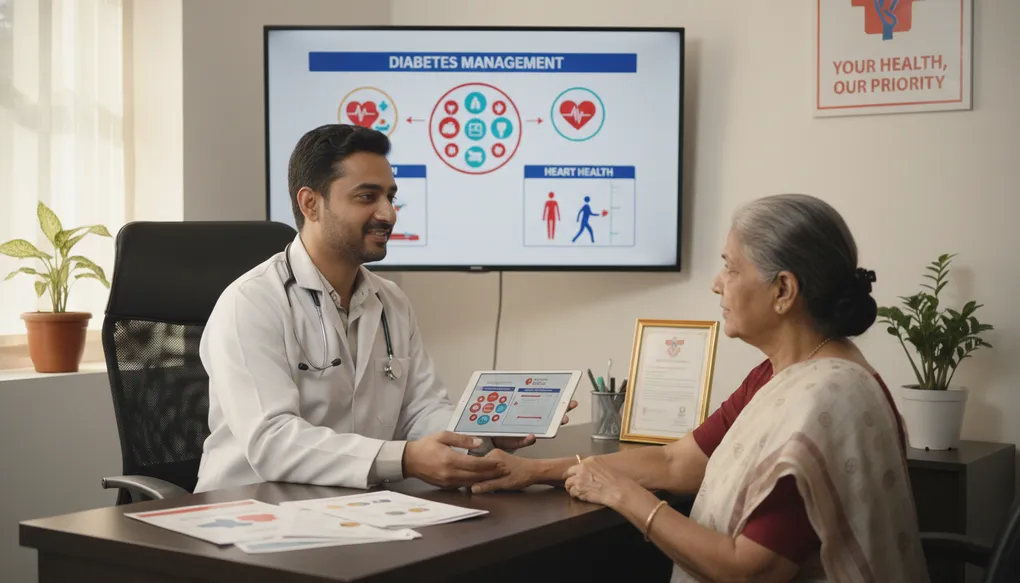
Chronic Disease Counselling Scripts
Generate comprehensive counselling scripts for diabetes, hypertension, and other chronic diseases—consistent, thorough patient education every time.
Good chronic disease management is 20% medication and 80% patient education. But delivering consistent, thorough counselling for every diabetic, every hypertensive, every thyroid patient—while managing a packed OPD—is nearly impossible. AI can help you prepare comprehensive, culturally appropriate counselling scripts that ensure no critical point is missed.
This guide builds on D2 - Patient Education Materials with detailed scripts specifically for chronic disease counselling.
What Problem This Solves
The counselling gap: A newly diagnosed diabetic needs to understand diet, exercise, medication timing, hypoglycemia signs, foot care, eye checkups, and more. Explaining all this thoroughly takes 30-45 minutes. Most doctors have 5-10 minutes per patient.
Inconsistent education: Monday’s diabetic gets detailed diet advice. Friday’s diabetic—when you’re exhausted—gets “avoid sweets, take medicines regularly.” Both deserve the same thorough care.
Cultural blind spots: Generic counselling materials talk about “whole grains and lean proteins.” Your patients eat roti, rice, dal, and sabzi. They fast during Navratri. They celebrate Diwali with mithai. They need advice that fits their actual lives.
Myth management: “Karela juice cures diabetes.” “BP medicines damage kidneys.” “Thyroid medicine is addictive.” You spend precious consultation time debunking the same myths repeatedly.
AI-generated counselling scripts give you:
- Comprehensive coverage of all essential points
- India-specific dietary and lifestyle advice
- Culturally sensitive guidance (festivals, fasting, family meals)
- Myth-busting sections tailored to common misconceptions
- Consistent quality whether it’s your first patient or fiftieth
How to Do It (Steps)
Step 1: Identify the Counselling Scenario
Different situations need different scripts:
| Scenario | Focus Areas |
|---|---|
| New diagnosis | Disease explanation, lifestyle changes, medication introduction, emotional support |
| Routine follow-up | Reinforcement, troubleshooting, medication adherence, complication screening |
| Poor control | Identifying barriers, intensifying education, addressing non-compliance |
| Pre-festival | Managing diet during celebrations, medication adjustments |
| Fasting guidance | Safe fasting practices, medication timing changes |
Step 2: Specify Patient Context
Include relevant details:
- Age and life stage (working adult, homemaker, elderly)
- Education level and health literacy
- Family situation (who cooks, who supports)
- Specific concerns or barriers mentioned
- Comorbidities affecting advice
Step 3: Request Structured Output
Ask for organized sections:
- Key messages (what patient MUST remember)
- Detailed explanations (for those who want to understand)
- Practical action items (what to DO)
- Warning signs (when to seek help)
- Common questions and answers
Step 4: Review and Personalize
AI gives you the comprehensive framework. You add:
- Patient’s specific test values
- Personalized targets
- Local resource recommendations
- Follow-up schedule
- Your clinical judgment on priorities
Example Prompts
Example 1: New Type 2 Diabetes Diagnosis
Create a comprehensive counselling script for a newly diagnosed Type 2 diabetic patient in India.

Patient profile:
- 48-year-old male, office worker
- HbA1c: 8.2%, FBS: 156 mg/dL
- BMI: 27, sedentary lifestyle
- North Indian, vegetarian
- Wife cooks all meals
- Concerned and anxious about diagnosis

Structure the script with:
1. Reassurance and disease explanation (simple terms)
2. Diet modifications with specific Indian food examples
   - What to reduce (with portions, not just "avoid")
   - What to increase
   - Meal timing importance
   - Rice/roti guidance
3. Physical activity recommendations (practical for desk job)
4. Medication explanation (Metformin 500mg BD)
   - How it works
   - When to take
   - Common side effects and management
5. Self-monitoring guidance
6. Hypoglycemia awareness (even though on Metformin)
7. Foot care basics
8. Warning signs requiring immediate attention
9. Follow-up schedule and tests needed
10. Addressing common myths:
    - "Diabetes means no rice ever"
    - "Karela/jamun/methi will cure diabetes"
    - "Once on medicine, always on medicine is bad"
11. Involving family (what wife needs to know)

Use reassuring, non-judgmental tone. Include specific quantities where helpful (e.g., "1 medium katori rice" rather than "limit rice").
Example 2: Hypertension Counselling with Comorbidities
Generate a counselling script for hypertension management.

Patient details:
- 55-year-old female, homemaker
- BP: 156/94 mmHg (average of last 3 readings)
- Also has Type 2 diabetes (controlled, HbA1c 6.8%)
- Overweight, knee pain limits exercise
- South Indian, non-vegetarian
- Lives in joint family, cooks for everyone
- Believes BP medicines will damage her kidneys

Cover:
1. Explaining hypertension and its silent danger
2. Connection between BP and diabetes (why control matters more)
3. DASH-style diet adapted for South Indian cuisine
   - Salt reduction strategies (specific to sambar, rasam, pickles)
   - Coconut and oil guidance
   - Fish recommendations (good choices)
4. Exercise options suitable for someone with knee problems
5. Medication counselling (Telmisartan 40mg)
   - Actually PROTECTS kidneys in diabetics
   - Address her specific fear with evidence
6. Home BP monitoring guidance
   - Technique
   - Timing
   - What readings to report
7. Stress and BP connection
8. Managing BP during cooking for whole family
   - How to make family meals that work for her
9. Warning signs of very high BP or complications
10. Myths to address:
    - "BP medicine damages kidneys"
    - "I feel fine, so my BP is fine"
    - "I can stop medicine when BP is normal"

Empathetic tone acknowledging her caregiver role and concerns.
Example 3: Thyroid Disorder - Hypothyroidism
Create patient counselling content for hypothyroidism.

Patient: 32-year-old woman, software professional
- TSH: 12.4 mIU/L (newly diagnosed)
- Symptoms: fatigue, weight gain, hair fall, irregular periods
- Trying to conceive
- Very anxious, has read scary things online
- Worried thyroid medicine is "lifelong addiction"

Include:
1. Simple explanation of thyroid function
   - Analogy that makes sense (thermostat, etc.)
2. Why her symptoms make sense now
3. Levothyroxine counselling:
   - How to take (empty stomach, 30-60 min before food)
   - What interferes (calcium, iron, tea, coffee)
   - Why it's replacement, not addiction
   - Safety in pregnancy (actually essential!)
4. What will improve with treatment (and timeline)
5. Weight management realistic expectations
6. Diet considerations:
   - Goitrogens (soy, cruciferous) - moderate, don't panic
   - Iodine - regular iodized salt is fine
   - No need for special "thyroid diet"
7. Fertility and pregnancy:
   - Good control helps conception
   - Continue medicine in pregnancy
   - Regular monitoring needed
8. Myths to address:
   - "Thyroid medicine is addictive"
   - "Thyroid means I'll always be fat"
   - "Natural remedies can cure thyroid"
   - "Cabbage/cauliflower is poison for thyroid"
9. Monitoring schedule
10. When to contact doctor (symptoms of over/under treatment)

Reassuring tone - emphasize this is very treatable and she can have normal life and pregnancy.
Example 4: PCOS Counselling for Young Patient
Develop counselling script for PCOS (Polycystic Ovary Syndrome).

Patient: 22-year-old college student
- Irregular periods (cycles 45-90 days)
- Acne, facial hair concerns (very distressed)
- BMI: 26
- Ultrasound shows polycystic ovaries
- Not currently trying to conceive
- Mother has diabetes
- Worried she "can never have children"

Structure:
1. Explaining PCOS simply
   - Not a disease, a syndrome (collection of features)
   - Very common (1 in 10 women)
   - Manageable, not a life sentence
2. Addressing her biggest concerns first:
   - Fertility reassurance (most women with PCOS conceive)
   - Cosmetic concerns are treatable
3. Lifestyle as primary treatment:
   - Weight loss impact (even 5% helps)
   - Exercise recommendations for PCOS
   - Diet approach (focus on whole foods, not restriction)
   - Indian diet modifications (reduce refined carbs)
4. Medications explained:
   - Metformin: how it helps PCOS
   - OCP for cycle regulation and acne
5. Managing cosmetic symptoms:
   - Medical options for hirsutism
   - What works, what doesn't
   - Timeline for improvement
6. Long-term health awareness:
   - Diabetes risk (family history makes it higher)
   - Why lifestyle matters now for future
7. Mental health acknowledgment:
   - PCOS and mood/anxiety connection
   - It's okay to feel frustrated
8. Myths:
   - "PCOS means infertility"
   - "It's because of something I did wrong"
   - "Only overweight women get PCOS"
9. When she'll need to think about fertility
10. Follow-up plan

Sensitive tone - acknowledge body image concerns without dismissing them.
Example 5: CKD Stage 3 - Initial Counselling
Create counselling script for early Chronic Kidney Disease.

Patient: 60-year-old male
- eGFR: 45 mL/min (CKD Stage 3a)
- Has diabetes (15 years) and hypertension (10 years)
- Current creatinine: 1.6 mg/dL
- Microalbuminuria present
- Very scared after being told he has "kidney disease"
- Asking about dialysis

Cover:
1. Reassurance first:
   - Stage 3 is NOT kidney failure
   - Many people stay at this stage for years
   - Dialysis is not imminent
2. Explaining kidney function simply
   - What eGFR means
   - Why we caught this early (good thing!)
3. Why this happened (diabetes + BP connection)
4. How to SLOW progression (empowering message):
   - BP control (target <130/80)
   - Diabetes control (HbA1c <7%)
   - These are most important!
5. Medication adjustments:
   - ACE inhibitor/ARB importance (kidney protection)
   - Medications to avoid (NSAIDs!)
   - Dose adjustments that may be needed
6. Diet modifications:
   - Protein: moderate (not severe restriction at Stage 3)
   - Salt: reduction important
   - Potassium: usually okay at this stage
   - Indian diet specifics (dal portions, salt in pickles/papad)
7. What to avoid:
   - NSAIDs (Brufen, Voveran, etc.) - list common brands
   - Unnecessary contrast dyes
   - Herbal supplements (many are nephrotoxic)
8. Monitoring schedule:
   - How often to check creatinine/eGFR
   - When to see nephrologist
9. Warning signs to watch for
10. Myths:
    - "Drinking lots of water flushes kidneys"
    - "Kidney disease = dialysis soon"
    - "All BP medicines harm kidneys"

Tone: Serious but not scary. Emphasize what's in his control.
Bad Prompt → Improved Prompt
Example 1: Diabetes Counselling
Bad Prompt:
Give me diabetes counselling points.Why it’s bad: No patient context, no structure, will get generic Western-focused advice.
Improved Prompt:
Create a diabetes counselling script for a newly diagnosed Type 2 diabetic.

Patient: 52-year-old female, housewife, South Indian
- HbA1c: 9.1%
- Vegetarian
- Husband and in-laws also eat meals she cooks
- Main concern: "Can I ever eat rice again?"
- Believes: "Diabetes came because of tension"

Include:
1. Reassurance and realistic expectations
2. South Indian diet modifications:
   - Rice strategies (not elimination)
   - Healthier sambar, rasam, poriyal tips
   - Tiffin modifications (dosa, idli, upma)
   - Coffee/tea guidance
3. Exercise suitable for homemaker
4. Medication adherence importance
5. Addressing her specific concern about rice
6. Correcting the "tension caused diabetes" belief gently
7. When to check sugar and what values mean
8. Warning signs

Practical, specific advice she can implement tomorrow.
Example 2: Hypertension Script
Bad Prompt:
Blood pressure patient education material.Why it’s bad: Could be prevention, could be treatment. No patient details.
Improved Prompt:
Generate counselling script for resistant hypertension.

Patient: 58-year-old male, businessman
- On 3 antihypertensives, BP still 150/95
- High stress, irregular meals, travels frequently
- Admits to missing doses when traveling
- High salt intake (loves pickles, papad, namkeen)
- Skeptical that "so many medicines" are needed

Cover:
1. Why BP isn't controlled (honestly discuss adherence)
2. Dangers of uncontrolled BP (stroke, heart, kidney) - make it real
3. Salt reduction strategies for someone who travels:
   - Restaurant choices
   - Travel-friendly low-salt snacks
   - Pickle/papad reduction strategy (gradual)
4. Medication adherence solutions:
   - Pill organizers
   - Phone reminders
   - What to do if dose missed
5. Why multiple medicines aren't "too much"
6. Stress management practical tips
7. Home monitoring during travel
8. Convincing someone skeptical (evidence-based approach)

Direct but respectful tone for educated patient.
Common Mistakes
Mistake 1: Generic Diet Advice
Wrong approach: “Eat whole grains, lean proteins, and vegetables. Avoid processed foods.”
Right approach: “Replace white rice with hand-pounded rice or reduce portion to 1 katori. Add more dal and sabzi to feel full. Choose roti made from mixed flour (wheat + jowar/bajra). For snacks, try roasted chana instead of namkeen.”
Mistake 2: Ignoring Cultural Food Practices
Wrong approach: Not mentioning festivals, fasting, or family eating patterns.
Right approach: “During Diwali, have 1-2 small pieces of mithai right after a meal rather than on empty stomach. During Navratri fasting, avoid fried foods like kuttu puri—try kuttu roti instead. When eating with family, serve yourself first with more vegetables, then take smaller portions of rice/roti.”
Mistake 3: All-or-Nothing Messaging
Wrong approach: “Never eat rice.” / “No sweets ever.” / “Stop all oil.”
Right approach: “Reduce rice from 2 katoris to 1 katori. Have sweets occasionally (once a week), small portion, after meals. Use 2-3 teaspoons oil per person per day for cooking.”
Mistake 4: Skipping Medication Fears
Wrong approach: Just explaining how to take medicine without addressing concerns.
Right approach: “Many patients worry that BP medicine damages kidneys. Actually, uncontrolled BP damages kidneys, and medicines like Telmisartan protect them—especially if you have diabetes. Taking medicine regularly is protecting your kidneys, not harming them.”
Mistake 5: Forgetting the Family
Wrong approach: Giving advice assuming patient controls all their food choices.
Right approach: “Ask your wife to join next visit—she needs to understand why less salt helps. You can make one meal for everyone—just keep salt, pickle, papad on the side for others to add. You don’t need separate cooking.”
Mistake 6: Information Overload in One Session
Wrong approach: Trying to cover everything in first counselling session.
Right approach: “Today let’s focus on medicine and basic diet changes. Next visit we’ll discuss exercise and foot care in detail. Don’t worry about remembering everything—we’ll go step by step.”
Clinic-Ready Templates
Template 1: Initial Diagnosis Counselling (Any Chronic Disease)
Generate initial diagnosis counselling script.

DISEASE: [DIABETES/HYPERTENSION/THYROID/PCOS/CKD]

PATIENT PROFILE:
- Age/Gender: [AGE] [MALE/FEMALE]
- Occupation: [JOB/HOMEMAKER/RETIRED/STUDENT]
- Key values: [RELEVANT LAB VALUES]
- Region/Diet type: [NORTH/SOUTH INDIAN] [VEG/NON-VEG]
- Family situation: [WHO COOKS, LIVES WITH WHOM]
- Main concern expressed: [PATIENT'S BIGGEST WORRY]
- Beliefs/misconceptions noted: [ANY MYTHS THEY MENTIONED]

STARTING MEDICATIONS: [LIST WITH DOSES]

Generate counselling script covering:
1. Disease explanation in simple Hindi/English terms
2. Why lifestyle changes are as important as medicine
3. Top 5 diet modifications specific to their food habits
4. Realistic physical activity recommendations
5. Medication: how to take, why it helps, side effects to expect
6. What will improve and when (realistic timeline)
7. Self-monitoring guidance
8. Warning signs requiring immediate attention
9. Addressing their specific concern/myth
10. Family involvement points
11. Follow-up schedule

Tone: Reassuring but honest. Patient should leave feeling empowered, not scared.
Time: Script should be deliverable in 15-20 minutes.
Template 2: Follow-Up Counselling (Poor Control)
Create follow-up counselling script for poor disease control.

CONDITION: [DISEASE]
CONTROL STATUS: [E.G., HBA1C 9.2% (WAS 8.5%), BP 160/100 DESPITE MEDS]

PATIENT: [AGE/GENDER/OCCUPATION]
TIME SINCE DIAGNOSIS: [DURATION]
CURRENT MEDICATIONS: [LIST]

IDENTIFIED ISSUES:
- Adherence: [GOOD/POOR - SPECIFY WHICH MEDS]
- Diet: [SPECIFIC PROBLEMS NOTED]
- Exercise: [CURRENT STATUS]
- Other factors: [STRESS/ILLNESS/TRAVEL/ETC.]

PATIENT'S EXPLANATION: [WHAT THEY SAY ABOUT POOR CONTROL]

Generate script that:
1. Opens non-judgmentally (no shaming)
2. Explores barriers honestly (ask before telling)
3. Explains consequences of poor control (motivate without terrorizing)
4. Identifies 2-3 achievable changes (not everything at once)
5. Problem-solves specific barriers mentioned
6. Discusses medication intensification if needed
7. Sets realistic short-term targets
8. Creates accountability plan
9. Schedules closer follow-up
10. Ends with confidence in patient's ability to improve

Tone: Supportive partner, not disappointed parent.
Template 3: Festival/Fasting Guidance
Create [FESTIVAL/FASTING] guidance for chronic disease patient.

OCCASION: [DIWALI/HOLI/NAVRATRI/EID/PONGAL/RAMADAN/KARVA CHAUTH/OTHER]
DURATION: [ONE DAY/NINE DAYS/ONE MONTH/ETC.]

PATIENT'S CONDITION(S): [LIST ALL]
CURRENT MEDICATIONS: [LIST WITH TIMING]
CONTROL STATUS: [WELL-CONTROLLED/MODERATE/POOR]

PATIENT'S PLAN: [WHAT THEY WANT TO DO - FAST/FEAST/BOTH]
CULTURAL IMPORTANCE: [HOW IMPORTANT IS THIS TO THEM]

Generate guidance covering:
1. General safety assessment (is fasting safe for them?)
2. If fasting is okay:
   - Medication timing adjustments
   - What to eat during eating windows
   - Hydration guidance
   - Blood sugar monitoring (if diabetic)
   - Warning signs to break fast
3. If fasting is risky:
   - Gentle explanation why
   - Modified fasting options that are safer
   - Religious exemption discussion (many faiths exempt the sick)
4. Festival food navigation:
   - What to enjoy in moderation
   - Portion strategies
   - Better choices among traditional foods
5. Medication adjustments if any
6. When to check in with doctor
7. What to do if they feel unwell

Respectful of religious/cultural importance while prioritizing safety.
Template 4: Myth-Busting Session
Create myth-busting counselling content for [CONDITION].

COMMON MYTHS IN INDIAN CONTEXT FOR THIS CONDITION:
[LIST 5-7 MYTHS YOU COMMONLY HEAR]

For each myth, provide:
1. The myth stated clearly
2. Why patients believe it (acknowledge the logic)
3. The truth explained simply
4. Evidence/analogy that makes sense
5. What to do instead

Also include:
- Why misinformation spreads (WhatsApp, well-meaning relatives)
- How to evaluate health information
- Reliable sources for patient education
- How to politely handle advice from relatives

Tone: Respectful of patient's intelligence, not condescending.
Not "you're wrong" but "let me explain why this isn't quite right"
Safety Note
These scripts are educational frameworks, not replacements for clinical judgment.
Always remember:
-
Individualize everything: A script is a starting point. Adjust for patient’s specific values, comorbidities, and circumstances.
-
Verify medication information: Double-check doses, interactions, and contraindications for each patient. AI can make errors with specific drug information.
-
Cultural sensitivity varies: Not all Indian patients are the same. Urban/rural, region, religion, and individual preferences all matter.
-
Update your knowledge: AI training has cutoff dates. Verify recommendations against current guidelines, especially for newer medications.
-
Complex cases need specialists: AI scripts work well for straightforward chronic disease management. Refer complex cases appropriately.
-
Emergency recognition: Always ensure patients know warning signs. A counselling script should never delay emergency care.
-
Mental health matters: Chronic disease takes psychological toll. Be alert to depression, anxiety, and disordered eating. AI scripts may miss these nuances.
When in doubt, trust your clinical training over any AI-generated content.
Copy-Paste Prompts
Prompt 1: Comprehensive Diabetes Counselling
Create comprehensive Type 2 diabetes counselling script.

Patient: [AGE]-year-old [MALE/FEMALE], [OCCUPATION]
Diagnosis: [NEW/KNOWN FOR X YEARS]
HbA1c: [VALUE]%, FBS: [VALUE] mg/dL
BMI: [VALUE]
Medications: [LIST WITH DOSES]
Diet: [NORTH/SOUTH INDIAN], [VEG/NON-VEG]
Family: [WHO COOKS, LIVING SITUATION]
Main concerns: [PATIENT'S QUESTIONS/WORRIES]
Misconceptions noted: [ANY MYTHS]

Cover all these areas:
1. Disease explanation (simple, non-scary)
2. Diet modifications with specific Indian food examples and portions
3. Physical activity (practical for their lifestyle)
4. Medication guidance (timing, food interactions, side effects)
5. Blood sugar monitoring (when, targets, what readings mean)
6. Hypoglycemia recognition and treatment
7. Foot care essentials
8. Eye and kidney screening importance
9. Sick day management
10. Festival/fasting guidance
11. Myth correction
12. Family education points
13. Warning signs for emergency
14. Follow-up schedule

Make it practical with specific examples, not generic advice.
Prompt 2: Hypertension Counselling Script
Generate hypertension counselling script.

Patient: [AGE]-year-old [MALE/FEMALE], [OCCUPATION]
BP: [VALUE] mmHg (average of recent readings)
Duration: [NEW/KNOWN FOR X YEARS]
Comorbidities: [DIABETES/KIDNEY DISEASE/HEART DISEASE/NONE]
Medications: [LIST WITH DOSES]
Lifestyle: [ACTIVITY LEVEL, STRESS, SMOKING, ALCOHOL]
Salt intake: [HIGH/MODERATE/LOW - SPECIFIC SOURCES]
Diet pattern: [REGION, VEG/NON-VEG]
Concerns: [PATIENT'S WORRIES - OFTEN MEDICATION FEARS]

Include:
1. Why BP matters (silent killer explanation)
2. BP targets for this patient
3. Salt reduction strategies (specific to their high-salt sources)
4. DASH-style diet adapted for Indian foods
5. Weight management if applicable
6. Exercise recommendations
7. Stress management practical tips
8. Medication: how it works, why it's safe, adherence importance
9. Home BP monitoring technique and schedule
10. Alcohol/smoking cessation if applicable
11. Common myths addressed
12. Warning signs (hypertensive emergency)
13. Why lifelong treatment is okay
14. Follow-up plan
Prompt 3: Thyroid Counselling (Hypo/Hyper)
Create thyroid counselling script for [HYPOTHYROIDISM/HYPERTHYROIDISM].

Patient: [AGE]-year-old [MALE/FEMALE]
TSH: [VALUE], T3/T4: [VALUES IF RELEVANT]
Symptoms: [LIST MAIN SYMPTOMS]
New diagnosis or known: [STATUS]
Medication: [LEVOTHYROXINE DOSE / ANTI-THYROID DRUG]
Special situations: [PREGNANCY PLANNING/PREGNANT/NONE]
Main concerns: [PATIENT'S WORRIES]
Misconceptions: [COMMON ONES: LIFELONG MEDICINE, WEIGHT, DIET FEARS]

Cover:
1. Simple thyroid explanation (use good analogy)
2. Why their symptoms make sense
3. Medication:
   - Exact instructions (timing, food interactions)
   - What interferes with absorption
   - Why it's replacement therapy, not addiction
   - How long until improvement
4. Diet truths:
   - Goitrogens: real advice (not fear-mongering)
   - Iodine: what's actually needed
   - No special expensive "thyroid diet" needed
5. Weight expectations (realistic)
6. Hair/skin improvement timeline
7. If planning pregnancy: importance of control, safety of meds
8. Monitoring schedule
9. Symptoms of over/under replacement
10. Myth-busting specific to their concerns
11. When to contact doctor
Prompt 4: PCOS Comprehensive Counselling
Generate PCOS counselling script.

Patient: [AGE]-year-old [FEMALE]
Presentation: [IRREGULAR PERIODS/HIRSUTISM/ACNE/INFERTILITY/WEIGHT]
BMI: [VALUE]
Ultrasound findings: [SUMMARY]
Hormonal values: [IF RELEVANT]
Trying to conceive: [YES/NO/FUTURE PLANS]
Main distressing symptoms: [WHAT BOTHERS HER MOST]
Concerns: [FERTILITY FEARS, BODY IMAGE, ETC.]

Include:
1. PCOS explanation (syndrome, not disease)
2. Reassurance (common, manageable, fertility usually possible)
3. Address her biggest concern first
4. Lifestyle management:
   - Why it's primary treatment
   - Exercise type and amount
   - Diet approach (not restriction-focused)
   - Indian diet modifications (reduce refined carbs)
   - Weight loss expectations (even small loss helps)
5. Medications if prescribed:
   - Metformin: how it helps PCOS
   - OCPs: for cycle regulation, acne, hirsutism
   - Other medications as relevant
6. Managing cosmetic symptoms:
   - What works, realistic timelines
   - Medical vs cosmetic approaches
7. Fertility discussion (appropriate to her current goals)
8. Long-term health:
   - Diabetes risk and prevention
   - Cardiovascular health
   - Endometrial health
9. Mental health acknowledgment
10. Myths: "PCOS = infertility," "caused by something I did"
11. Follow-up and monitoring plan

Empathetic tone, especially regarding body image concerns.
Prompt 5: CKD Patient Counselling
Create CKD counselling script.

Patient: [AGE]-year-old [MALE/FEMALE]
eGFR: [VALUE] mL/min (Stage [1-5])
Creatinine: [VALUE]
Cause: [DIABETES/HYPERTENSION/UNKNOWN/OTHER]
Comorbidities: [LIST]
Current medications: [LIST]
Proteinuria status: [VALUE IF KNOWN]
Patient's understanding: [WHAT DO THEY THINK CKD MEANS]
Main fear: [USUALLY DIALYSIS]

Cover:
1. Reassurance appropriate to stage
2. CKD explanation in simple terms
3. What eGFR means (percentage kidney function)
4. Why early detection is good news
5. How to slow progression:
   - BP control (most important!)
   - Diabetes control if applicable
   - Medication adherence
6. Medications:
   - ACE-I/ARB: kidney-protective, not harmful
   - Medications to AVOID (NSAIDs list with brand names)
7. Diet appropriate to CKD stage:
   - Protein: not severe restriction early
   - Salt: important to reduce
   - Potassium: when to worry (usually later stages)
   - Indian food specifics (dal portions, salt sources)
8. What to avoid:
   - Pain killers (specific brands)
   - Herbal supplements
   - Contrast dyes (when unavoidable, precautions)
9. Monitoring schedule
10. When dialysis actually becomes needed (if ever)
11. Myth-busting: water flushing, all BP meds bad
12. Warning signs
13. Nephrologist referral criteria

Honest but hopeful tone.
Do’s and Don’ts
Do’s
Do personalize every script Add patient’s actual lab values, specific food preferences, and individual barriers. Generic advice gets ignored.
Do address emotions first A scared patient won’t absorb education. Start with reassurance, then information.
Do use familiar food examples “1 medium katori rice” means more than “150 grams carbohydrate.” Use their actual foods.
Do involve family appropriately The person who cooks needs to understand. The supportive spouse can help with adherence.
Do acknowledge cultural practices Fasting, festivals, and family meals are important. Work with them, not against them.
Do correct myths gently “That’s a common belief, let me explain what we know…” not “That’s completely wrong.”
Do break information into visits Day 1: medicines and basic diet. Day 2: exercise and monitoring. Don’t overwhelm.
Do provide written summaries AI-generated scripts can become patient handouts (after your review).
Do check understanding “Can you tell me how you’ll take this medicine?” catches misunderstandings.
Do celebrate small wins “Your HbA1c came down from 9 to 8.5—that’s real progress!” Motivation matters.
Don’ts
Don’t read scripts verbatim They’re frameworks for your conversation, not scripts to recite. Keep it natural.
Don’t skip medication concerns Unaddressed fears lead to non-adherence. Ask “Any worries about these medicines?”
Don’t use medical jargon “Your glycosylated hemoglobin is elevated” means nothing. “Your 3-month sugar average is high” does.
Don’t give all-or-nothing advice “Never eat rice” fails. “Have rice with more dal and sabzi” succeeds.
Don’t forget the follow-up “Come back in 3 months” without specifying what to monitor sets up failure.
Don’t ignore non-adherence patterns If they’re missing medicines, ask why. Cost? Side effects? Forgot? Solutions differ.
Don’t dismiss alternative medicine questions “I know you’ve heard about karela juice. Here’s what studies actually show…” is better than dismissing.
Don’t assume literacy Verbal instructions may need reinforcement with pictures or family involvement.
Don’t forget mental health Chronic disease causes depression and anxiety. Screen for it. Address it.
Don’t promise what you can’t deliver “You’ll never need dialysis” isn’t yours to guarantee. “We’ll do everything to prevent it” is honest.
1-Minute Takeaway
Chronic disease counselling requires time you don’t have.
AI helps by generating comprehensive, culturally appropriate scripts that ensure you cover all essential points—diet (with actual Indian foods), medications (with myth-busting), lifestyle changes (practical for their life), and warning signs.
Three keys to success:
-
Specify patient context: Age, region, diet type, occupation, family situation, and their specific concerns/myths. The more context, the more useful the script.
-
Ask for Indian-specific examples: Generic “whole grains and lean protein” advice fails. Request roti/rice portions, specific sabzi recommendations, festival eating strategies.
-
Always personalize: AI gives you the comprehensive framework. You add the patient’s actual numbers, your clinical judgment, and the human connection that makes counselling work.
Remember: The goal isn’t to read a script—it’s to ensure no critical point is missed while making advice practical enough that patients actually follow it. Use these prompts to prepare better, counsel more consistently, and help your chronic disease patients truly understand how to manage their health.
Start with one condition you see most frequently. Generate a script, review it, use it for a week. See how much more thorough your counselling becomes.