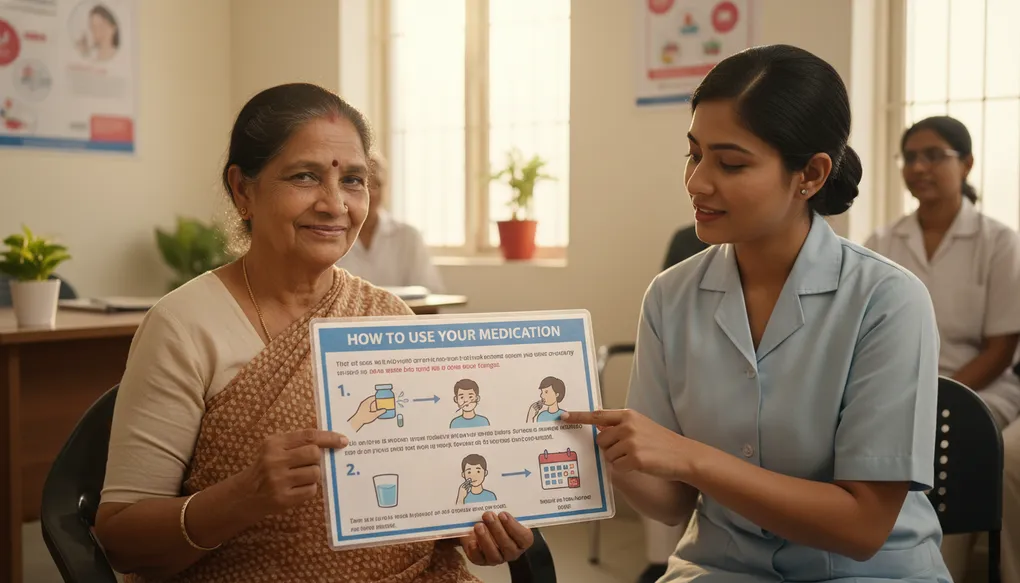
High-Quality Patient Instructions
Create clear, patient-friendly instructions that reduce confusion and callbacks—written at the right literacy level for your patient population.
Every doctor has experienced this: you spend ten minutes explaining medication timing, diet restrictions, and warning signs—only to get a call the next day asking, “Doctor, should I take this before food or after?”
The problem isn’t the patient. It’s that verbal instructions don’t stick, and generic printed sheets don’t address the patient’s specific situation.
Good patient instructions are the difference between compliance and confusion, between smooth recovery and avoidable callbacks.
This article builds on the prompt fundamentals from B1 and B2, and the privacy principles from C1, to help you create patient instructions that actually work—across different literacy levels, languages, and clinical situations.
What Problem This Solves
Patient instructions fail for predictable reasons:
- Too complex: Medical jargon that patients nod along to but don’t understand
- Too generic: One-size-fits-all sheets that don’t address the patient’s specific medicines, conditions, or concerns
- Wrong format: Dense paragraphs when patients need simple numbered steps
- No urgency signals: Patients don’t know which symptoms are “wait and watch” vs “come immediately”
- Language mismatch: English instructions for patients more comfortable in Hindi, Tamil, or Marathi
The result? Missed doses, incorrect timing, unnecessary panic about normal side effects, or dangerous delays when real warning signs appear.
AI can help you create personalised, literacy-appropriate, bilingual instructions in under 2 minutes—but only with well-crafted prompts.
How to Do It (Steps)
Step 1: Identify the Instruction Type
Different situations need different formats:
| Instruction Type | Key Focus | Format |
|---|---|---|
| Medication instructions | Timing, food, duration | Table + numbered steps |
| Pre-procedure preparation | What to do/avoid before | Day-by-day checklist |
| Post-procedure care | Recovery, restrictions, follow-up | Phased timeline |
| Lifestyle modifications | Diet, activity, habits | Daily routine format |
| Warning signs | What to watch for | Traffic light system (green/yellow/red) |
Step 2: Assess the Patient’s Literacy Level
Ask yourself:
- Can they read Hindi/English comfortably?
- What’s their education level (approximate)?
- Who will help them follow instructions at home?
Use these categories in your prompts:
- Basic literacy: Simple sentences, pictures/symbols described, family member as support
- Moderate literacy: Can read simple Hindi/English, numbered steps work well
- High literacy: Can handle detailed written instructions, tables, and medical terms with explanations
Step 3: Choose Language Approach
- Bilingual (English + Hindi): Most versatile for North/Central India
- Single language (Hindi/regional): For patients with limited English
- English with simple words: For educated patients who prefer English
Step 4: Include the “When to Call” Section
Every patient instruction should end with clear guidance on:
- What’s normal (don’t worry)
- What needs a call within 24 hours
- What needs immediate attention
Step 5: Verify Before Giving
Critical: Always review AI-generated instructions for accuracy. Check medication names, dosages, timings, and warning signs against your clinical knowledge.
Example Prompts (2-5)
Example 1: Medication Instructions (Basic Literacy)
Create medication instructions for a 58-year-old patient with limited
literacy (studied till class 5). He is starting:
- Tab Metformin 500mg twice daily
- Tab Telmisartan 40mg once daily

His wife will help him follow instructions. Create in Hindi with
English medicine names. Use:
- Very simple sentences (5-7 words max)
- Numbered steps
- Clear timing with meals (breakfast/lunch/dinner words, not times)
- What to do if he misses a dose
- 3 warning signs that need doctor visit

Keep it to one page that can be read aloud easily.
Example 2: Pre-Procedure Preparation (Colonoscopy)
Create pre-colonoscopy preparation instructions for a 45-year-old
educated patient in Bangalore. Include:
- What to eat/avoid starting 3 days before
- Clear bowel preparation steps with timing
- What medicines to stop (general guidance—I'll add specifics)
- Day-before and morning-of checklist
- What to bring to the hospital

Format as a day-by-day checklist. Include both English and Hindi
versions on the same page. Add a "Common Questions" section addressing
typical patient anxieties about the procedure.
Example 3: Post-Surgery Care (Cataract)
I'm an ophthalmologist. Create post-cataract surgery instructions for
a 65-year-old retired teacher. She lives with her son's family.

Include:
- Eye drop schedule (I'll add specific medicines)—use a visual table
- Activities to avoid and for how long
- Sleeping position guidance
- Normal vs concerning symptoms (with traffic light system)
- Follow-up schedule
- Instructions for family members on how to help

Create in English. Reading level: moderate (she's educated but elderly).
Make font guidance large-print friendly.
Example 4: Lifestyle Modification (Diabetes + Hypertension)
Create a lifestyle instruction sheet for a newly diagnosed Type 2
diabetic patient who also has hypertension. He is a 52-year-old
vegetarian bank manager in Pune.

Include:
- Diet guidelines using common Indian foods (what to eat, what to reduce)
- Simple exercise recommendations (nothing gym-based, walking-focused)
- Stress management basics
- Home monitoring guidance (BP, sugar—when and how often)
- "Small wins" approach—one change per week

Format as a "Your 4-Week Start Plan" with weekly focus areas.
Bilingual: English headings, Hindi explanations.
Tone: Encouraging, not overwhelming.
Example 5: Warning Signs Handout (Post-Delivery)
Create a warning signs handout for a woman going home after normal
delivery. She is 26, first-time mother, lives in a joint family in
a semi-urban area near Lucknow.

Include:
- Normal things to expect (reassurance section)
- Warning signs for mother: fever, heavy bleeding, severe headache,
  difficulty breathing, leg pain/swelling
- Warning signs for baby: not feeding, yellow skin, fever, no wet
  diapers
- Clear "Go to hospital immediately if..." section
- "Call us if..." section (less urgent)

Format: Traffic light system (Green = normal, Yellow = call clinic,
Red = go to hospital now). Bilingual Hindi-English.
Make it suitable to share with mother-in-law and husband too.
Bad Prompt → Improved Prompt
Scenario: Instructions for a patient starting blood pressure medication
Bad Prompt:
“Give me patient instructions for BP medicine”
What’s wrong:
- No specific medication mentioned
- No patient context (age, literacy, language)
- No format specified
- No mention of what to include
What you get: A generic paragraph about hypertension that’s useless for your specific patient.
Improved Prompt:
Create patient instructions for a 60-year-old Hindi-speaking woman
starting Tab Amlodipine 5mg once daily for hypertension. She studied
till class 8 and her daughter helps her with medicines.

Include:
1. When to take it (morning/evening, with/without food)
2. What to expect in the first week (common effects like ankle swelling)
3. What to avoid (grapefruit, sudden position changes)
4. Home BP monitoring guidance (when to check, what numbers are concerning)
5. Warning signs needing immediate attention
6. When is the next follow-up

Format: Numbered steps in simple Hindi. Include English medicine name.
Keep sentences short (under 10 words). Add a section her daughter can
use to track daily BP readings for one week.
Why it’s better:
- Specific medication with dose
- Clear patient profile (age, language, education, support person)
- Structured requirements (6 specific sections)
- Format specified (numbered, short sentences, Hindi)
- Practical addition (tracking section for family)
Common Mistakes
1. Assuming One Literacy Level Fits All
A college professor and a daily-wage worker need very different instruction formats. Always specify literacy level in your prompt.
Fix: Include phrases like “patient studied till class 5” or “educated professional” in your prompt.
2. Forgetting the Family
In India, healthcare is a family affair. Instructions often need to work for the spouse, children, or in-laws who’ll be helping.
Fix: Add “include guidance for family caregiver” or “make it suitable to explain to family members.”
3. No “What’s Normal” Section
Patients panic about normal side effects (drowsiness from antihistamines, dark stools from iron) and ignore serious warning signs.
Fix: Always ask for a section distinguishing “normal/expected” from “concerning” symptoms.
4. Timing Without Context
“Take twice daily” is unclear. Does that mean morning and night? With meals? 12 hours apart?
Fix: Specify “use breakfast/lunch/dinner as timing anchors” or “specify exact times based on Indian meal patterns.”
5. Dense Paragraphs Instead of Scannable Formats
A patient won’t read a 500-word paragraph when they’re unwell. They need to quickly find “what do I do now?”
Fix: Request “numbered steps,” “bullet points,” “table format,” or “checklist style.”
6. Skipping the Verification Step
AI might hallucinate a drug interaction or give incorrect timing. Patients trust what’s written.
Fix: Always review generated instructions against your clinical knowledge before printing.
Clinic-Ready Templates
Template 1: Medication Instruction Generator
Create medication instructions for [PATIENT AGE/GENDER] with
[LITERACY LEVEL: basic/moderate/high] literacy.

Medications:
- [MEDICINE 1 with dose and frequency]
- [MEDICINE 2 with dose and frequency]
- [Add more as needed]

Patient speaks [LANGUAGE]. [SUPPORT PERSON, if any] will help at home.

Include:
1. Medicine schedule table (medicine name, dose, timing with meals)
2. Important instructions for each medicine (with food/empty stomach, etc.)
3. Common side effects that are normal
4. Side effects that need doctor's attention
5. What to do if a dose is missed
6. Storage instructions if relevant

Format: [TABLE/NUMBERED LIST/CHECKLIST]
Language: [ENGLISH/HINDI/BILINGUAL]
Reading level: [SIMPLE SENTENCES/MODERATE/DETAILED]
Template 2: Pre-Procedure Preparation Sheet
Create pre-procedure preparation instructions for [PROCEDURE NAME]
scheduled [NUMBER] days from now.

Patient: [AGE/GENDER], [RELEVANT HEALTH CONDITIONS], [LITERACY LEVEL]

Include:
1. Diet modifications (starting from day -[X])
2. Medicines to stop (leave space for me to fill specific names)
3. Medicines to continue
4. Day-before preparation checklist
5. Morning-of checklist
6. What to bring to hospital/clinic
7. What to expect on procedure day
8. Common patient concerns/FAQ (3-4 questions)

Format: Day-by-day checklist with tick boxes
Language: [LANGUAGE PREFERENCE]
Include a "Call us if..." section for pre-procedure concerns.
Template 3: Post-Procedure Care Instructions
Create post-[PROCEDURE] care instructions for [PATIENT DESCRIPTION].

Include:
1. First 24 hours care (rest, diet, activity restrictions)
2. Wound/site care if applicable
3. Medicine schedule (leave space for specific names)
4. Activity restrictions with timeline (when can they resume normal activities)
5. Diet progression if relevant
6. Warning signs using traffic light system:
   - GREEN (normal, don't worry): [list]
   - YELLOW (call clinic): [list]
   - RED (go to hospital immediately): [list]
7. Follow-up appointment reminder
8. Care instructions for family members

Format: Phased timeline (Day 1, Days 2-3, Week 1, Week 2-4)
Language: [BILINGUAL/SINGLE LANGUAGE]
Template 4: Lifestyle Modification Sheet
Create lifestyle modification instructions for a [AGE]-year-old
[OCCUPATION] patient newly diagnosed with [CONDITION].

Dietary preferences: [VEG/NON-VEG/EGGETARIAN]
Location: [CITY/REGION] (for food availability context)
Current lifestyle: [BRIEF DESCRIPTION—sedentary job, etc.]

Include:
1. Diet modifications (what to increase, what to reduce, what to avoid)
   - Use common Indian foods and recipes
   - Include practical swaps (instead of X, try Y)
2. Physical activity recommendations (practical, not gym-based)
3. Sleep and stress guidance
4. Home monitoring if relevant (BP, sugar, weight)
5. Small, achievable weekly goals
6. Common mistakes to avoid

Tone: Encouraging, not restrictive
Format: "Your Weekly Plan" with specific daily guidance
Language: [PREFERENCE]
Template 5: Warning Signs Card (Bilingual)
Create a warning signs card for [CONDITION/SITUATION] for a patient
in [CITY/REGION].

Patient context: [AGE], [LITERACY], [WHO'S AT HOME TO HELP]

Create two versions on one page—English on top, Hindi below.

Include:
1. "What's normal" reassurance section (3-4 points)
2. "Call the clinic if..." (non-emergency but needs attention)
3. "Go to hospital immediately if..." (emergency signs)
4. Contact numbers section (space for clinic number, emergency)
5. Nearest hospital to go to (leave blank for me to fill)

Format: Traffic light visual system (Green/Yellow/Red)
Keep each point under 8 words.
Make it suitable to stick on the refrigerator or keep in wallet.
Safety Note
AI-generated patient instructions must be verified before use.
Critical checks before giving instructions to patients:
- Medication accuracy: Verify drug names, doses, and timing against prescription
- Interaction warnings: Confirm food/drug interactions mentioned are accurate
- Warning signs: Ensure all relevant red flags for the condition are included
- Contact information: Add your clinic’s actual phone number and address
- Cultural appropriateness: Review for any culturally insensitive suggestions
Never:
- Give AI-generated instructions without reading them completely
- Include patient names or identifiers when creating prompts
- Rely on AI for emergency symptom guidance—always verify from clinical sources
- Use AI instructions for high-risk situations (e.g., chemotherapy, post-cardiac care) without specialist review
Remember: You are accountable for what you give your patient, not the AI.
Copy-Paste Prompts
For Quick Medication Instructions
Create medication instructions in simple Hindi for [MEDICINE NAME]
[DOSE] [FREQUENCY]. Patient is [AGE]-year-old with [BASIC/MODERATE]
literacy. Include: timing with meals, common side effects, warning
signs, and missed dose guidance. Format as numbered steps under 10
words each.
For Bilingual Instruction Sheet
Create bilingual (English + Hindi) patient instructions for
[CONDITION/PROCEDURE]. Patient: [BRIEF DESCRIPTION].
English on left column, Hindi on right column.
Include: what to do, what to avoid, warning signs, follow-up timing.
Keep sentences short and parallel in both languages.
For Warning Signs Card
Create a pocket-sized warning signs card for [CONDITION] in [LANGUAGE].
Use traffic light format: Green (normal), Yellow (call), Red (emergency).
Maximum 5 points per category. Keep each point under 8 words.
Include space for clinic contact number.
For Post-Procedure Instructions
Create post-[PROCEDURE] instructions for [PATIENT DESCRIPTION].
Include: first 48 hours care, activity restrictions with timeline,
wound care if applicable, diet guidance, warning signs (traffic light
format), and follow-up reminder. Format as day-by-day checklist.
Language: [PREFERENCE]. Literacy level: [LEVEL].
For Lifestyle Advice Sheet
Create lifestyle modification sheet for [CONDITION] for a [AGE]-year-old
[VEG/NON-VEG] patient in [CITY]. Focus on: diet (Indian foods), exercise
(practical, not gym), and one habit change per week. Tone: encouraging.
Format as "4-Week Plan." Include family involvement suggestions.
For Test Preparation Instructions
Create preparation instructions for [TEST NAME] scheduled for [PATIENT].
Include: diet restrictions (how many hours before), water/medicines
guidance, what to bring, what to expect during test, and post-test
instructions. Format as timeline checklist. Language: [PREFERENCE].
Do’s and Don’ts
Do’s
- Do specify literacy level—it dramatically changes the output quality
- Do include family/caregiver in the instructions when relevant
- Do use the traffic light system for warning signs—it’s universally understood
- Do request bilingual formats for patients who may need family help
- Do ask for timing anchored to meals (not clock times) for Indian patients
- Do verify every instruction before giving to patients
- Do include a “What’s normal” section to reduce unnecessary anxiety
- Do leave space for personalisation (clinic number, specific follow-up dates)
Don’ts
- Don’t use AI-generated instructions without thorough review
- Don’t assume English instructions work for all patients
- Don’t create dense paragraphs—patients need scannable formats
- Don’t forget to include emergency contact guidance
- Don’t use medical jargon without simple explanations
- Don’t give same-format instructions to a professor and a farmer
- Don’t skip the “when to worry” vs “when to wait” distinction
- Don’t include patient identifying information in your prompts
1-Minute Takeaway
Great patient instructions = right content + right format + right language level
Quick formula:
Create [INSTRUCTION TYPE] for [PATIENT: age, literacy, language].
Include: [SPECIFIC SECTIONS NEEDED].
Format: [TABLE/CHECKLIST/NUMBERED STEPS].
Language: [ENGLISH/HINDI/BILINGUAL].
Add: Warning signs (traffic light system) + when to call.
Five things every patient instruction needs:
- What to do (clear, numbered steps)
- What to avoid
- What’s normal (reassurance)
- When to call (non-emergency)
- When to rush to hospital (emergency)
The literacy level ladder:
- Basic: Very simple sentences, family support mentioned, pictures described
- Moderate: Short sentences, numbered steps, simple Hindi/English
- High: Detailed explanations, tables, medical terms with meanings
Before you hand it over:
- Read it completely
- Check medication names and doses
- Verify warning signs are accurate
- Add your clinic’s contact number
- Ensure language matches patient’s comfort level
The goal: A patient (or their family) should be able to answer “What do I do now?” by looking at your instruction sheet—without calling you.
Next up: Article D3—Follow-up planning prompts that ensure patients return with the right information at the right time.