Complaint-to-Structure: Clean Clinical Notes
Transform messy patient complaints into structured clinical notes in seconds—save time during busy OPDs while maintaining quality documentation.
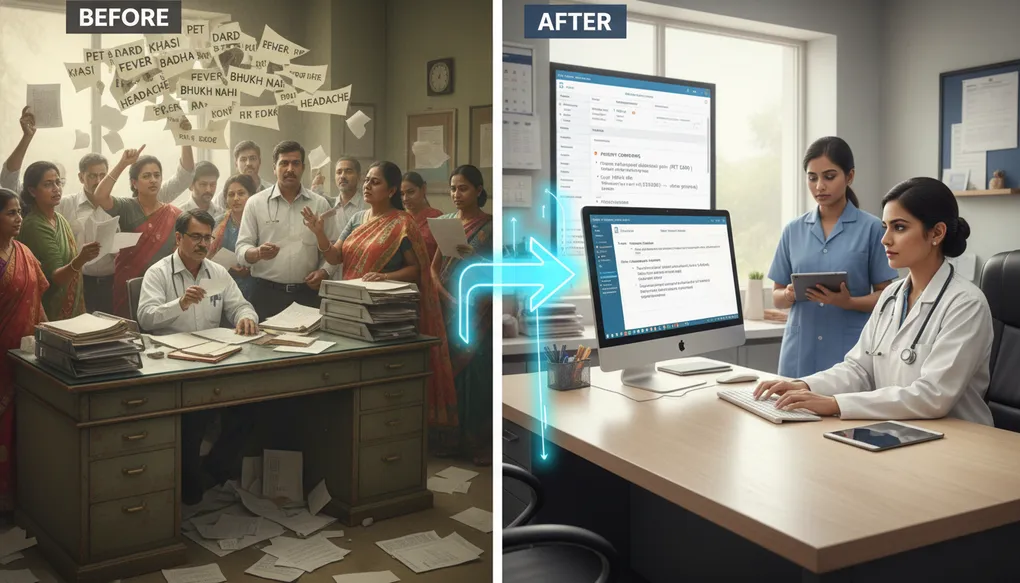
You’re in the middle of a 60-patient OPD. The patient in front of you says: “Doctor, pet mein dard hai… 3-4 din se… khana khane ke baad zyada hota hai… acidity bhi hai… thoda ulti jaisa bhi lagta hai… kabhi kabhi yahan bhi dard hota hai…”
They point vaguely at three different areas. You’re trying to type notes while processing this, and there’s already a queue building outside.
What if you could convert that rambling complaint into a clean, structured clinical note in 15 seconds?
This is where AI shines—not making clinical decisions, but organizing information so you can focus on what matters: examining the patient and planning treatment.
What Problem This Solves
Documentation in Indian OPDs faces unique challenges:
- Volume: 50-100 patients daily means seconds per patient for notes
- Mixed language: Patients describe symptoms in Hindi, Marathi, Tamil, or regional languages mixed with English
- Rambling complaints: Patients often present multiple complaints in a stream-of-consciousness style
- Incomplete history: Key details get lost when you’re rushed
- Medicolegal needs: Despite time pressure, documentation must be thorough
The result? Either you spend precious minutes typing, or your notes become cryptic abbreviations that even you can’t decipher later.
AI-assisted structuring solves this by:
- Converting rambling verbal complaints into organized clinical formats
- Ensuring you don’t miss standard HPI elements (onset, duration, severity, etc.)
- Creating consistent documentation that’s useful for follow-ups
- Freeing your mental energy for clinical thinking instead of typing
Remember: AI structures the information. You verify, correct, and add clinical judgment. The final note is yours.
How to Do It (Steps)
Step 1: De-identify Before You Type
Critical first step: Never paste patient names, phone numbers, or identifying details into any AI tool.
Instead of:
“Rajesh Kumar, 45M, phone 98765-43210, came with chest pain”
Use:
“45-year-old male with chest pain”
This protects patient privacy and is sufficient for AI to help structure the note.
Step 2: Capture the Raw Complaint
Type or dictate the patient’s complaint as they say it—messy is fine. Include:
- Their exact words (even in Hindi/regional language)
- All symptoms mentioned, even if they seem unrelated
- Rough timeline they provide
- Any treatments already tried
Step 3: Use a Structuring Prompt
Feed this raw input to AI with a clear prompt asking for specific structure. The AI will organize it into standard clinical format.
Step 4: Review and Correct
AI will sometimes misinterpret or assume. Always:
- Verify the timeline makes sense
- Correct any misinterpreted symptoms
- Add findings from your examination
- Include your clinical impression
Step 5: Finalize the Note
The AI output is your starting point. Your clinical eye completes it.
Example Prompts (2-5)
Example 1: Basic Complaint Structuring
Raw input from patient:
“Doctor, 3 din se fever hai… body pain bhi hai… kal raat thodi thand lagi… pet theek nahi hai… 2 baar loose motion hua… sir mein bhi dard hai… kuch kha nahi pa raha”
Prompt:
I'm a general physician. Convert this patient complaint into a structured
clinical note with Chief Complaint, HPI (onset, duration, progression,
associated symptoms, aggravating/relieving factors), and relevant
negative findings to document.

Patient complaint (translated where needed):
"3 days fever, body pain, chills last night, GI upset with 2 episodes
of loose stools, headache, decreased appetite"

Format as a concise clinical note suitable for OPD records.
AI Output:
Chief Complaint: Fever x 3 days

HPI:
- Onset: 3 days ago
- Duration: Continuous
- Progression: Associated chills noted last night (suggests fever spike)
- Associated symptoms:
  * Generalized body ache
  * Headache
  * Loose stools (2 episodes)
  * Decreased appetite
- Aggravating factors: Not specified
- Relieving factors: Not specified
- Treatment taken: Not mentioned

Pertinent negatives to document:
- Rash
- Bleeding manifestations
- Vomiting
- Urinary symptoms
- Cough/respiratory symptoms
- Joint pain/swelling
Example 2: Abdominal Pain Structuring
Prompt:
Structure this abdominal pain complaint for my OPD notes:

"Pain in stomach area for 1 week, worse after eating, some burning
sensation, occasional nausea, no vomiting, tried antacid but temporary
relief only, patient is stressed about work"

Give me: Chief complaint, HPI with SOCRATES format (Site, Onset,
Character, Radiation, Associated symptoms, Timing, Exacerbating/relieving,
Severity), and questions I should still ask.
Example 3: Multiple Complaints Organization
Prompt:
Patient presented with multiple complaints. Help me organize into
primary and secondary complaints with brief HPI for each:

"Blood pressure check karna hai... BP ki goli khatam ho gayi...
kabhi kabhi chakkar aata hai... 6 mahine se diabetes bhi hai...
sugar check nahi karaya... pair mein sujan bhi aa gayi hai...
1 hafte se... dono pair mein"

Organize by clinical priority. Note which complaints need immediate
attention vs routine follow-up.
Example 4: Pediatric Complaint from Parent
Prompt:
Convert this mother's description of her child's illness into a
structured pediatric clinical note:

"Baby ko 2 din se bukhar hai... 102-103 aa raha tha... kaan mein
haath daal raha hai baar baar... raat ko roya bahut... khana kam
kha raha hai... potty normal hai... cough nahi hai"

Child is 18 months old. Structure as: Chief complaint, HPI, feeding/
activity assessment, and red flags to examine for.
Example 5: Follow-up Visit Structuring
Prompt:
Structure this follow-up visit note:

"Patient came for BP follow-up. Was started on Telmisartan 40mg
2 weeks ago. Says BP is better at home (shows diary: 130-140/80-90
range). No side effects. Giddiness has reduced. Still has morning
headaches occasionally. Compliance: taking medicine regularly.
Diet: reduced salt. Exercise: walking 20 min daily."

Format as a follow-up SOAP note focusing on response to treatment.
Bad Prompt → Improved Prompt
Scenario: Converting a diabetes patient’s complaints
Bad Prompt:
“Diabetes patient complaining of many things, make it structured”
What’s wrong:
- No actual complaint content provided
- No format specified
- No context about what type of structure needed
- AI has nothing to work with
Improved Prompt:
I'm documenting a diabetes follow-up in my OPD. Structure this patient's
complaints into a clinical note:

"Sugar patient... 5 saal se diabetes... metformin le raha hoon...
sugar control nahi ho rahi... last test mein 280 fasting tha...
pair mein jalan hoti hai raat ko... thakan bhi bahut hai...
baar baar bathroom jaana padta hai... weight bhi badh gaya hai
10 kg 1 saal mein... diet follow nahi ho pata... mithai kha leta hoon
kabhi kabhi"

Structure as:
1. Current glycemic status
2. Symptoms suggesting complications (organize by system)
3. Medication compliance issues
4. Lifestyle factors
5. Red flags requiring attention today

Use brief clinical language suitable for medical records.
Why it’s better:
- Provides actual complaint content
- Specifies exact structure needed
- Asks for clinically relevant organization
- Appropriate for documentation purpose
Common Mistakes
1. Including Patient Identifiers
Wrong: “Ramesh Sharma from Andheri came with…” Right: “45-year-old male from Mumbai came with…”
Always de-identify before pasting into AI.
2. Expecting AI to Diagnose
Wrong: “What disease does this patient have based on these complaints?” Right: “Structure these complaints and suggest relevant differentials to consider”
AI structures and suggests; you diagnose.
3. Accepting Output Without Verification
AI may misinterpret Hindi terms or make assumptions. Always review:
- Did it get the timeline right?
- Are all symptoms captured?
- Did it misunderstand any regional terms?
4. Not Specifying the Format
Wrong: “Organize this complaint” Right: “Organize this complaint as: Chief Complaint, HPI with OPQRST format, pertinent negatives”
Be specific about structure you need.
5. Skipping Your Clinical Input
AI cannot know:
- What you observed during examination
- Non-verbal cues from the patient
- Your clinical suspicion based on experience
- Local disease patterns in your area
Always add your clinical findings and impression.
6. Using AI Notes Verbatim in Records
AI output is a draft. Your final note should reflect your actual clinical encounter, not generic AI text.
Clinic-Ready Templates
Template 1: General OPD Complaint Structuring
I'm a [SPECIALTY] doctor in [CITY/REGION]. Structure this patient
complaint into a clinical note:

Patient: [AGE]-year-old [MALE/FEMALE]
Raw complaint: "[PASTE PATIENT'S COMPLAINT - DE-IDENTIFIED]"

Structure as:
- Chief Complaint (one line)
- HPI (onset, duration, progression, associated symptoms, aggravating/
  relieving factors, severity, previous treatment)
- Relevant past history to ask about
- Pertinent negatives to document

Keep it concise for busy OPD documentation.
Template 2: System-Specific Complaint Organizer
Organize this [SYSTEM: GI/Respiratory/Cardiac/Neuro/MSK] complaint:

"[PASTE COMPLAINT]"

Use the standard [OPQRST/SOCRATES] format for the main symptom.
Include system-specific red flags I should assess for.
Format for quick OPD documentation.
Template 3: Chronic Disease Follow-up Structuring
Structure this follow-up visit for a [CONDITION: Diabetes/Hypertension/
Asthma/Other] patient:

"[PASTE PATIENT'S UPDATE AND COMPLAINTS]"

Organize into:
1. Disease control status (symptoms, home monitoring if any)
2. Medication compliance and side effects
3. New complaints or complications
4. Lifestyle adherence
5. Points needing attention today

Brief format suitable for follow-up documentation.
Template 4: Multi-Complaint Prioritization
This patient has multiple complaints. Help me organize by clinical priority:

"[PASTE ALL COMPLAINTS]"

Categorize into:
1. Needs immediate attention today
2. Needs investigation/workup
3. Can be addressed in follow-up
4. Chronic/lifestyle issues for counseling

Brief clinical format.
Template 5: Referral Note Structuring
I need to refer this patient to [SPECIALTY]. Structure a referral note:

Patient: [AGE/GENDER]
My findings: "[PASTE YOUR CLINICAL FINDINGS AND CONCERNS]"

Create a concise referral note including:
- Reason for referral
- Relevant history summary
- Key examination findings
- Investigations done with results
- Specific questions for the specialist

Professional format suitable for inter-doctor communication.
Safety Note
Your clinical judgment is irreplaceable.
AI-assisted note structuring is a time-saving tool, not a clinical decision-maker. Keep these principles in mind:
-
De-identify always: Remove names, phone numbers, addresses, and any identifying details before using AI tools. Use age, gender, and clinical details only.
-
Verify every output: AI may misinterpret symptoms, especially when translated from Hindi/regional languages. Read every AI-generated note critically.
-
Add your examination findings: AI only knows what you tell it. Your clinical examination, observations, and instincts must be documented by you.
-
Don’t skip the history-taking: Using AI to structure notes doesn’t mean rushing through the patient interaction. The goal is better documentation, not faster patient dismissal.
-
Maintain final responsibility: The note in your records is your professional document. You are responsible for its accuracy, not the AI.
-
Keep copies appropriately: Don’t store patient information in AI chat histories. Use AI for structuring, then document in your proper EMR/records system.
Copy-Paste Prompts
Quick Complaint-to-Note Converter
Convert to structured clinical note:
Patient: [AGE] [GENDER]
Complaint: "[PASTE DE-IDENTIFIED COMPLAINT]"

Format: Chief complaint, HPI (onset, duration, severity, associated
symptoms, aggravating/relieving factors), pertinent negatives to ask.
Brief OPD format.
Pain Complaint Organizer (SOCRATES)
Structure this pain complaint using SOCRATES format:
"[PASTE PAIN DESCRIPTION]"

Site, Onset, Character, Radiation, Associated symptoms, Timing,
Exacerbating/relieving, Severity (1-10). Add relevant red flags
to assess.
Fever Workup Organizer
Organize this fever case for systematic workup:
"[PASTE FEVER COMPLAINT WITH ALL DETAILS]"

Structure: Duration and pattern, localizing symptoms, exposure/travel/
contact history, associated symptoms by system, treatments tried.
Suggest focused examination points.
GI Complaint Structuring
Structure this GI complaint for documentation:
"[PASTE GI COMPLAINT]"

Include: Main symptom with timeline, appetite/diet changes, bowel
habits, associated symptoms (nausea/vomiting/pain), alarming features
to rule out. Brief clinical format.
Respiratory Complaint Organizer
Organize this respiratory complaint:
"[PASTE COUGH/BREATHLESSNESS/OTHER RESPIRATORY COMPLAINT]"

Structure: Main symptom timeline, associated symptoms, severity
assessment, triggers/relievers, smoking/occupational history,
red flags for this region/season. OPD documentation format.
Chronic Disease Review Template
Structure this chronic disease follow-up:
Disease: [CONDITION]
Duration: [YEARS]
Current medications: [LIST]
Patient update: "[PASTE WHAT PATIENT REPORTED]"

Organize: Control status, compliance assessment, new symptoms,
complication screening points, lifestyle factors. Follow-up note format.
Quick Vitals + Complaint Integration
Integrate vitals with complaint for documentation:
Vitals: BP [X/Y], PR [X], SpO2 [X]%, Temp [X], RBS [X] (if done)
Complaint: "[PASTE COMPLAINT]"

Create integrated assessment note highlighting any vital abnormalities
relevant to the presenting complaint.
Do’s and Don’ts
Do’s
- Do de-identify every single time—make it a habit before pasting anything
- Do capture complaints in patient’s own words first, then use AI to structure
- Do verify timelines and symptom descriptions in AI output
- Do add your examination findings and clinical impression manually
- Do use consistent templates for similar complaint types—it speeds up your workflow
- Do keep AI-assisted notes as drafts; finalize with your clinical input
- Do specify the format you need (SOAP, OPQRST, systems-based, etc.)
- Do use this for documentation efficiency, not to skip proper history-taking
Don’ts
- Don’t ever include patient names, phone numbers, or identifying details
- Don’t accept AI output without reading and verifying it
- Don’t use AI structuring as a substitute for clinical examination
- Don’t expect AI to understand local disease patterns or regional language nuances perfectly
- Don’t copy AI notes directly into medico-legal documents without your edits
- Don’t rush patient interaction just because AI will “fix” your notes later
- Don’t rely on AI for clinical decisions—it structures, you decide
- Don’t forget to document what AI cannot know: your observations, examination, and plan
1-Minute Takeaway
AI transforms messy patient complaints into structured clinical notes—but you remain the doctor.
The workflow:
- De-identify (remove names, numbers)
- Capture raw complaint (messy is okay)
- Use AI to structure (Chief Complaint + HPI + relevant points)
- Verify and correct AI output
- Add your examination and clinical impression
- Finalize for your records
Quick template for any complaint:
Convert to structured clinical note:
Patient: [AGE] [GENDER]
Complaint: "[DE-IDENTIFIED COMPLAINT]"
Format: Chief complaint, HPI, pertinent negatives. Brief OPD format.
Remember:
- AI saves documentation time
- You save clinical judgment time for what matters
- De-identify ALWAYS
- Verify ALWAYS
- Final note is YOUR professional document
In a 50-patient OPD, saving even 1 minute per patient’s documentation gives you nearly an hour back. Use that time for better patient care, not more typing.
This article builds on the prompt engineering fundamentals from “What Prompt Engineering Is (For Doctors)” and “How to Give AI Context.” Apply these structuring techniques to your next OPD and see the difference.