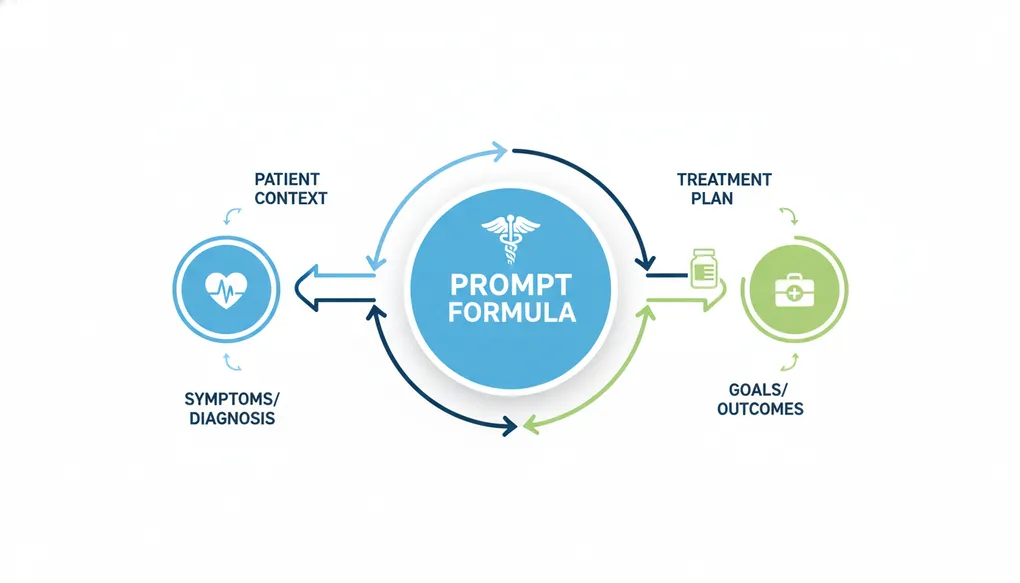
The 5-Part Prompt Formula
Master the essential framework for writing effective AI prompts—Role, Context, Task, Format, and Constraints. Works for any medical use case.
Think of AI as a new intern joining your clinic. Would you just say “help that patient” and walk away? Of course not! You would tell them who they should act as, give them background, explain the task clearly, specify how you want things done, and set boundaries.
That is exactly what good prompting is about. This article teaches you the 5-Part Prompt Formula—a simple framework you can use for any AI task in your practice.
What Problem This Solves
Most doctors try AI and get disappointing results. Why? Because they write prompts like this:
“Write patient instructions for diabetes.”
The AI does not know:
- Should it write for a newly diagnosed patient or someone managing diabetes for years?
- Is the patient educated or needs simple language?
- Should it be 50 words or 500 words?
- What format works best—paragraphs or bullet points?
The 5-Part Formula fixes this. It gives AI everything it needs to give you exactly what you want—the first time.
How to Do It (Steps)
Here is the formula. Remember it as R-C-T-F-C (Role, Context, Task, Format, Constraints):
Part 1: ROLE
Tell AI who to be. This sets the tone, expertise level, and perspective.
Examples:
- “Act as an experienced general physician…”
- “You are a friendly clinic receptionist…”
- “Respond as a patient educator who speaks Hindi and English…”
Part 2: CONTEXT
Give background information. The more relevant details, the better the output.
Include things like:
- Patient type (age, education level, condition)
- Clinic setting (busy OPD, rural PHC, specialty clinic)
- Language or cultural considerations
- Any specific situation details
Part 3: TASK
State clearly what you want done. Be specific!
Examples:
- “Write discharge instructions for…”
- “Explain this diagnosis in simple terms…”
- “Create a diet chart for…”
- “Summarize these symptoms for documentation…”
Part 4: FORMAT
Specify how you want the output structured.
Options include:
- Bullet points
- Numbered steps
- Table format
- Short paragraphs
- Q&A format
- Checklist
Part 5: CONSTRAINTS
Set limits and safety rules. This prevents AI from going off-track.
Examples:
- “Keep it under 200 words”
- “Use 8th-standard English only”
- “Do not include medication dosages”
- “Avoid medical jargon”
- “Include a reminder to consult doctor before changing medicines”
Example Prompts
Example 1: Patient Education Handout
Without the formula:
“Write about hypertension care.”
With the 5-Part Formula:
Role: Act as a patient educator at a busy Indian urban clinic.
Context: The patient is a 55-year-old businessman, newly diagnosed with Stage 1 hypertension. He is educated but has no medical background. He travels frequently for work.
Task: Create a lifestyle modification guide he can follow even while traveling.
Format: Use bullet points with short explanations. Include a “Quick Tips for Travel” section at the end.
Constraints: Keep total length under 300 words. Use simple English. Do not recommend specific medications. Include reminder to take BP readings regularly.
Example 2: Appointment Reminder Message
Role: You are a friendly clinic receptionist who communicates in simple Hindi-English mix.
Context: Patient is a senior citizen coming for a follow-up diabetes checkup. Many patients in our clinic forget to bring previous reports.
Task: Write a WhatsApp reminder message for appointment tomorrow at 10 AM.
Format: Short message, maximum 4-5 lines.
Constraints: Remind them to bring: previous reports, medicine list, and come fasting. Keep tone warm but professional. Use simple language that elderly patients understand easily.
Example 3: Clinical Documentation Help
Role: Act as a medical documentation assistant familiar with Indian clinical practice.
Context: I am an orthopedic surgeon. Patient presented with knee pain for 3 months, worse on climbing stairs, morning stiffness for 15 minutes, no trauma history, X-ray shows grade 2 OA changes.
Task: Help me write a concise clinical note for this consultation.
Format: Standard SOAP format (Subjective, Objective, Assessment, Plan).
Constraints: Keep it brief and professional. Do not add information I have not provided. Leave placeholders for examination findings I will add.
Example 4: Explaining a Diagnosis
Role: You are a kind pediatrician who is excellent at explaining things to worried parents.
Context: A mother has brought her 4-year-old child who has been diagnosed with viral fever with mild throat infection. The mother is anxious because the fever has lasted 3 days.
Task: Write an explanation I can share with her about why viral fevers last 5-7 days and why antibiotics are not needed.
Format: Conversational paragraphs, like I am speaking directly to her.
Constraints: Reassuring tone. Under 150 words. Mention when she SHOULD worry and come back immediately. Do not use scary medical terms.
Bad Prompt → Improved Prompt
Bad Prompt:
“Give me diet advice for a diabetic patient.”
What is wrong: No role, no patient details, no format preference, no constraints.
Improved Prompt:
Role: Act as a diabetes educator at an Indian clinic.
Context: Patient is a 45-year-old vegetarian woman from South India, newly diagnosed with Type 2 diabetes. She cooks at home, has a moderate budget, and her family eats the same food.
Task: Create a practical one-week meal plan she can follow without cooking separate meals.
Format: Table with Breakfast, Lunch, Evening Snack, and Dinner for each day.
Constraints: Include only commonly available Indian foods. Mention portion sizes in simple terms (like “1 katori” or “1 medium roti”). Keep carbohydrate portions controlled. Add 2-3 tips at the end for eating during festivals.
Common Mistakes
| Mistake | Why It Fails | How to Fix |
|---|---|---|
| Too vague | AI guesses what you want | Add specific details in Context |
| No format specified | Output may be in wrong structure | Always mention Format |
| Forgetting constraints | AI writes too much or includes unwanted content | Set word limits and exclusions |
| Skipping the Role | Generic, impersonal tone | Start with “Act as…” |
| Information overload | AI gets confused | Focus Context on relevant details only |
| Asking for medical advice directly | Safety and accuracy issues | Always frame as “help me draft” or “assist with” |
Clinic-Ready Templates
Quick Reference Card
Copy this and keep it handy:
THE 5-PART PROMPT FORMULA

R - ROLE      → "Act as a [type of professional]..."
C - CONTEXT   → "The patient is... The situation is..."
T - TASK      → "Please [specific action]..."
F - FORMAT    → "Present this as [structure type]..."
C - CONSTRAINTS → "Keep it under [X] words. Do not include..."
Universal Medical Prompt Template
ROLE: Act as [healthcare professional type] who [special quality/expertise].

CONTEXT:
- Patient: [age, gender, relevant background]
- Condition: [diagnosis or presenting complaint]
- Setting: [clinic type, any special circumstances]
- Other: [language needs, cultural factors, etc.]

TASK: [Specific action you want - be clear and direct]

FORMAT: [Bullet points / Table / Numbered list / Paragraphs / Other]

CONSTRAINTS:
- Length: [word/line limit]
- Language: [simple/technical, any language mix]
- Must include: [specific elements]
- Must avoid: [things to exclude]
- Safety: [any medical disclaimers needed]
Safety Note
Important reminders when using AI in medical practice:
-
AI assists, you decide. Always review AI-generated content before sharing with patients.
-
Never share identifiable patient information with AI tools. Remove names, specific dates, and identifying details.
-
AI can make mistakes. Especially with drug dosages, interactions, and recent medical guidelines. Always verify.
-
Cultural sensitivity matters. Review outputs to ensure they are appropriate for your patient population.
-
Document your process. If you use AI to help create patient materials, maintain your professional responsibility for the content.
-
When in doubt, leave it out. If AI generates something you are not sure about, verify with reliable sources first.
Copy-Paste Prompts
Prompt 1: Patient Discharge Instructions
Role: Act as a patient educator at an Indian hospital.

Context: Patient is a [AGE]-year-old [GENDER] being discharged after [PROCEDURE/CONDITION]. Education level is [BASIC/MODERATE/GOOD]. Family will help with care at home.

Task: Write discharge instructions they can understand and follow at home.

Format:
- Numbered list for medications
- Bullet points for warning signs
- Simple checklist for daily care

Constraints:
- Use simple English that a 10th-standard student can understand
- Keep under 250 words
- Do not write specific dosages (I will add those)
- Include: when to take medicines, warning signs to watch for, when to come for follow-up
- Must include: "Contact clinic immediately if..." section
Prompt 2: Explaining Test Results to Patients
Role: You are a caring physician who explains things simply without causing unnecessary worry.

Context: Patient is a [AGE]-year-old who just received [TEST NAME] results. The finding is [BRIEF FINDING]. They are [ANXIOUS/CALM/CONFUSED] about what it means.

Task: Write an explanation of what this result means in simple terms that I can share with the patient.

Format: Short paragraphs, conversational tone.

Constraints:
- Under 150 words
- Do not use medical jargon—or if you must, explain it immediately
- Include what this means for them practically
- End with reassurance and clear next steps
- Do not diagnose—frame as "this suggests" or "this may indicate"
Prompt 3: Creating a Treatment Plan Summary
Role: Act as a medical documentation assistant.

Context:
- Patient: [AGE]-year-old [GENDER]
- Diagnosis: [PRIMARY DIAGNOSIS]
- Other conditions: [COMORBIDITIES IF ANY]
- Current medications: [LIST]

Task: Help me create a treatment plan summary for this patient's records.

Format:
- Assessment (2-3 lines)
- Plan (numbered list)
- Follow-up instructions (bullet points)
- Red flags to watch for (bullet points)

Constraints:
- Professional medical language appropriate for documentation
- Keep concise—total under 200 words
- Leave [BLANK] placeholders for specific details I need to add
- Do not suggest medications I have not mentioned
Prompt 4: Health Education Poster Content
Role: Act as a public health educator creating materials for an Indian clinic waiting room.

Context: The clinic serves [URBAN/RURAL] patients with [EDUCATION LEVEL] literacy. Topic is [HEALTH TOPIC]. Many patients speak [LANGUAGE] primarily.

Task: Write content for an A4 health education poster about this topic.

Format:
- One catchy headline
- 5-6 key points with short explanations (one line each)
- One call-to-action at the bottom

Constraints:
- Total under 100 words (posters need to be quick to read)
- Use simple vocabulary—8th standard level
- Include one "Did you know?" fact
- Culturally appropriate examples
- Positive, encouraging tone
Prompt 5: WhatsApp Message for Test Results
Role: You are a professional clinic coordinator who sends test result notifications.

Context: Patient [NAME] had [TEST TYPE] done on [DATE]. Results are [NORMAL/ABNORMAL/NEED DISCUSSION]. Our clinic policy is patients must collect reports in person for abnormal results.

Task: Write a WhatsApp message informing them about their results.

Format: Brief message, 4-5 lines maximum.

Constraints:
- Professional but warm tone
- If normal: include brief reassurance
- If abnormal: do not alarm, just ask them to visit
- Include clinic timing and contact number: [NUMBER]
- Do not include actual values in message
Do’s and Don’ts
DO:
- Start with a clear Role every time
- Include relevant patient details in Context (without identifying information)
- Be specific about what you want in Task
- Always specify Format—it saves editing time
- Set word limits and exclusions in Constraints
- Review and edit all AI outputs before use
- Test prompts with different scenarios
- Save your best prompts for reuse
DON’T:
- Share real patient names, dates of birth, or identifying details
- Accept AI output without reviewing it
- Ask AI to make diagnostic or treatment decisions
- Forget to set appropriate constraints
- Use AI-generated content for legal or official documentation without proper review
- Assume AI knows current drug prices, availability, or local guidelines
- Skip the Role—it makes a big difference in output quality
- Write one giant paragraph—structure your prompt clearly
1-Minute Takeaway
Remember: R-C-T-F-C
Every good prompt has 5 parts:
- ROLE — Tell AI who to be (“Act as…”)
- CONTEXT — Give relevant background
- TASK — Say exactly what you want
- FORMAT — Specify the structure
- CONSTRAINTS — Set limits and rules
The Quick Test: Before sending any prompt, ask yourself:
- Did I tell AI who to be?
- Did I give enough background?
- Is my request specific?
- Did I say how I want the output?
- Did I set appropriate limits?
If you can answer yes to all five, you will get much better results.
Start simple, then refine. You do not need to write perfect prompts immediately. Start with the formula, see what you get, and adjust. With practice, writing good prompts becomes second nature—just like taking a good patient history.
Next article: Learn how to customize AI’s writing style for different patients with our Guide to Tone and Language Matching.