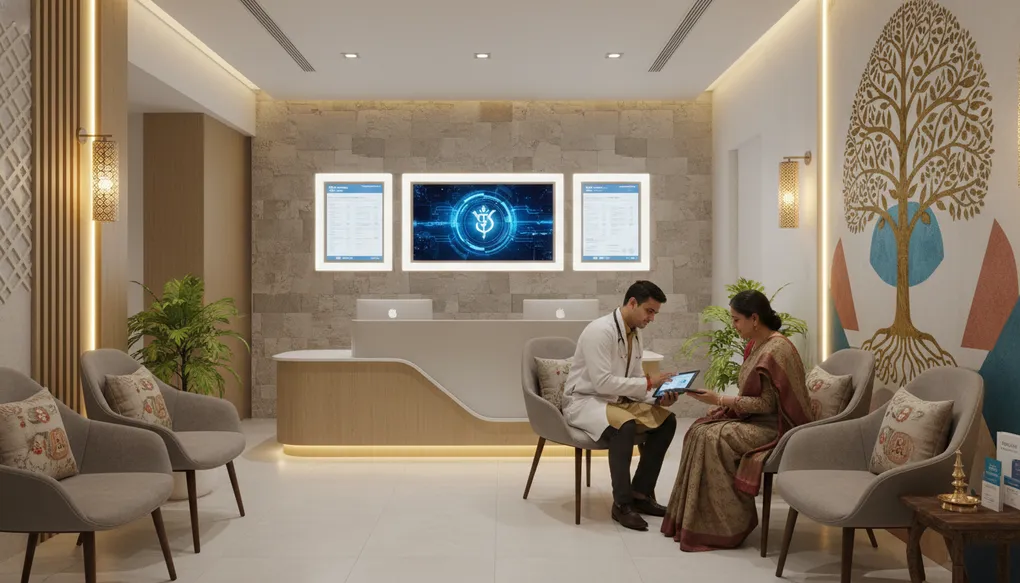
Modern Clinics Need Modern Communication
Why Indian doctors need prompt engineering skills in 2026—save time, reduce burnout, and improve patient outcomes with AI-assisted workflows.
Picture this: It’s 7 PM. You’ve seen 62 patients today. Your hand aches from writing prescriptions. Three patients are still waiting outside. Your phone buzzes with WhatsApp messages asking, “Doctor, can I take Crocin with my BP medicine?” You haven’t had lunch. And tomorrow? Same story.
Sound familiar?
You didn’t study medicine for 10+ years to burn out writing the same discharge summaries, explaining post-operative care for the hundredth time, or typing referral letters at midnight. Yet here we are—brilliant clinicians drowning in paperwork while our clinical skills gather dust.
But what if you had a tireless assistant who could draft patient education materials in Hindi, summarize case histories in seconds, and help you communicate complex diagnoses in simple language? Not to replace your judgment—never that—but to handle the repetitive communication tasks that eat into your patient care time?
That’s exactly what prompt engineering offers you. And no, you don’t need to be “tech-savvy” or understand coding. If you can write a referral letter, you can write a prompt.
What Problem This Solves
Let’s be honest about the challenges Indian doctors face daily:
The OPD Reality
- 50-80 patients in a 6-hour OPD is “normal” in most government and busy private setups
- Average consultation time: 2-3 minutes (when it should be 10-15)
- Language barriers with patients from different states
- Explaining the same condition (diabetes management, hypertension lifestyle changes) dozens of times daily
The Communication Burden
- Discharge summaries that take 20-30 minutes each
- Patient education that gets rushed or skipped entirely
- Referral letters written hastily between patients
- WhatsApp queries that pile up by evening
- Medico-legal documentation that can’t be compromised
The Burnout Epidemic A 2023 IMA study found that 87% of Indian doctors report burnout symptoms. The administrative load—not patient care—is the primary driver.
What Prompt Engineering Solves:
- Reduces documentation time by 60-70% (once you learn the basics)
- Creates consistent, high-quality patient communication materials
- Helps translate complex medical information into patient-friendly language (including Hindi, Tamil, Telugu, and other regional languages)
- Frees up mental energy for what actually matters: clinical decision-making
This isn’t about replacing you. It’s about getting you an assistant who never tires, never forgets, and works at your command.
How to Do It (Steps)
Getting started with AI-assisted communication is simpler than you think. Here’s your roadmap:
Step 1: Access an AI Tool (5 minutes)
- ChatGPT (chat.openai.com) - Free version available
- Claude (claude.ai) - Excellent for medical writing
- Google Gemini (gemini.google.com) - Integrated with Google services
For now, any of these will work. Just create a free account.
Step 2: Understand the Basic Prompt Structure (2 minutes) A good prompt has three parts:
- Role: Who should the AI act as?
- Task: What exactly do you need?
- Context: Relevant details and constraints
Think of it like giving instructions to a new resident. The clearer you are, the better the output.
Step 3: Start with One Use Case Don’t try to revolutionize your entire practice overnight. Pick ONE thing:
- Patient education handouts
- Discharge summary drafts
- Consent form explanations
- Post-operative care instructions
Step 4: Iterate and Refine Your first prompt won’t be perfect. That’s okay. Adjust based on the output, just like you’d refine instructions to a junior doctor.
Step 5: Build Your Prompt Library Save prompts that work well. Over time, you’ll have a personalized toolkit that saves hours every week.
Example Prompts
Here are practical prompts you can use starting today:
Prompt 1: Patient Education Handout
You are a senior physician creating patient education materials for an Indian audience.

Create a simple, easy-to-understand handout about Type 2 Diabetes management for a 55-year-old patient. Include:
- What the condition means (in simple terms)
- Diet recommendations using Indian foods (roti, rice, dal, sabzi)
- Exercise suggestions suitable for Indian lifestyle
- Warning signs to watch for
- When to contact the doctor immediately

Use short sentences. Avoid medical jargon. The patient has studied till 10th standard.
Prompt 2: Discharge Summary Draft
Act as a medical documentation specialist. Draft a discharge summary for:

Patient: 45-year-old male
Admission: Acute appendicitis
Procedure: Laparoscopic appendectomy
Hospital stay: 3 days
Complications: None

Include: Admission diagnosis, procedure details, post-op recovery, medications at discharge, follow-up instructions, and warning signs requiring immediate attention.

Format it professionally for a multi-specialty hospital in India.
Prompt 3: Medicine Explanation for Patient
Explain the following prescription to a patient in simple Hindi-English mix (Hinglish), as spoken in North Indian cities:

Medicines:
- Tab Metformin 500mg twice daily
- Tab Telmisartan 40mg once daily morning
- Tab Atorvastatin 10mg once daily night

Cover: Why each medicine is needed, when to take it, common side effects to watch for, and what to do if a dose is missed.

Keep it conversational, like a doctor explaining to a patient in OPD.
Prompt 4: Referral Letter
Write a professional referral letter from a General Physician to a Cardiologist for:

Patient: 58-year-old female
Reason: Suspected unstable angina
Findings: ECG shows ST depression in leads V4-V6, Troponin I mildly elevated
Current medications: Aspirin, Atorvastatin, Metoprolol
Request: Urgent evaluation and management advice

Keep it concise but complete. Follow standard Indian medical referral format.
Prompt 5: WhatsApp-Friendly Response
A patient's relative has sent a WhatsApp message asking if the patient (post-cholecystectomy, day 5) can eat rajma-chawal.

Write a brief, friendly WhatsApp response that:
- Answers their specific question
- Gives general dietary guidance for this recovery stage
- Reminds them of warning signs
- Maintains professional boundaries

Keep it under 100 words. Warm but professional tone.
Bad Prompt → Improved Prompt
Let’s see how small changes make a big difference:
Example 1: Patient Education
Bad Prompt:
Tell me about diabetes.Problem: Too vague. AI will give generic, textbook information not useful for patients.
Improved Prompt:
Create a patient education handout about Type 2 Diabetes for a [55-YEAR-OLD] [MALE] patient from [TIER-2 CITY IN MAHARASHTRA].

The patient:
- Works as a [SHOPKEEPER] (sits most of the day)
- Eats typical Maharashtrian diet (bhakri, zunka, rice)
- Has [CLASS 10] education
- Recently diagnosed, feeling scared

Include:
- Simple explanation of what's happening in their body
- 5 specific food swaps they can make
- Realistic exercise suggestions for their lifestyle
- Reassurance that the condition is manageable
- Warning signs in bullet points

Write in simple English with some Marathi food terms. Friendly, encouraging tone.
Example 2: Medication Instructions
Bad Prompt:
Explain metformin side effects.Problem: Clinical focus, not patient-friendly, no context.
Improved Prompt:
My patient is a [60-YEAR-OLD GRANDMOTHER] who just started Metformin 500mg for diabetes. She's worried about taking "English medicine" for the first time.

Write a reassuring explanation covering:
- Why this medicine helps (simple analogy)
- How to take it to minimize stomach upset
- What side effects are normal vs. concerning
- How long before she'll see benefits
- Reassurance from a "doctor's perspective"

Tone: Like a kind, patient doctor explaining to their own mother. Simple Hindi-English mix.
Example 3: Discharge Summary
Bad Prompt:
Write discharge summary for appendix surgery.Problem: Missing all clinical details, no structure, no patient specifics.
Improved Prompt:
Draft a discharge summary for:

PATIENT DETAILS:
- [32-YEAR-OLD MALE], [SOFTWARE ENGINEER]
- MRD No: [HOSPITAL MRD NUMBER]
- Admission: [DATE] | Discharge: [DATE]

CLINICAL DETAILS:
- Diagnosis: Acute appendicitis with localized peritonitis
- Procedure: Laparoscopic appendectomy on [DATE]
- Surgeon: Dr. [NAME]
- Anesthesia: General
- Operative findings: Gangrenous appendix, minimal pus
- Post-op: Uneventful, started orals on POD 1

DISCHARGE MEDICATIONS:
- Tab Augmentin 625mg TDS x 5 days
- Tab Pantoprazole 40mg OD x 7 days
- Tab Paracetamol 650mg SOS for pain

Include: Standard discharge summary sections, follow-up in 1 week, wound care instructions, dietary advice, activity restrictions, warning signs.

Format: Standard Indian hospital discharge summary format.
Common Mistakes
Mistake 1: Being Too Vague
- “Explain heart disease” gives textbook content
- “Explain what’s causing chest pain to my 60-year-old diabetic patient with a recent angioplasty” gives useful, specific content
Mistake 2: Forgetting the Audience Always specify who will read the output. Patient education for a college professor looks different from that for a farmer from rural Bihar.
Mistake 3: Not Specifying Language/Tone Want Hinglish? Tamil medical terms? Formal or conversational? Say it explicitly.
Mistake 4: Accepting First Output as Final AI gives you a draft. Review it. Edit it. Ask for revisions. You’re the editor-in-chief.
Mistake 5: Copy-Pasting Without Review The AI doesn’t know your specific patient. Always verify medications, doses, and advice match your clinical judgment.
Mistake 6: Sharing Patient-Identifying Information Never include real names, phone numbers, Aadhaar numbers, or identifying details in prompts. Use placeholders: [PATIENT NAME], [AGE], [CONDITION].
Mistake 7: Overcomplicating Prompts Start simple. Add details only if the output isn’t what you need. You don’t need 500-word prompts for simple tasks.
Clinic-Ready Templates
Copy these templates and customize for your specialty:
Template 1: Patient Condition Explanation
Create a patient-friendly explanation of [CONDITION NAME] for a [AGE]-year-old [OCCUPATION] from [REGION/STATE].

Education level: [EDUCATION]
Language preference: [HINDI/ENGLISH/HINGLISH/OTHER]
Key concerns to address: [PATIENT'S MAIN WORRIES]

Include:
- What is happening in their body (simple analogy)
- Why it happened (if known)
- What treatment involves
- Expected timeline for improvement
- Lifestyle modifications specific to their situation
- When to seek emergency care

Tone: [REASSURING/MATTER-OF-FACT/DETAILED AS REQUESTED BY PATIENT]
Template 2: Post-Procedure Instructions
Create post-procedure care instructions for [PROCEDURE NAME].

Patient profile: [AGE, GENDER, RELEVANT CONDITIONS]
Procedure date: [DATE]
Home situation: [LIVES ALONE/WITH FAMILY/CAREGIVER AVAILABLE]

Cover:
- First 24-48 hours care
- Wound/site care specific to Indian climate
- Diet progression (with Indian food examples)
- Activity restrictions with timeline
- Medications schedule in simple table format
- Warning signs requiring immediate hospital visit
- Follow-up appointment details

Language: [PREFERENCE]
Format: Printable single page if possible
Template 3: Specialist Referral
Write a referral letter to [SPECIALTY] for:

Patient: [AGE, GENDER, OCCUPATION]
Referring from: [YOUR SPECIALTY/CLINIC NAME]
Referral urgency: [ROUTINE/SOON/URGENT]

Presenting complaint: [BRIEF DESCRIPTION]
Relevant history: [KEY POINTS]
Investigations done: [LIST WITH RESULTS]
Current medications: [LIST]
Working diagnosis: [YOUR IMPRESSION]
Specific request: [WHAT YOU NEED FROM SPECIALIST]

Format: Professional medical referral, concise, one page
Safety Note
AI is your assistant, not your replacement.
This is non-negotiable. Every output from AI must be filtered through your clinical judgment. Here’s why:
-
AI can hallucinate: It may generate plausible-sounding but incorrect medical information. You must verify.
-
AI doesn’t know your patient: You’ve examined them. You’ve seen their face when they describe pain. AI has only the text you provide.
-
Context matters: That “routine” discharge summary might miss something crucial only you observed during rounds.
-
Medicolegal responsibility is yours: If something goes wrong, “the AI told me” is not a defense. Every document that goes to a patient should be reviewed and approved by you.
-
Drug interactions and doses: Always verify medications, especially for patients on multiple drugs or with organ impairment.
The Golden Rule: AI drafts, you decide.
Use AI to save time on the mechanical aspects of communication. Use your irreplaceable clinical training for everything that matters.
Copy-Paste Prompts
Ready to use right now. Just fill in the [BRACKETS]:
Quick Patient Education
Explain [CONDITION] to my patient in simple terms. They are [AGE] years old, [EDUCATION LEVEL] educated, from [REGION]. Use [LANGUAGE PREFERENCE]. Focus on: what it is, what to do, what to avoid, when to worry. Keep it under 200 words.Rapid Discharge Summary
Draft discharge summary: [AGE] [GENDER], admitted for [DIAGNOSIS], underwent [PROCEDURE/TREATMENT], staying [X] days. Discharge meds: [LIST]. Follow-up: [WHEN]. Standard format, include all essential sections.WhatsApp Patient Reply
Patient asks via WhatsApp: "[THEIR QUESTION]"
Context: [RELEVANT CLINICAL CONTEXT]
Write a brief, professional WhatsApp reply. Warm but maintains boundaries. Under 75 words.
Consent Explanation
Explain the consent for [PROCEDURE] to a patient in simple [LANGUAGE]. Cover: what will be done, why it's needed, main risks, alternatives, expected outcome. Reassuring but honest. Like explaining to a worried family member.Medicine Schedule Card
Create a simple medicine schedule card for:
[LIST MEDICATIONS WITH DOSES AND FREQUENCY]

Format as a table with: Medicine name | What it's for (simple) | When to take | Special instructions

Language: [PREFERENCE]
Add icons/symbols if helpful for low-literacy patient.
Do’s and Don’ts
Do’s
- Do start with simple prompts and add complexity as needed
- Do specify your audience (patient education level, language preference)
- Do include relevant clinical context for accurate outputs
- Do review every AI output before using it
- Do ask for revisions if the first output isn’t right (“Make it simpler” or “Add more detail about diet”)
- Do save prompts that work well for reuse
- Do use placeholders [LIKE THIS] to protect patient privacy
- Do think of AI as a first-year resident: helpful, but needs supervision
- Do customize outputs for your specific patient population
- Do share useful prompts with colleagues (we all benefit)
Don’ts
- Don’t share identifiable patient information with AI tools
- Don’t use AI outputs without clinical review
- Don’t rely on AI for diagnosis or treatment decisions
- Don’t assume AI knows your local formulary or drug availability
- Don’t use AI for emergency decision-making (examine your patient!)
- Don’t expect perfection—AI is a tool, not a specialist consultant
- Don’t forget that medicolegal responsibility remains with you
- Don’t let AI replace patient interaction—communication builds trust
- Don’t use overly complex prompts when simple ones work
- Don’t skip the learning curve—invest time now, save hours later
1-Minute Takeaway
Here’s what you need to remember:
The Problem: You’re spending hours on documentation and communication tasks that drain your energy for actual patient care.
The Solution: Prompt engineering—learning to effectively instruct AI tools to handle routine communication tasks.
The Reality: This isn’t about replacing your expertise. It’s about delegating the mechanical work so you can focus on clinical judgment.
Getting Started:
- Pick one AI tool (ChatGPT, Claude, or Gemini)
- Try one prompt from this article today
- Review and edit the output
- Save prompts that work for you
The Safety Mantra: AI drafts, you decide. Every output gets your clinical review.
The Promise: Master these skills, and you could reclaim 1-2 hours daily. That’s time for your patients, your family, or simply yourself.
Welcome to the Indigital Prompt Engineering Guide. You’ve taken the first step. In the articles ahead, we’ll dive deeper into specific use cases—from crafting perfect patient education materials to managing that overflowing WhatsApp inbox.
Your clinic is about to get a very capable assistant. Let’s make sure you know how to work with it.
Next up: Crafting patient education materials that actually get read and followed.